Artificial intelligence has become the market’s defining growth story, but not every investor wants to chase non‑profitable high flyers. I see a small group of established dividend payers quietly building the infrastructure, chips, and networks that make AI possible, while still trading at valuations that leave room for both income and capital appreciation. By focusing on three companies that sit at the heart of AI hardware and data plumbing, I can target durable cash flows today and exposure to a secular trend that could reshape corporate profits for years.
Across the AI ecosystem, the most compelling income opportunities cluster around infrastructure: chip designers, foundries, and networking specialists that sell into cloud, enterprise, and telecom customers. These businesses are not just riding a fad, they are embedded in long upgrade cycles as data centers retool for AI workloads, and recent reporting on AI and dividend strategies suggests that investors who look past the latest hype can still find real value in this corner of the market.
Why AI infrastructure can still be bought at a reasonable price
The core reason I focus on AI infrastructure rather than flashy consumer applications is that the spending is both massive and recurring. Enterprise and cloud providers are racing to deploy new compute clusters, storage, and networking gear to handle training and inference, and that spending sits on top of what was already a large technology budget. One analysis of the sector notes that the global AI market is expected to climb from $189 billion toward a much larger opportunity, which underscores how early we still are in this build‑out even after the first wave of enthusiasm.
Dividend investors have started to notice that some of the most reliable payers are also the ones supplying the chips and systems that power AI. A separate look at income ideas tied to this trend highlighted how a basket of five dividend names is positioned to benefit from what it called an AI efficiency boom across the S&P 500, as companies adopt automation and analytics to cut costs. I view that as a useful framing: the same hardware that trains large language models for cloud giants is also being used by industrials, banks, and healthcare providers to squeeze more productivity out of existing operations, which should support multi‑year demand rather than a one‑off spending spike.
Broadcom: AI accelerators with a dividend backbone
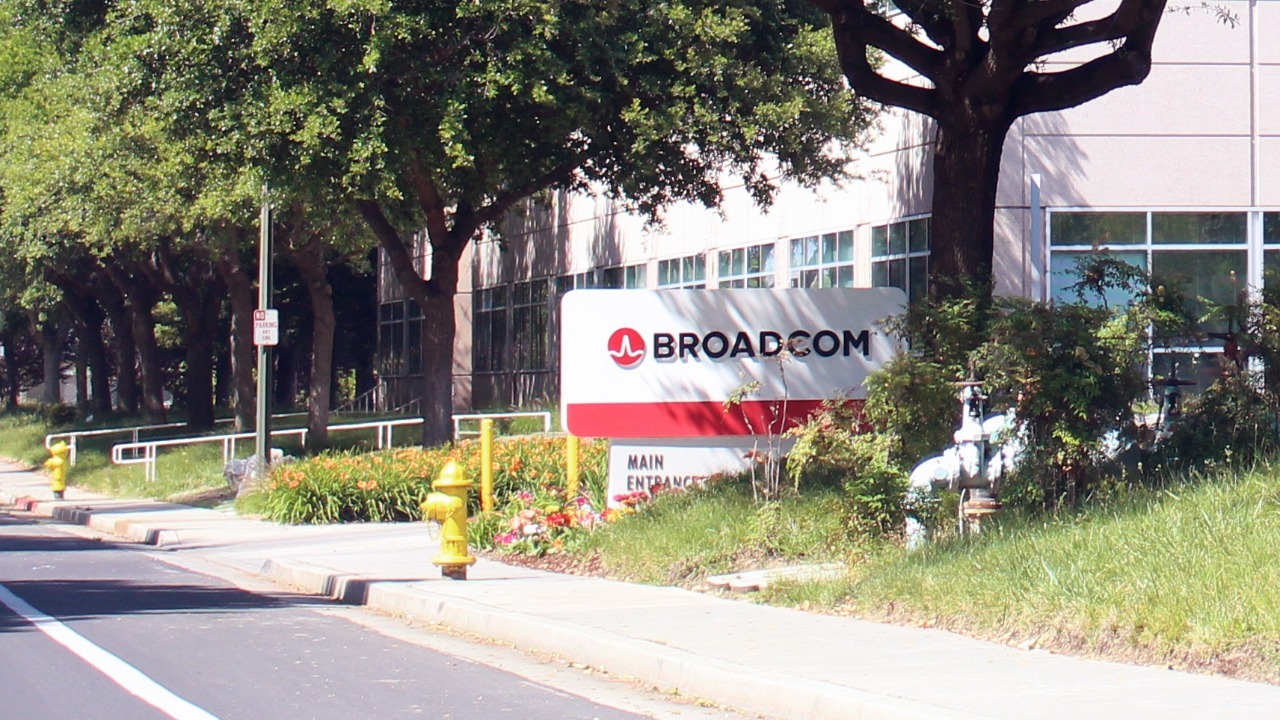
Broadcom sits at the intersection of AI compute and networking, and it is the first name I consider when I want both yield and exposure to the build‑out of advanced data centers. The company designs custom accelerators and high‑speed interconnects that help hyperscale customers move and process the massive datasets required for training and inference. Its own materials emphasize how its AI infrastructure portfolio is built for massive amounts of data, which is exactly what large language models and recommendation engines demand as they scale.
Recent coverage of AI‑linked dividend stocks has pointed out that Broadcom offers this infrastructure while still being treated by many investors as a traditional chip and software conglomerate, which helps keep its valuation grounded relative to pure‑play AI names. In a breakdown of three AI‑driven dividend stocks, the same analysis that tracked Trending Tickers such as BTC at 89027.48 with a move of 4.5 percent, ETH at 2893.61 with a change of 8.07 percent, and NUVB at 7.05, also highlighted Broadcom’s role in supplying AI hardware to cloud leaders. I read that juxtaposition as a reminder that while traders obsess over volatile crypto quotes, a company like Broadcom can quietly compound value through long‑term contracts, recurring software revenue, and a dividend policy that returns a meaningful share of cash to shareholders.
TSMC: the AI foundry behind the scenes
The second stock on my list does not always get labeled an “AI play” in casual conversation, but it is difficult to imagine the current boom without it. Taiwan Semiconductor Manufacturing Company is the leading contract chip manufacturer for advanced nodes, and its process technology underpins many of the GPUs, CPUs, and custom accelerators that power AI workloads. On its own investor‑facing materials, the company presents itself as a global semiconductor foundry that enables customers’ innovations, which in practice means it is fabricating the cutting‑edge silicon that AI leaders design but cannot manufacture in‑house.
From a dividend and valuation perspective, I see TSMC as a way to own the “picks and shovels” of AI without paying the premium attached to the most visible chip designers. Because it serves a broad mix of customers across smartphones, PCs, automotive, and data center, its revenue base is more diversified than a single‑product AI specialist, yet the surge in AI demand still flows directly into higher utilization of its most advanced fabs. That dynamic has led some analysts to group it alongside other AI‑linked dividend names that can benefit from the same secular trend identified in the Artificial intelligence growth forecasts, while still trading at earnings multiples that reflect cyclical semiconductor risks rather than blue‑sky AI assumptions.
Cisco: networking the AI era while shifting to recurring cash flow
The third company I focus on is Cisco, which has been quietly repositioning itself for the AI age while maintaining a solid dividend profile. The business has long dominated enterprise networking, and AI workloads are now forcing customers to rethink how they move data inside and between data centers. Reporting on AI‑driven dividend stocks noted that Cisco has spent years shifting its revenue mix toward a recurring model, which has strengthened its cash flow and helped support ongoing shareholder returns even as it invests in next‑generation hardware and cybersecurity solutions tailored to AI‑heavy environments.
That strategic pivot is particularly important for dividend investors, because it reduces Cisco’s dependence on one‑off hardware cycles and ties more of its revenue to software, subscriptions, and services. Community discussions among income‑focused investors have also started to recognize Cisco’s role in the AI ecosystem, with one breakdown of Network and compute “plumbing” pointing out that Cisco (ticker CSCO) offers a 2.39 percent yield while partnering with NVIDIA on Ethernet‑based AI fabrics such as Spectrum‑X. I view that partnership as a sign that Cisco is not content to defend legacy switching, it is actively aligning itself with the companies designing the most demanding AI systems, which should keep its products relevant and its dividend supported.
How these three compare with the broader AI dividend universe
Broadcom, TSMC, and Cisco do not exist in a vacuum, and it is worth comparing them with the broader set of AI‑linked dividend payers to understand where the value still lies. A survey of top AI stocks that also pay dividends, which appeared in mid‑2024 alongside Trending Tickers such as BTC‑USD at 85946.03 with a move of 6.91 percent, ETH‑USD at 2813.59 with a change of 7.21 percent, and NFE at 1.4600, underscored that investors have plenty of options across sectors. Yet many of those names either have shorter dividend histories or more concentrated exposure to a single AI product cycle, which can make their payouts more vulnerable if expectations reset.
By contrast, the three companies I highlight combine AI leverage with diversified revenue streams and established capital return policies. Another piece on dividend stocks positioned to profit from the AI efficiency boom pointed to large technology constituents of the NASDAQ such as AAPL, GOOG, META, and MSFT as beneficiaries of AI adoption, and those are certainly core holdings for many portfolios. I see Broadcom, TSMC, and Cisco as complementary rather than competing ideas: they supply the chips, manufacturing capacity, and networking that those software and platform giants rely on, which means their fortunes are tied to a broader swath of AI spending. For dividend investors who want to participate in that ecosystem without overpaying for the most popular tickers, these three still look priced for value relative to the growth they are helping to unlock.
More From TheDailyOverview
- Dave Ramsey warns to stop 401(k) contributions
- 11 night jobs you can do from home (not exciting but steady)
- Small U.S. cities ready to boom next
- 19 things boomers should never sell no matter what

Grant Mercer covers market dynamics, business trends, and the economic forces driving growth across industries. His analysis connects macro movements with real-world implications for investors, entrepreneurs, and professionals. Through his work at The Daily Overview, Grant helps readers understand how markets function and where opportunities may emerge.

