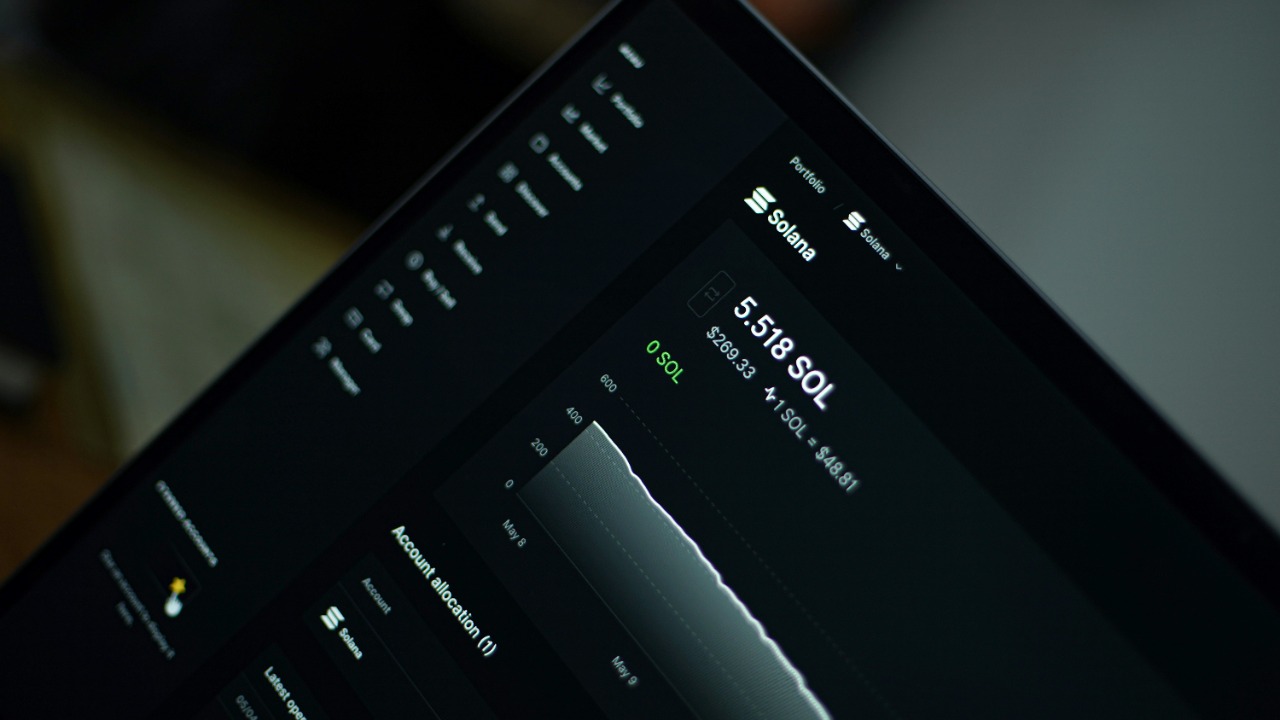
Solana’s growing war chest has become one of the most closely watched balance sheets in crypto, not just because of its size but because of what it signals about the network’s next phase. With a reported $1.65 billion in treasury assets aligned with the ecosystem, the question is no longer whether the capital exists, but whether it can be deployed in a way that compounds developer activity, real-world adoption, and investor confidence over the long haul.
I see the stakes as unusually high: if Solana’s treasury strategy works, it could harden the chain’s position as a core settlement layer for both retail and institutional users, but if it misfires, the same stockpile risks becoming a symbol of missed opportunity in an increasingly competitive market for blockspace and liquidity.
The making of a $1.65 billion Solana war chest
The headline figure that has captured attention is the $1.65 billion pool of cash and stablecoins assembled around Solana, a sum that would be notable for any growth-stage tech platform, let alone a public blockchain. Earlier in the summer, $1.65 billion was raised to build what was described as the largest Solana (SOL) treasury, a move that instantly changed how traditional markets viewed the chain’s capital base. The fact that this capital is denominated in cash and stablecoins, rather than purely in volatile native tokens, gives Solana a more flexible runway to fund builders, liquidity programs, and infrastructure without being forced to sell into market weakness.
One of the most striking details is who is helping to assemble this capital. A 60-year-old design firm, Forward Industries, has aligned itself with Solana’s ecosystem, raising funds to support what is framed as a long-term treasury strategy rather than a short-lived speculative bet. That a 60-year-old company like Forward Industries is willing to tie its future to Solana (CRYPTO: SOL) suggests that the network is starting to attract corporate treasury interest that goes beyond the usual crypto-native players. For a chain that has spent years fighting for credibility against older incumbents, that kind of crossover capital is as important as the raw dollar amount.
How Solana plans to turn treasury into traction
Capital on its own does not guarantee growth, so the more important question is how Solana intends to convert this $1.65 billion into durable network effects. Reporting around the Solana treasury describes a strategic fund that is explicitly designed to fuel development, attract talent, and build real-world utility on the network, rather than simply sitting as a passive reserve. The stated aim is to back projects that deepen Solana’s role in payments, consumer apps, and institutional finance, with the treasury positioned as a catalyst for a broader wave of ecosystem building rather than a single flagship bet. That framing is critical, because it turns the treasury into an active policy tool for the chain’s economic future rather than a static line item.
There are already signs that this approach is feeding into a more constructive market structure for SOL. Analysts tracking the treasury have pointed to a strong bullish setup forming around Solana, arguing that a well-capitalized ecosystem fund can support both developer incentives and liquidity programs that make it easier for new users to onboard. The idea is that if the treasury consistently backs credible teams and infrastructure, it can encourage strong institutional allocations that, in turn, stabilize the token’s demand profile. That feedback loop, where targeted spending from the Solana treasury helps create conditions for more long-term capital to enter the ecosystem, is at the heart of the bullish thesis around this war chest.
Institutional signals: Forward Industries and corporate treasuries
For traditional investors, one of the most telling developments is the way corporate treasuries are starting to treat Solana as a strategic asset rather than a speculative side bet. Forward Industries, described as a 60-year-old design firm, has raised $1.65 billion in cash and stablecoins to assemble what it calls the largest Solana (SOL) treasury, a move that effectively turns the company into a leveraged play on the network’s long-term success. The fact that a firm with six decades of operating history is willing to make such a concentrated bet on Solana signals a shift in how established businesses view blockchain exposure, particularly when it comes to using treasuries as a bridge between traditional finance and on-chain ecosystems.
That corporate posture matters because it can influence how other balance-sheet managers think about digital assets. When a company like Forward Industries publicly aligns itself with Solana, it creates a reference point for CFOs and boards that might otherwise be hesitant to move beyond Bitcoin or Ethereum. The reporting around this move highlights how Forward Industries is not just buying SOL, but actively building a treasury structure around the network, which suggests a more sophisticated approach to risk management and yield generation. If that model proves resilient through market cycles, it could encourage a second wave of corporate treasuries to treat Solana as a core holding rather than a tactical trade.
Is Solana structurally set up for long-term investors?
Even with a massive treasury behind it, Solana still has to answer a basic question for long-term investors: is the network’s design and economic model robust enough to justify multi-year exposure? Analysts who have looked at Solana’s fundamentals argue that the chain has strong potential as a long-term play because of its high throughput, low transaction costs, and growing base of consumer-facing applications. A detailed breakdown of whether Is Solana Good As a Long Term Investment, for example, points to the network’s innovative technology and expanding ecosystem as key reasons some investors are comfortable holding through volatility.
At the same time, those same assessments are clear that Solana is not a risk-free bet. The network still faces intense competition from other smart contract platforms, as well as regulatory uncertainty that could affect everything from token classification to exchange access. The long-term investment case hinges on whether Solana can keep shipping improvements, maintain uptime, and continue attracting developers at a pace that justifies its valuation. In that context, the $1.65 billion treasury is best understood as a tool that can help Solana execute on its roadmap, not a guarantee that the roadmap will succeed. For investors thinking in years rather than months, the interplay between the treasury’s deployment and the chain’s technical progress will be the key metric to watch.
Ownership concentration and governance risks
Another factor that will shape how far Solana’s treasury can carry it is the distribution of SOL itself. According to recent blockchain data, the top 10 holders control 6.58% of the total supply, while the top 20 own 11.03%, a level of concentration that is significant but not extreme by crypto standards. These figures, reported on According to on-chain analysis, suggest that while there are large stakeholders, the token is not dominated by a tiny handful of wallets in the way some early-stage projects are. For a network that aspires to be a global settlement layer, that degree of dispersion is an important starting point for credible governance.
However, concentration metrics only tell part of the story. The real test is how those large holders, including entities tied to the treasury, behave in practice when it comes to governance votes, protocol upgrades, and market liquidity. If the biggest wallets consistently support decisions that favor long-term stability and decentralization, the treasury can act as a stabilizing force that underwrites experimentation without undermining trust. If, instead, large holders use their influence to push through self-serving changes or to exit liquidity at the expense of smaller participants, the same concentration could become a liability. In that sense, the $1.65 billion aligned with Solana’s future is both an asset and a responsibility, one that will require transparent governance and disciplined deployment to truly fuel long-term growth.
What the next phase of Solana’s treasury experiment will reveal
Looking ahead, I see Solana’s treasury as a live experiment in how aggressively a blockchain can use capital to accelerate its own network effects. The presence of a large, liquid fund gives Solana room to back ambitious projects in areas like payments, gaming, and real-world asset tokenization, while also supporting infrastructure such as validators, indexers, and developer tooling. Reporting on the Solana treasury emphasizes its role in attracting talent and building real-world utility, which are exactly the levers that tend to separate enduring platforms from short-lived fads. If the fund can consistently identify and support teams that bring new users on-chain, the payoff could be a self-sustaining ecosystem where organic demand eventually matters more than treasury subsidies.
The flip side is that large treasuries can sometimes dull market discipline, encouraging projects to chase grants rather than product-market fit. That risk is particularly acute in crypto, where token incentives can mask weak fundamentals for long stretches of time. The key for Solana will be to treat its $1.65 billion not as a bottomless subsidy pool, but as a finite resource that must be allocated with the same rigor a venture firm would apply. The fact that Nov coverage on Nov 18, 2025, framed the Solana treasury as a strategic fund rather than a marketing budget is encouraging, as it suggests an awareness of those trade-offs. If the network can maintain that discipline, align large holders, and keep shipping at the protocol level, then Solana’s war chest will look less like a speculative bet and more like the foundation of a durable, long-term growth story for SOL.
More From TheDailyOverview
- Dave Ramsey warns to stop 401(k) contributions
- 11 night jobs you can do from home (not exciting but steady)
- Small U.S. cities ready to boom next
- 19 things boomers should never sell no matter what

Alex is the strategic mind behind The Daily Overview, guiding its mission to uncover the forces shaping modern wealth. With a background in market analysis and a track record of building digital-first businesses, he leads the publication with a focus on clarity, depth, and forward-looking insight. Alex oversees editorial direction, growth strategy, and the development of new content verticals that help readers identify opportunity in an ever-evolving financial landscape. His leadership emphasizes disciplined thinking, high standards, and a commitment to making sophisticated financial ideas accessible to a broad audience.

