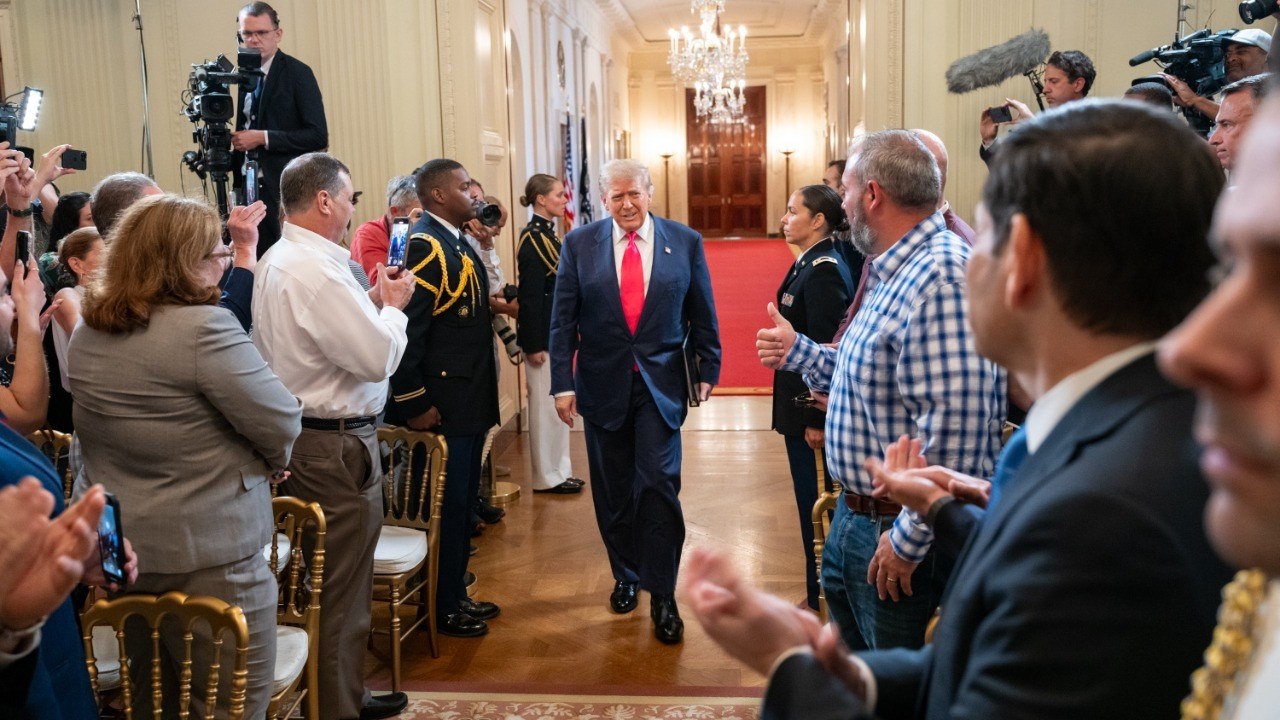
President Donald Trump is taking one of the defining fights of his second term to the highest court in the country. This week his administration asked the Supreme Court to reinstate the sweeping asylum bar he imposed on his first day back in office, a policy that all but shut the door on migrants trying to claim protection after crossing the southern border illegally. A panel of federal appeals judges in Washington declared that bar unlawful, and the administration is now betting that a conservative Supreme Court will see the border the way the president does.
The petition sets up one of the most consequential immigration showdowns the justices have faced since Trump returned to power. At stake is whether a president can slam shut the asylum system by declaring the situation at the border an invasion, or whether that power belongs only to Congress. The answer will shape enforcement heading into the November midterms and beyond.
The day-one proclamation that shut the border
On January 20, 2025, hours after being sworn in, Trump signed Proclamation 10888, “Guaranteeing the States Protection Against Invasion.” The order declared that the flow of migrants across the southern border amounted to an invasion under the Constitution’s Guarantee Clause, and it directed the federal government to repel and remove anyone who crossed illegally. Crucially, it cut off access to the asylum process for those migrants until the president decided the invasion had ended.
The text published in the Federal Register instructed the Department of Homeland Security, the State Department and the Justice Department to take “all necessary action” to immediately turn back border crossers and to restrict the immigration-law provisions, including asylum, that would otherwise let them stay. It was the most aggressive assertion of unilateral border authority any modern president had attempted, and it became the legal spine of the administration’s entire enforcement strategy.
What the D.C. Circuit did to it
That strategy ran into a wall in the courts. A panel of the U.S. Court of Appeals for the District of Columbia Circuit struck the asylum bar down as unlawful, ruling that the Immigration and Nationality Act does not allow a president to suspend the statutory right to apply for asylum or to remove people through procedures Congress never authorized. The judges wrote that denying asylum “in one stroke, without any information about the affected individuals, necessarily ignores every risk of persecution they face when forced back to where they came from.”
The appeals court did leave the policy in force while the administration appealed, a partial reprieve that kept the border shut in practice even as the ruling declared the proclamation illegal in principle. For the administration, that was not enough. A ruling on the books calling the president’s signature border order unlawful is a loaded weapon that a future court, or a future administration, could fire at any moment. The White House wanted it gone.
The petition now landing on the justices’ desk
So the Justice Department went over the appeals court’s head. In a petition docketed this week in the case now titled Mullin v. RAICES, No. 26-239, Solicitor General D. John Sauer urged the justices to take the case and reverse the D.C. Circuit. He described the proclamation as one of the president’s most important initiatives and warned that the lower-court ruling “threatens to revive the chaos along the southwest border that the proclamation has fended off for the past year and a half.”
The petition frames the dispute as a separation-of-powers emergency, arguing that unelected judges have inserted themselves into the operation of national security and foreign policy. “The proclamation and its asylum restrictions are thus critical pieces of American national and foreign policy; the judicial interference by the lower courts in the operation of those initiatives warrants this Court’s review,” the government wrote. It is a direct appeal to the conservative majority’s skepticism of district and circuit judges who have repeatedly blocked the administration’s agenda from the bench.
The 84% number at the center of the fight
The administration’s strongest argument is not legal theory but raw enforcement data. Border Patrol encounters with migrants along the southern border fell 84% in fiscal year 2025 compared with the year before, according to the Pew Research Center, dropping to the lowest level in more than half a century. The government credits the proclamation and its asylum bar for choking off the pull factor that drew record numbers of migrants north under the previous administration.
Opponents note that the collapse in crossings has many causes, and the plaintiffs argue the numbers cannot justify shredding a protection Congress wrote into law. But politically, the figure is devastating for the other side. A president who inherited a border in open crisis can now point to a 50-year low and tell the justices that his order is the reason. Undoing it, the administration insists, means inviting the surge back.
Who is suing, and what happens next
The challenge was brought by immigrant-advocacy groups including the Refugee and Immigrant Center for Education and Legal Services, Las Americas Immigrant Advocacy Center and the Florence Immigrant and Refugee Rights Project, along with more than a dozen individual migrants who say the proclamation forced families back toward danger. Faisal Al-Juburi, a co-CEO of RAICES, accused the administration of trying to “seize unchecked power” and “bypass laws that Congress passed to protect asylum seekers,” calling the petition an attack on the checks and balances that constrain the presidency.
That argument has persuaded lower-court judges before, which is exactly why the administration wants the Supreme Court to have the final word. The justices are expected to consider whether to hear the case at a closed-door conference after their new term opens in October. If they grant review and side with the president, the asylum bar stops being a policy that survives only on borrowed time and becomes settled law, a precedent affirming that a president can seal the asylum system when he judges the border to be under invasion. If they decline, the D.C. Circuit’s ruling stands as a marker that a future court could use to tear the whole framework down. Either way, the outcome will define how far a president can go to control who gets into the country, and it will land in the middle of an election fought largely over that question.
This article was produced with the assistance of artificial intelligence and reviewed and edited by The Daily Overview’s editorial team.

Elias Broderick specializes in residential and commercial real estate, with a focus on market cycles, property fundamentals, and investment strategy. His writing translates complex housing and development trends into clear insights for both new and experienced investors. At The Daily Overview, Elias explores how real estate fits into long-term wealth planning.


