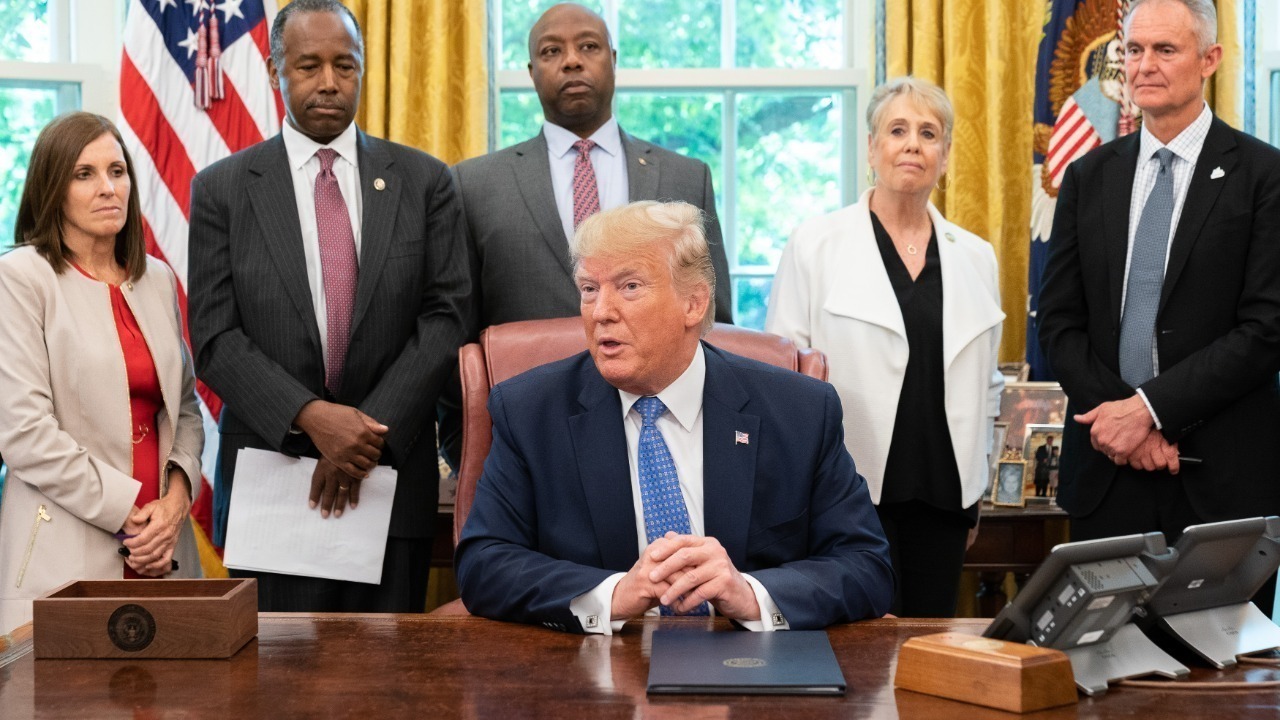
Standing in the Oval Office in front of a map of the Great Lakes with the words “Lake America” printed in large red letters over Lake Ontario, President Donald Trump signed an executive order Thursday that strips the lake of the name it has carried for centuries. “This is official, effective immediately,” he told reporters after putting his signature on the page. The move lands in the middle of a rapidly worsening standoff with Canada, and Trump left no doubt about the message he was sending.
“Canada has been ripping us off for a long time on trade, very sadly,” the president said, tying the renaming directly to the collapse of trade talks and the tariff war now consuming relations between Washington and Ottawa. Within hours, Canada’s leaders fired back, setting off a cross-border shouting match over a body of water that touches both countries.
The order Trump signed in the Oval Office
The executive order declares that “The United States is the greatest protector of the Great Lakes” and states that the lake “will continue to play a pivotal role in shaping America’s future and the global economy.” On that basis, it directs that the water bounded on the south and east by New York, and on the north and west by the Canadian province of Ontario, “officially be renamed as Lake America.”
It is the same playbook Trump used to rechristen the Gulf of Mexico as the Gulf of America earlier in his term: a unilateral executive action that reaches for a familiar landmark and stamps the country’s name on it. This time the target sits on an international border, which turns a symbolic gesture into a diplomatic provocation aimed squarely at a neighbor the president has spent months accusing of bad faith.
What “effective immediately” actually requires
For all the finality in Trump’s words, the change does not happen with the stroke of a pen. The order tasks Interior Secretary Doug Burgum and the U.S. Board on Geographic Names with carrying out the renaming within 30 days, including updating the federal names database and removing references to Lake Ontario “consistent with applicable law.”
That machinery matters. The Board on Geographic Names is the federal body that standardizes what places are officially called, and its Domestic Names Committee draws members from the Departments of the Interior, Commerce, Agriculture, Defense and Homeland Security, along with the Postal Service and the Library of Congress. Its decisions are recorded in the Geographic Names Information System, the government’s authoritative register of American place names. Once the administration updates that system, “Lake America” becomes the official U.S. label, at least on American maps and in American documents. What it cannot do is bind Canada, which controls its own half of the shoreline and its own naming decisions, or the rest of the world, which is under no obligation to follow Washington’s lead.
Ottawa and Ontario refuse to play along
Canada’s response was immediate and unyielding. Prime Minister Mark Carney rejected the renaming outright, noting that the name comes from the Wendat word “Ontari’io,” meaning roughly “the lake is beautiful, the lake is big.” Carney pointed out that the name is more than 400 years old, predating both the Confederation of Canada and the American Declaration of Independence, and said that “naming reality means calling it Lake Ontario — then, now and always.”
Ontario Premier Doug Ford was blunter still. “It’s Lake Ontario to Canadians and the rest of the world. Now and forever,” he wrote. Trump was not interested in a truce. He dismissed Ford’s defiance as “bluster,” branded him Carney’s “flunky,” and mocked the premier as the “less charismatic, intelligent, and overall unimpressive brother” of the late Toronto mayor Rob Ford. He also accused Canada of feeling “entitled” and of being impossible to deal with on trade. The exchange made clear that the lake was never really the point; it was a vehicle for the larger grievance.
A new front in the trade war
The renaming did not come out of nowhere. It followed a breakdown in U.S.-Canada trade negotiations that has already produced a fresh round of retaliatory tariffs and a relationship deteriorating by the week. Trump has spent recent weeks threatening steep duties on Canadian goods and casting Ottawa as a freeloader living off American markets, and the “Lake America” order fits neatly into that pressure campaign. It costs the administration nothing, dominates a news cycle, and forces Canadian leaders to spend their energy defending the name of a lake instead of negotiating from strength.
For the president’s supporters, that is precisely the appeal. The order projects the same America-first confidence that carried Trump back to the White House, and it treats a trading partner that many conservatives view as smug and protectionist to a taste of hardball. Critics see a petty stunt that alienates a longtime ally over a symbolic slight. Both readings agree on one thing: the gesture was designed to sting, and it did.
Democrats turn it into theater
The opposition wasted no time turning the moment into political theater of its own. Illinois Governor JB Pritzker mocked the order by sarcastically announcing that he would rename Lake Michigan as “Lake Illinois” and joking that he might annex Green Bay for good measure. The bit was meant to cast the president’s action as absurd, a governor answering a stunt with a stunt.
Whether it reads as clever or as a Democratic governor trivializing his own credibility depends entirely on the viewer. What is not in dispute is that a single executive order managed to pull the prime minister of Canada, a provincial premier and an American governor into the same fight within hours, all of them arguing about what to call a lake. That is exactly the kind of outsized reaction Trump tends to provoke on purpose, and the renaming has already delivered the attention he was after, whatever the maps ultimately say.
The Daily Overview used artificial-intelligence tools in the reporting and drafting of this story, with final review and editing performed by a human editor.

Cole Whitaker focuses on the fundamentals of money management, helping readers make smarter decisions around income, spending, saving, and long-term financial stability. His writing emphasizes clarity, discipline, and practical systems that work in real life. At The Daily Overview, Cole breaks down personal finance topics into straightforward guidance readers can apply immediately.


