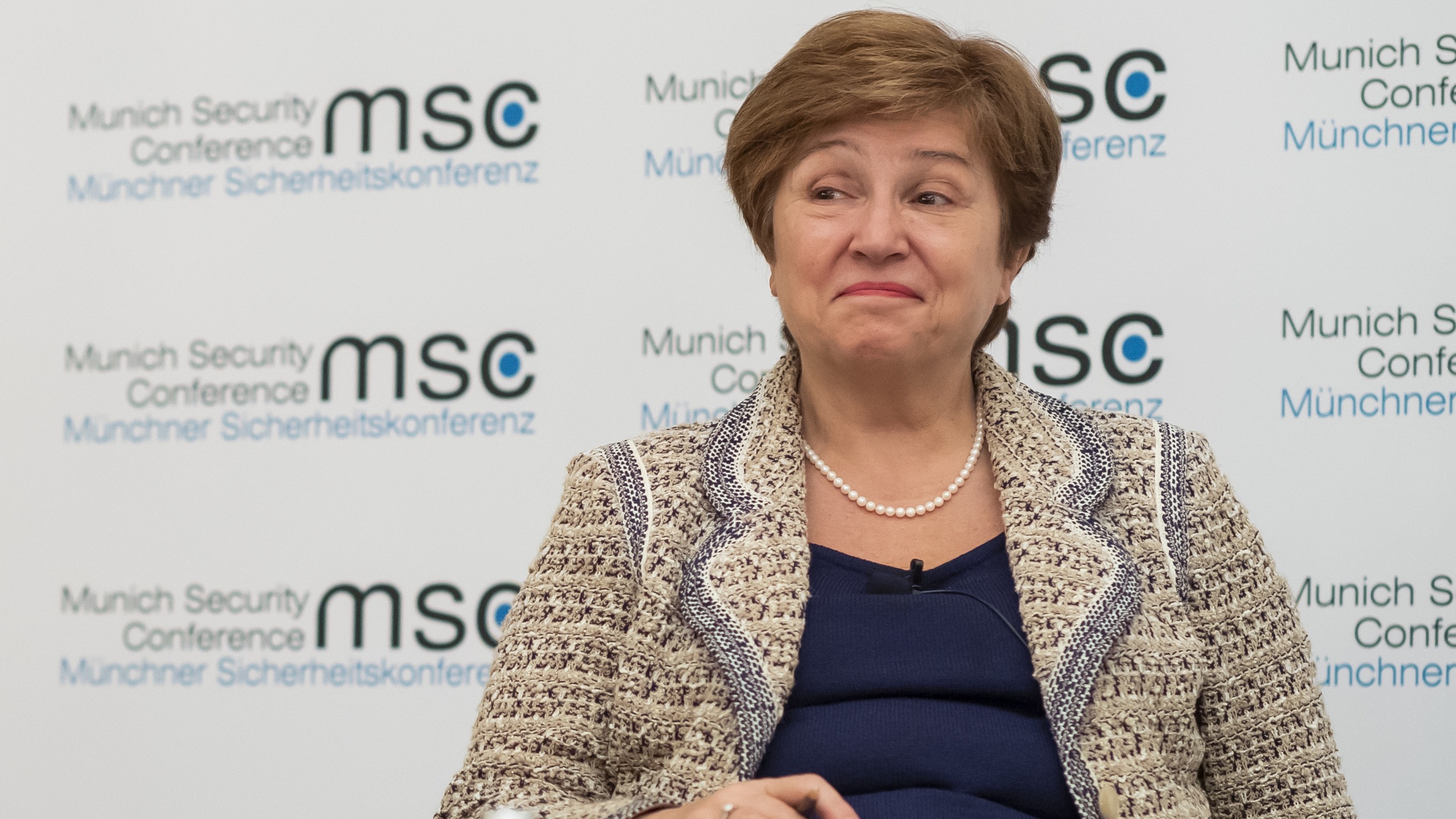
Artificial intelligence is already reshaping who wins and who loses in the global economy, and the early pattern is stark. Productivity gains are flowing fastest to the people and firms that were already ahead, while a wave of automation threatens to erase exactly the kind of entry level jobs that used to be a ladder into the middle class. Yet International Monetary Fund managing director Kristalina Georgieva argues that the same forces enriching the top could, if handled carefully, raise incomes at the bottom through classic spillover effects.
Her message, delivered around the World Economic Forum meetings in Davos, is blunt: AI is “for real” and coming like a “tsunami” for the labor market, but it does not have to be a death knell for younger and low wage workers. The outcome will depend on whether governments and employers move fast enough to channel AI’s windfall gains into broader opportunity rather than letting them pool at the top.
AI’s productivity boom is already skewed to the top
The first phase of the AI revolution is rewarding those with capital, skills, and market power. Large companies that can afford to integrate generative models into software, logistics, and customer service are seeing efficiency jump, which in turn boosts profits and executive pay. Georgieva’s own institution, the IMF, has highlighted how early AI productivity gains are “making the rich richer,” as high earners and asset owners capture the lion’s share of the upside.
IMF research, cited by Georgieva, suggests that AI will touch a majority of jobs in advanced economies, but not in the same way for everyone. In wealthier countries, around 60% of roles are expected to be affected, compared with 40% globally, and a significant share of that impact will come from automation that replaces tasks rather than simply assisting workers. The IMF’s own analysis points to two broad scenarios, one in which AI augments human labor and another in which it displaces it, and warns that without cooperative rules the technology could deepen inequality instead of narrowing it, a concern reflected in the IMF’s research.
The “tsunami” threat to young and entry level workers
Georgieva has chosen deliberately vivid language to describe what is coming for the labor market. At Davos she warned that AI is about to hit jobs “like a tsunami,” stressing that younger workers are likely to feel the shock first because so many of the roles they typically fill are routine, digital, and therefore easy to automate. In one panel conversation, she was introduced as One of the few global economic leaders willing to say bluntly that AI could be a “death knell” for traditional entry level paths into white collar work.
Her warning is grounded in specific numbers. Georgieva told audiences that AI could disrupt 60% of roles in advanced economies, echoing the IMF’s broader estimate that around 60% of jobs in rich countries and 40% globally will be affected in some way. She has urged policymakers to “Wake up, AI is for real,” a phrase that has been widely quoted and that she repeated in warnings carried by Wake and other outlets.
Why the IMF still sees a silver lining for low wage workers
Despite the alarm, Georgieva is not a technological pessimist. Her cautiously optimistic case for low wage workers rests on what she and other economists call the Spillover effect, the idea that when high earners in a city or sector see their incomes jump, they spend more on local services. In her telling, AI powered productivity in finance, tech, and professional services will leave affluent workers with more disposable income, which they will channel into restaurants, childcare, home repairs, personal training, and other in person services that are harder to automate.
That logic underpins what some have dubbed the Spillover Argument. Georgieva has argued that this pattern is “well documented” in past technology booms and that there is no reason to think AI will be different, a view she elaborated in a panel discussion summarized in IMF focused coverage. In that conversation she described how the spending power of AI enhanced professionals could lift demand for cleaners, drivers, and carers, nudging up wages at the bottom even as the top pulls further away.
The middle class squeeze and the risk of a hollowed out labor market
If the very top and the very bottom can both gain in different ways, the group most at risk is the middle. Georgieva has repeatedly warned that the middle class, especially in advanced economies, could be squeezed as AI automates mid skill office roles without creating enough new, well paid jobs to replace them. At the World Economic Forum in WEF Davos 2026, she said AI is advancing faster than policymakers’ ability to regulate it and stressed that the challenge is to “make it inclusive” so that the gains do not bypass the broad middle of society.
Other reporting from Davos reinforces that concern. Georgieva told the World Economic Forum in the Swiss ski resort that the IMF expects 60 per cent of jobs in advanced economies to be affected, a figure that aligns with the IMF’s Georgieva warnings about disruption. She has framed this as a political as well as economic risk, hinting that a hollowed out middle class could fuel social unrest if AI’s benefits are seen as captured by a small elite.
What it will take to turn a “tsunami” into shared prosperity
For Georgieva, the policy response is as urgent as the technology itself. She has argued that governments need to invest heavily in education and retraining so that workers can move into roles that AI complements rather than replaces, a point she made when she said at Davos that AI is about to hit jobs like a tsunami and that younger workers will only benefit if they get a “matching productivity boost” through skills and tools. She has also pressed for stronger social safety nets and active labor market policies so that those displaced by automation are not simply left to fend for themselves.
Her broader message is that the AI boom will not automatically translate into inclusive growth. The IMF has stressed that AI productivity gains are already tilting toward those at the top, even as the Spillover Argument suggests low wage workers could see some benefit through higher demand for services. To make that outcome more likely, Georgieva has called for international coordination on AI rules, echoing the IMF view that unregulated AI could entrench global divides.
Her warnings have been amplified by detailed reporting on how AI will hit youth employment. Kristalina Georgieva told interviewers that AI would wipe out many roles traditionally taken up by younger workers, a point illustrated in a Kristalina Georgieva profile that ran alongside a Photograph by Denis Balibouse for Reut. She has also been quoted through International Monet and other channels urging leaders to move faster than the technology, not simply react to it.
Behind the rhetoric is a consistent thread. As head of the International Monetary Fund, Georgieva is trying to steer a narrative in which AI is neither miracle nor menace but a powerful accelerant of existing trends. If leaders heed her call to “Wake up,” invest in people, and design rules that spread the gains, the same AI wave that is supercharging the rich and threatening jobs could still lift low wage workers through the kind of Spillover Argument she has championed.
More From TheDailyOverview
*This article was researched with the help of AI, with human editors creating the final content.

Grant Mercer covers market dynamics, business trends, and the economic forces driving growth across industries. His analysis connects macro movements with real-world implications for investors, entrepreneurs, and professionals. Through his work at The Daily Overview, Grant helps readers understand how markets function and where opportunities may emerge.

