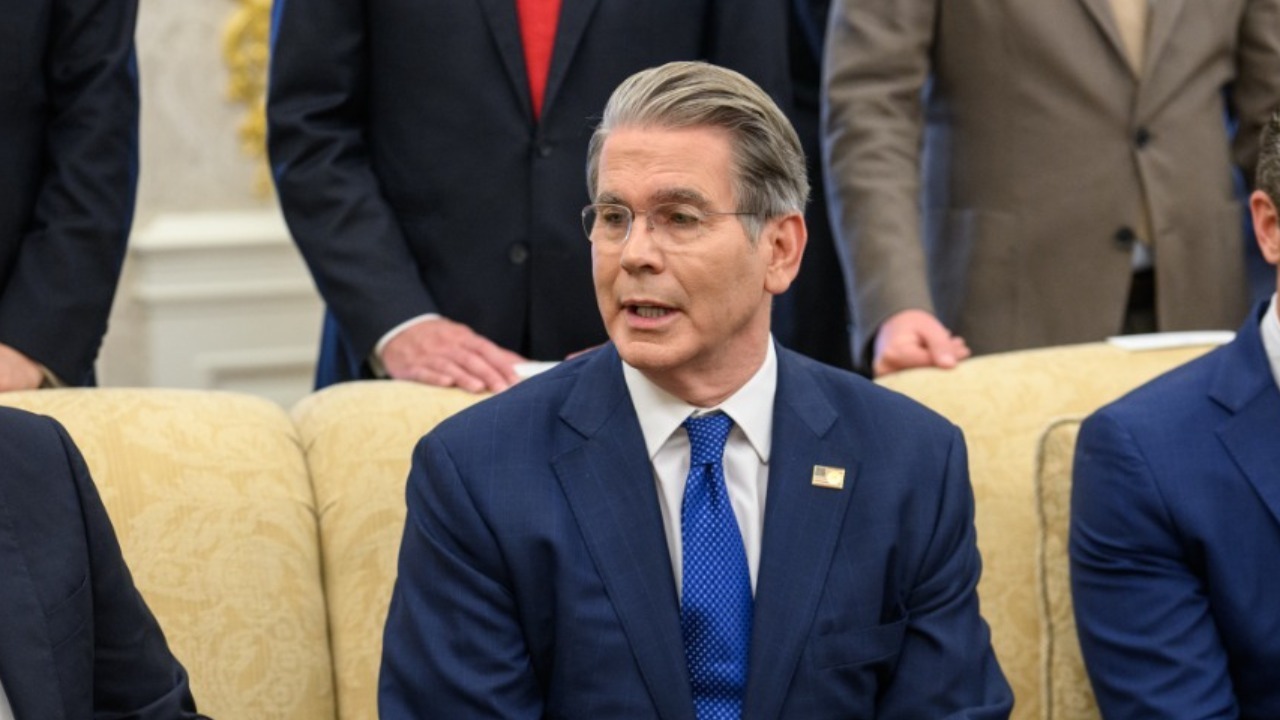
As President Donald Trump doubles down on his Greenland tariff threats, his own Treasury chief is publicly warning Europe that striking back would be a serious mistake. Scott Bessent is not just defending the White House line, he is arguing that a full‑blown trade fight over the Arctic island would damage both sides and risk hardening a geopolitical rift that already runs deep. I see his message as an attempt to pull Europe back from the brink at the very moment the bloc is preparing its most aggressive economic response in years.
That tension is now playing out in Davos, where the US Treasury secretary is trying to calm what he repeatedly calls “hysteria” while European leaders weigh a package of retaliatory measures worth tens of billions of euros. The question is whether Bessent’s warning will be heard as pragmatic advice or as pressure from a Washington that has already decided there is, in Trump’s words, “no going back” on Greenland.
The Davos warning and Trump’s Greenland hard line
In the Swiss Alpine resort of Davos, where the World Economic Forum gathers political and business elites, Scott Bessent has chosen unusually blunt language for a Treasury chief. When asked by journalists in the town about possible European countermeasures, he said it would be “very unwise” for the European Union to retaliate against the United States over the Greenland tariffs, according to reporting from Davos. I read that as a deliberate attempt to frame any European response as an overreaction, even before the bloc has finalized its plans.
Bessent’s intervention comes as Trump signals he is not interested in compromise on Greenland at all. In live updates on the standoff, Treasury Secretary Scott Bessent has been quoted telling reporters that Trump sees the Greenland move as central to his strategy and that European retaliation would be “unwise,” a message echoed in coverage of the Treasury. Trump has already told allies there is “no going back” on his Greenland takeover push, which means Bessent is effectively asking Europe to absorb the shock without hitting back.
Why Bessent says retaliation would be “very unwise”
From Bessent’s perspective, the core argument is that escalation would hurt Europe more than it hurts the United States. The US Treasury secretary has urged European countries not to retaliate against the trade tariffs on Greenland, warning that a tit‑for‑tat response could spiral into a broader conflict reminiscent of the worst days of the trade war between the US and China, according to detailed accounts of Scott Bessent. I see that warning as both economic and political: he is signaling that the White House is prepared to absorb European anger but not European counter‑tariffs.
He has also tried to delegitimize the European debate itself, repeatedly describing the reaction as “hysteria” and insisting that governments should “take a breath” and let negotiations play out. In one appearance, Bessent used that word four times in 22 minutes while stressing that European nations should not retaliate to the tariff threat, a pattern highlighted in coverage of the Treasury. That rhetorical choice matters: by casting European concern as emotional rather than strategic, he is trying to make any retaliation look irrational.
Europe’s emerging “trade bazooka” and the €93 billion threat
European leaders, however, are not treating this as a passing tantrum from Washington. The bloc is readying retaliatory measures that could include a package of €93 billion-worth of tariffs on goods coming from the United States if a planned deal on Greenland is not completed later in January. That figure, €93 billion, is not just a negotiating chip, it is a signal that Brussels is prepared to weaponize its market access on a scale that would have been unthinkable a few years ago.
Officials have described this as a potential “trade bazooka,” a term that captures both the size of the package and the political risk of firing it. Reporting on the Greenland standoff notes that Trump “won’t budge” even as Europe threatens this kind of trade bazooka against the US. From where I sit, that leaves Europe with a stark choice: either follow through and accept the fallout, or back down and risk looking weak in the face of American economic coercion.
Security stakes: Greenland, the “golden dome” and Arctic power
Part of what makes this confrontation so charged is that Greenland is not just about fish, minerals or shipping lanes, it is about security. Trump has tied his Greenland push to a broader “golden dome” defense concept, with Bessent describing the island as essential to that plan in interviews cited in Greenland coverage. In that framing, any European move that undermines US control or influence over Greenland is not just an economic issue, it is a challenge to Trump’s vision of American strategic dominance in the Arctic.
European leaders see the same map but draw different conclusions. Kaja Kallas, the European Union’s top diplomat, has warned that President Trump’s approach to Greenland and tariffs is reshaping how Europe thinks about its security relationship with Washington, according to live reporting by Kaja Kallas. I read that as a sign that the Greenland dispute is accelerating a broader European shift away from automatic alignment with US priorities, especially when those priorities are presented as non‑negotiable presidential red lines.
Trust deficit: Europe questions Trump as Bessent pleads for restraint
Even as Bessent calls for calm, key European figures are openly questioning whether Trump can be trusted to keep any deal on Greenland or tariffs. One prominent report describes a “Top EU Official Questions Donald Trump” and his “Trustworthiness Over Greenland Tariff Threat,” capturing the mood in Brussels that any concession today could be reversed tomorrow by a late‑night presidential decision, according to the Top EU Official report. That trust deficit makes Bessent’s appeal for patience a much harder sell.
At the same time, Bessent is trying to present himself as the voice of continuity and rationality inside the administration. In Davos, he has painted a picture of a US president who is firm but open to negotiation, while warning that Europe risks “alienating the US even further” if it abandons its more cautious approach, a line that appears in analysis of how Europe is ditching its softly‑softly strategy. I see a clear split screen: a president escalating and a Treasury secretary urging restraint abroad, even as he defends the policy at home.
More From TheDailyOverview

Grant Mercer covers market dynamics, business trends, and the economic forces driving growth across industries. His analysis connects macro movements with real-world implications for investors, entrepreneurs, and professionals. Through his work at The Daily Overview, Grant helps readers understand how markets function and where opportunities may emerge.

