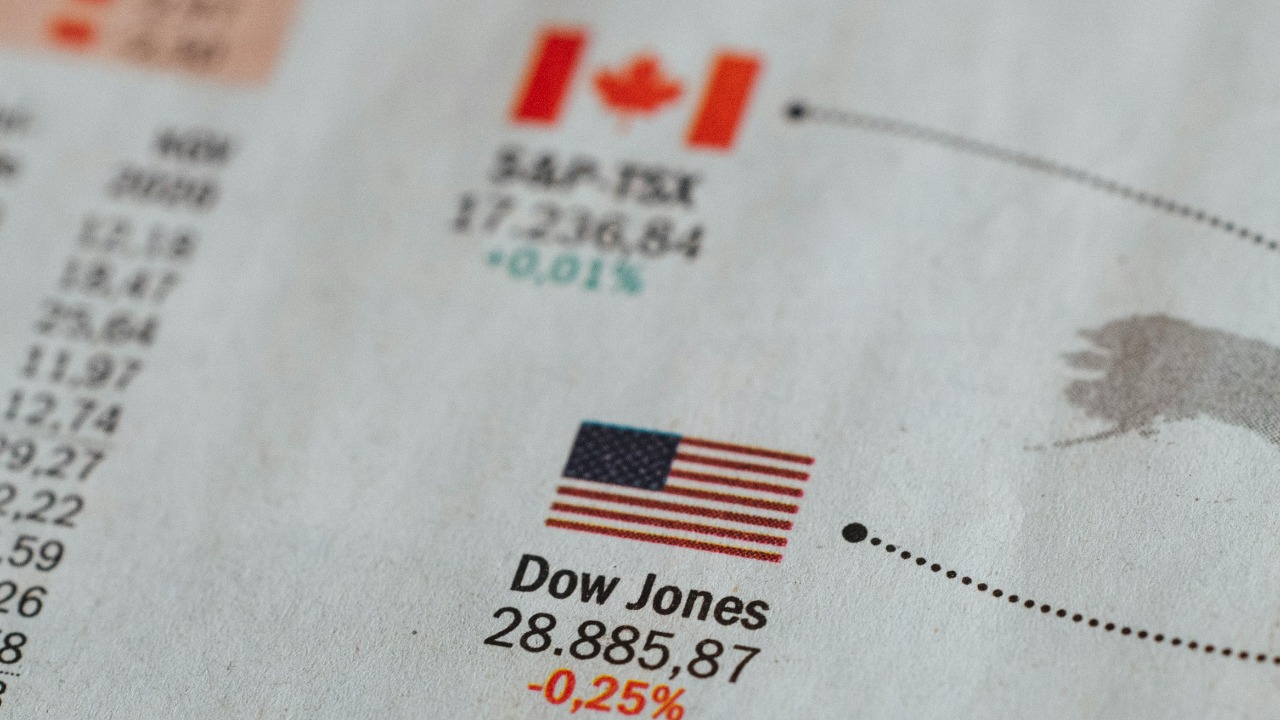
Wall Street is staring at a volatile open as political risk and mega-cap earnings collide. Dow futures are under pressure after President Donald Trump threatened tariffs of up to 100% on Canadian imports, just as Tesla, Microsoft, Meta and Apple prepare to report results that could reset expectations for the entire tech complex. The combination leaves traders trying to price both a potential trade shock and a decisive earnings test for the market’s most important stocks.
The stakes are unusually high. Canada is one of America’s most critical trading partners, and a 100 percent tariff would reverberate through supply chains at the same time investors are gauging whether the artificial intelligence boom and electric vehicle transition can keep powering profit growth. I see a market that is being forced to reassess both policy risk and earnings resilience in real time.
Tariff threat turns Canada into a new flashpoint
The immediate catalyst for the latest futures wobble is President Donald Trump’s warning that he is prepared to slap 100% tariffs on Canadian goods if Ottawa pursues a trade arrangement that, in his view, turns the country into a “drop off port” for China. In a televised segment, Donald Trump is described as threatening 100% tariffs on Canadian imports, underscoring how quickly trade policy can swing from rhetoric to market-moving risk. The concern is not just the headline number, but the signal that the White House is willing to weaponize tariffs again at scale.
Canada is the U.S.’s second-largest trading partner, and a 100 percent tariff on Canadian goods would translate into tens of billions of dollars of disrupted commerce, according to reporting on Canada. President Donald Trump has framed the issue explicitly around China, warning that “China will eat Canada alive, completely devour it, including the destruction of their businesses, social fabric, and general way of life” if a Beijing-linked deal goes ahead, according to a detailed account of his comments on China. That framing turns a bilateral trade dispute into a proxy fight over global supply chains, which markets are quick to price into risk assets.
Dow futures wobble as policy risk and shutdown fears collide
The tariff threat is landing in a market already primed for political shocks. Earlier this week, Dow Jones Futures were already reflecting anxiety as “Trump Threatens” a Canada Tariff and “Government Shutdown Risks Spike” while an “Earnings Wave Looms.” That combination of fiscal brinkmanship and trade brinkmanship is exactly the kind of macro overhang that can cap equity multiples, even when corporate profits are holding up. I see traders treating every new political headline as a reason to trim risk rather than buy dips.
There is precedent for this kind of reaction. A separate account of recent market moves notes that Stock futures slid after Trump announced tariffs on European goods, with From CNN reporter Auzinea Bacon US describing how futures plunged on a Sunday as investors braced for higher costs that would make imports more expensive for American consumers. That episode underlines how quickly futures can gap lower when tariff threats move from talk to specific targets, and it helps explain why the mention of 100% duties on Canada is being treated as more than just political theater.
Trump’s Canada warning and the China angle
Trump’s rhetoric toward Ottawa is not occurring in a vacuum. In a detailed account of his remarks, President Donald Trump is quoted warning that if Canada becomes a conduit for Chinese goods, he will respond with 100% tariffs, a stance highlighted in coverage of Fox News Flash. The fact that he delivered the warning on a Saturday, a time when markets are closed but social media is active, meant futures traders had to digest the risk in compressed fashion once electronic trading reopened.
Another detailed summary of his comments emphasizes that Trump is threatening 100% tariffs on Canadian imports as a retaliatory measure if a China-linked deal “even come close to happening,” language that appears in the retaliatory tariffs coverage. That framing matters for markets because it suggests the tariffs are not a distant negotiating tactic but a conditional response that could be triggered quickly if talks with China cross a line defined in Washington. For multinational companies that rely on integrated North American supply chains, the risk is that a political dispute over China and Canada suddenly becomes a hard cost shock.
Tech earnings wave: Tesla, Microsoft, Meta and Apple in focus
Layered on top of the policy drama is an earnings calendar dominated by Tesla, Microsoft, Meta and Apple, which together account for a large share of the Dow Jones and Nasdaq’s market value. One preview notes that Dow Jones futures are being led by Tesla, Microsoft, Meta and Apple as investors brace for a week “packed with mega cap earnings” after a whipsaw period driven by Trump headlines. I see that setup as a classic tug of war: strong numbers could offset macro jitters, while any disappointment would compound them.
On the fundamentals, recent results have been solid. The Microsoft Earnings Summary shows that Microsoft reported an EPS of $4.13 in its most recent quarter, topping analyst expectations and underscoring the strength of its cloud and AI franchises. A separate calendar of Key Expected Earnings Data lists the upcoming Report Date, Period Ending, Zacks Consensus Estimate and Earnings for Microsoft, giving traders a clear benchmark for what the market is pricing in, as seen in the Key Expected Earnings. With expectations already high, any hint of slowing AI demand could hit the broader tech complex.
Tesla and Meta: sentiment hinges on growth narratives
Tesla is another focal point for futures traders, both because of its weight in major indexes and because it is a bellwether for risk appetite. The Tesla Earnings Summary shows that Tesla delivered EPS of $0.50 in its latest reported quarter, matching the $0.50 figure that analysts had penciled in. A separate breakdown of Tesla (TSLA) Most Recent Earnings notes a Report Date Oct 22, 2025, a Period Ending Q3 2025, an Est. EPS of $0.50 and an Actual EPS of $0.50, details that appear in the Most Recent Earnings summary for TSLA. That kind of in-line result keeps the growth story intact but leaves little room for error if deliveries or margins wobble.
Meta is in a slightly different position, with its turnaround story now giving way to questions about how sustainable its AI and advertising momentum really is. The Meta Platforms Earnings Summary shows that Meta Platforms reported an EPS of $7.25 for Q3 2025, beating expectations and reinforcing its status as a cash machine, according to the Meta Platforms recap. Another breakdown of Meta (META) Most Recent Earnings lists Report Date Oct 29, 2025, Period Ending Q3 2025, Est. EPS of $6.66 and Actual EPS of $7.25, underscoring how consistently the company has been beating the Est. EPS bar, as detailed in the Most Recent Earnings summary for Meta. If that pattern continues, it could help offset some of the macro gloom that tariffs and shutdown talk are injecting into the tape.
More From The Daily Overview
*This article was researched with the help of AI, with human editors creating the final content.

Grant Mercer covers market dynamics, business trends, and the economic forces driving growth across industries. His analysis connects macro movements with real-world implications for investors, entrepreneurs, and professionals. Through his work at The Daily Overview, Grant helps readers understand how markets function and where opportunities may emerge.

