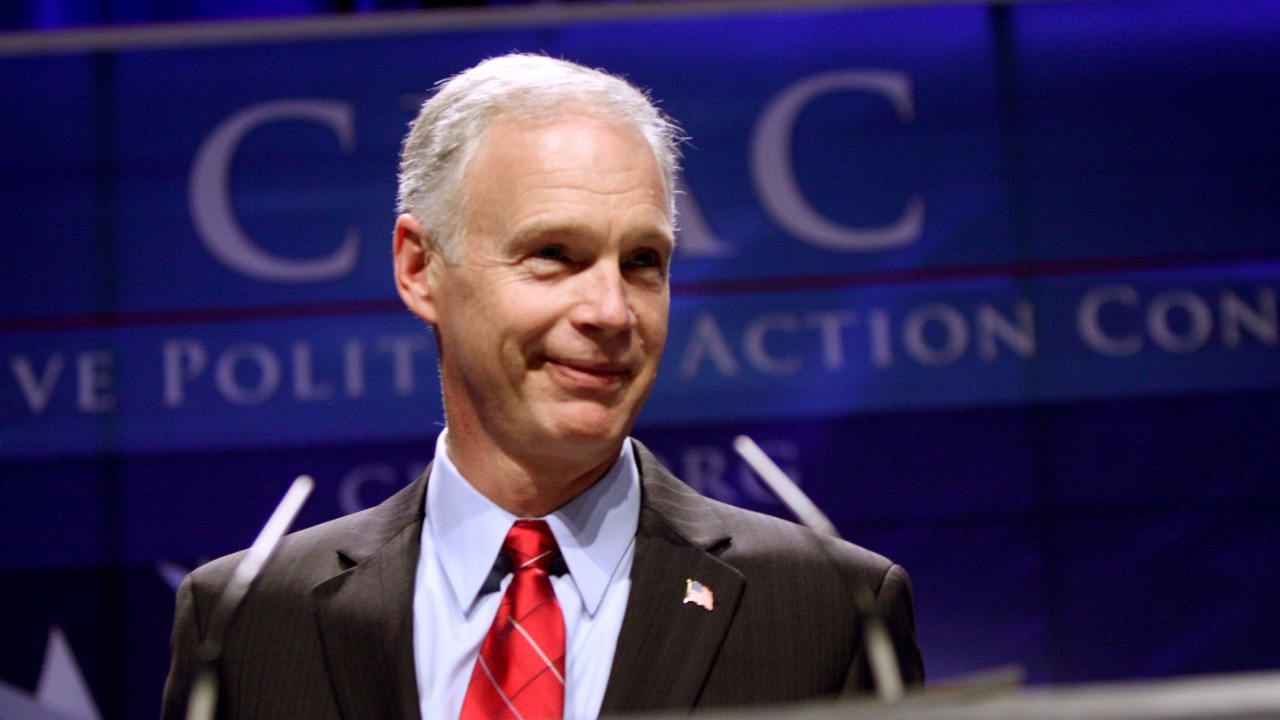
America’s debt load is closing in on $30 trillion, and the warning from Senator Ron Johnson is blunt: the country is living on borrowed time as interest costs crowd out core government functions. The numbers are not just abstract accounting entries, they are reshaping the federal budget, financial markets, and the political fights that define Washington. I see Johnson’s alarm as part of a broader reckoning over how long the United States can sustain this trajectory without forcing painful choices on taxpayers, retirees, and future workers.
Johnson’s warning and the scale of the debt problem
Senator Ron Johnson has framed the nearly $30 trillion federal debt as a ticking clock, arguing that the United States is approaching a point where its obligations will overwhelm its capacity to respond to crises or invest in growth. His core claim is that the combination of rising interest rates and relentless deficits is pushing the federal balance sheet into territory that will eventually demand abrupt spending cuts or tax hikes. That argument rests on a simple budget reality: when the Treasury must refinance trillions of dollars at higher yields, interest payments grow faster than the economy, which is exactly what recent federal data show as the debt stock climbs toward the $30 trillion mark and beyond, with net interest already rivaling or exceeding major program areas such as defense and Medicare in some projections, according to available budget estimates.
When Johnson says the country is on borrowed time, he is not just talking about the headline number, he is pointing to the speed at which that number has grown and the political unwillingness to slow it. Over roughly the past decade, Washington has layered emergency pandemic spending, large tax cuts, and bipartisan budget deals on top of structural imbalances in Social Security and Medicare, all financed through additional borrowing. As a result, debt held by the public has surged relative to gross domestic product, and the Congressional Budget Office has warned that under current law, federal debt will continue to rise as a share of the economy, driven by demographics and health costs as well as interest. Johnson’s rhetoric amplifies those warnings by arguing that once investors begin to doubt the government’s ability or willingness to stabilize the debt, the cost of borrowing could spike, a risk underscored in recent long-term outlooks that show interest costs consuming a growing share of federal revenue.
How interest costs are reshaping the federal budget
The most immediate way the near-$30 trillion debt burden shows up is in the line item for net interest, which has climbed sharply as the Federal Reserve has raised rates and older low-cost debt has rolled over. I see this as the quiet budget story behind Johnson’s alarm: every additional dollar spent on interest is a dollar not available for defense, infrastructure, or safety-net programs. Recent projections indicate that net interest payments are on track to become one of the largest categories of federal spending within the next decade, surpassing traditional discretionary programs if current trends hold, a shift documented in detailed spending projections that break out interest as a rapidly growing share of outlays.
That dynamic creates a feedback loop that is difficult to escape. As deficits persist, the Treasury issues more securities, which must be sold at yields high enough to attract buyers in a world where inflation and policy rates are no longer near zero. Higher yields raise interest costs, which widen the deficit further unless offset by spending cuts or higher taxes. Johnson’s warning about borrowed time reflects this loop: he argues that the budget is drifting toward a point where interest, Social Security, Medicare, and defense together leave little room for anything else. Analysts who track the federal balance sheet have echoed that concern by highlighting scenarios in which interest alone could claim a double-digit share of gross domestic product later this century if lawmakers do not change course, as outlined in several long-range debt scenarios.
Entitlements, demographics, and the structural drivers of red ink
Behind the headline debt figure sit structural forces that no short-term budget deal can fully fix, and Johnson often points to these as the real source of fiscal risk. An aging population is pushing up the cost of Social Security and Medicare as the ratio of workers to retirees shrinks, while health care spending per beneficiary continues to rise faster than the overall economy. I read Johnson’s argument as a call to confront these demographic and programmatic pressures directly, rather than relying on across-the-board cuts to discretionary spending that leave the main drivers of long-term deficits untouched. The Congressional Budget Office has repeatedly shown that, under current law, spending on major health programs and Social Security will climb steadily as a share of gross domestic product, a pattern laid out in its baseline projections and long-term outlooks.
Those same reports make clear that revenue, while projected to grow, does not keep pace with the automatic increases built into entitlement formulas and interest costs. That mismatch is why Johnson and other fiscal hawks argue that the United States is not simply facing a temporary spike in borrowing but a structural gap that widens over time. Addressing it would require either slowing the growth of benefits, raising additional revenue, or some combination of both, choices that carry heavy political costs. The longer lawmakers wait, the more abrupt and concentrated any eventual changes will have to be, a point underscored in analyses that compare early, gradual reforms with delayed, sharper adjustments in programs like Social Security and Medicare, as detailed in several policy option studies.
Political gridlock and the limits of fiscal warnings
Johnson’s message about the dangers of a near-$30 trillion debt lands in a Congress that has struggled to pass even routine appropriations on time, let alone comprehensive fiscal reforms. I see a clear disconnect between the scale of the problem he describes and the incremental, crisis-driven way lawmakers have managed the budget in recent years, often relying on short-term continuing resolutions and last-minute debt ceiling suspensions. That pattern has been documented in repeated analyses of appropriations that show how frequently Congress has turned to stopgap funding, a habit that keeps the government open but does little to change the long-term debt trajectory.
The politics of debt have also hardened along partisan lines, with Republicans like Johnson emphasizing spending restraint and Democrats more likely to focus on tax increases for high earners and corporations, even as both parties have supported costly initiatives when in power. That polarization makes it difficult to assemble the kind of broad coalition that major fiscal reforms typically require. Historical reviews of deficit reduction efforts, including the bipartisan agreements of the 1980s and 1990s, highlight how rare it is for both sides to accept politically painful trade-offs at the same time, a contrast to the current environment described in several retrospective budget studies. Johnson’s warning about borrowed time is, in part, a bet that rising interest costs and market pressure will eventually force that kind of compromise, but for now, the legislative path remains narrow.
What borrowed time means for households and future policy
For most Americans, the idea of a $30 trillion federal debt can feel remote, but the consequences Johnson describes would show up in familiar ways if the trajectory continues. Higher federal borrowing can put upward pressure on interest rates over time, which would affect mortgages, auto loans, and credit card balances, especially if investors begin to demand a larger premium to hold U.S. debt. At the same time, a budget increasingly dominated by interest and mandatory programs leaves less room for investments that support long-term growth, such as transportation projects, scientific research, and education grants, a trade-off highlighted in spending breakdowns that show discretionary accounts shrinking relative to the overall budget.
Johnson’s claim that America is on borrowed time is ultimately a statement about choices, not destiny. The projections he cites are based on current law and policy, which means they can change if lawmakers decide to adjust taxes, benefits, or spending priorities. The challenge, as the budget experts he often references have noted, is that the most effective solutions tend to be the least politically attractive, especially when they involve changes that are felt immediately while the benefits accrue gradually over years. I see his warnings as part of a broader effort to move that conversation from the realm of abstract numbers into concrete trade-offs that voters and policymakers can no longer postpone, a shift that will require sustained attention to the kind of detailed fiscal projections that have been sounding the alarm long before the debt approached the $30 trillion mark.
More From TheDailyOverview
- Dave Ramsey warns to stop 401(k) contributions
- 11 night jobs you can do from home (not exciting but steady)
- Small U.S. cities ready to boom next
- 19 things boomers should never sell no matter what

Grant Mercer covers market dynamics, business trends, and the economic forces driving growth across industries. His analysis connects macro movements with real-world implications for investors, entrepreneurs, and professionals. Through his work at The Daily Overview, Grant helps readers understand how markets function and where opportunities may emerge.

