President Donald Trump promised that his One Big Beautiful Bill would turbocharge growth while taming Washington’s red ink. Instead, a growing chorus of budget analysts warn that the sprawling tax and spending package risks pushing federal borrowing into uncharted territory. Their concern is not only the size of the short‑term hit, but the way the law locks in structural deficits that could leave the United States far less prepared for the next downturn.
I see a widening gap between the administration’s upbeat projections and the more sober arithmetic coming from independent forecasters. The White House argues that faster growth and spending restraint will offset the cost of the One Big Beautiful Bill, yet outside models increasingly suggest the law could supercharge the national debt and test the limits of US fiscal credibility.
What the “One Big Beautiful Bill” actually does
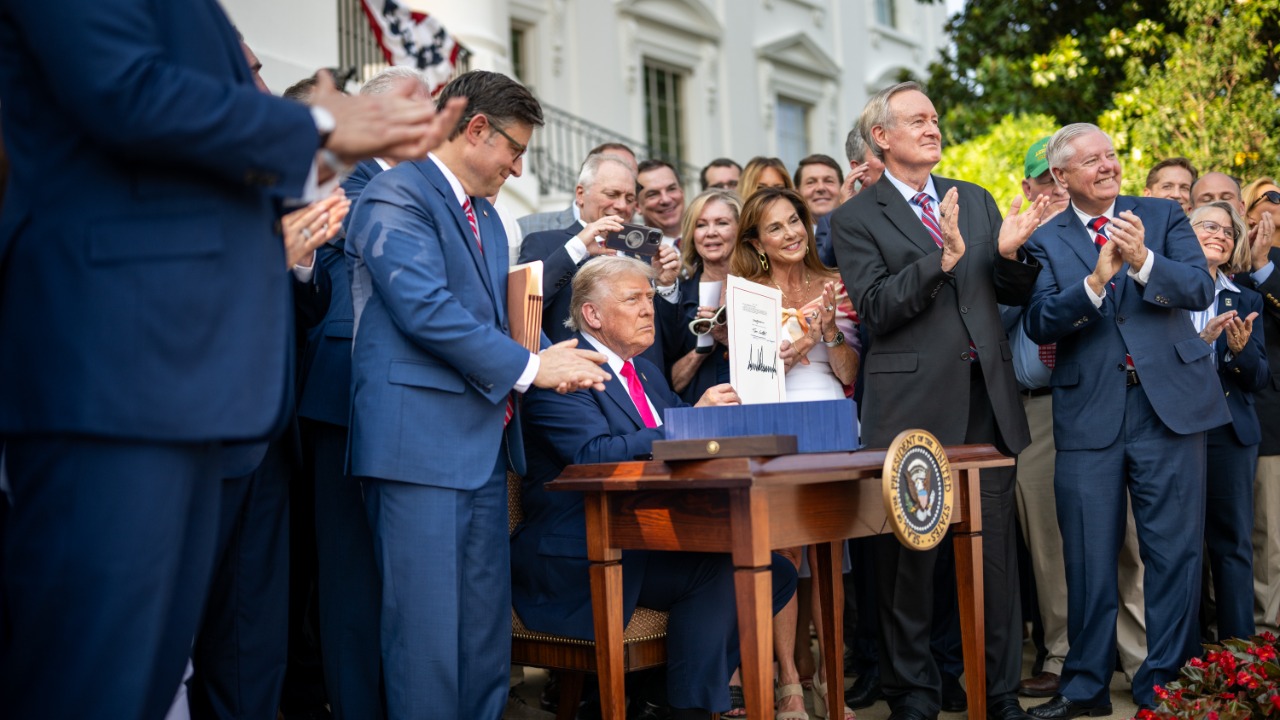
The starting point for this debate is what President Trump actually signed. On July 4, 2025, President Trump approved H.R. legislation that created the One Big Beautiful Bill Act, a sweeping package of tax cuts and new outlays that reworked both sides of the federal ledger. A detailed breakdown of what it costs shows that the law layers permanent rate reductions on top of temporary incentives, while also expanding certain spending programs, year by year and provision by provision. Consumer‑facing guidance on tax law changes underscores how deeply the One Big Beautiful Bill Act reshapes individual and business liabilities for the 2025–2026 filing seasons.
Supporters inside the administration frame the law as a growth engine that will ultimately pay for itself. An official Analysis by the Council of Economic Advisers, or CEA, argues that President Trump’s pro‑growth economic policies and efforts at reining in waste will reduce deficits relative to a current‑policy baseline. A companion White House account of how the One Big Beautiful Bill slashes deficits projects trillions in savings compared with that internal benchmark, contending that unleashed investment will swell tax receipts. The core dispute is whether those optimistic feedback effects are remotely plausible.
Debt projections that keep budget experts up at night
Outside the West Wing, the numbers look far less forgiving. A new report from the Congressional Budget Office, highlighted in a Congressional Budget Office briefing, finds that President Trump’s tax and spending law will add more than $3 trillion to the federal deficit over the coming decade. A separate CBO projection, cited in a Congressional Budget Office television segment, goes further, estimating that the “big beautiful bill” will increase the federal debt by $5 trillion if its temporary provisions are extended instead of allowed to expire. Those figures sit uneasily beside the administration’s claim that the law will shrink the debt burden.
Independent think tanks are even blunter. One assessment of the 2025 Budget Reconciliation Act, shared in a post that quotes “According to the Tax Foundation, the One Big Beautiful Bill Act OBBBA supports US,” concludes that the Budget Reconciliation Act Will Increase Debt While Modestly Boosting The Economy Benjamin, Page Display Date July, and warns that debt could climb toward 120% of GDP by 2034 if the law is fully implemented, a scenario flagged in the Budget Reconciliation Act analysis. A separate study from Europe‑based researchers notes that, on 4 July 2025, President Donald Trump signed into law the One Big Beautiful Bill Act, or OBBBA, and asks bluntly how much of a threat it poses to US debt sustainability, describing its own projections as “plausible” but worrying in a threat assessment. When I line up these forecasts, the through‑line is clear: even under relatively friendly assumptions, the law pushes federal borrowing sharply higher.
Why economists doubt growth will save the day
The administration’s defense rests heavily on the idea that faster growth will offset lost revenue. There is precedent for that argument in earlier tax debates, but the historical record is sobering. A briefing on how the Tax Cuts and Jobs Act affected the federal budget shows that the 2017 law widened deficits even after accounting for stronger output, a pattern documented in a federal budget outlook analysis. Earlier work on Trump’s campaign‑era tax blueprint warned that his plan could leave America $10 trillion deeper in debt and push total federal obligations toward roughly $30 trillion without offsetting cuts, a scenario laid out in a Trump tax study. Those warnings echo loudly as analysts revisit the new law’s revenue math.
Professional forecasters are not buying the idea that this time will be different. A survey summarized by The Wall Street Journal found that 65% of the economists believe Trump’s plans would do more to increase the annual federal deficit and national debt than to reduce them, and that the benefits would tilt toward the wealthiest Americans, according to the Wall Street Journal survey. At the same time, a macroeconomic review by Center for Tax and Budget Policy Director John W. Diamond examines how the One Big Bea package affects investment, wages and output, with the About the Episode summary noting that John W. Diamond evaluates the macroeconomic impacts of the One Big Bea legislation. A companion description of the same work, which again highlights the Center for Tax and Budget Policy Director John, Diamond and the One Big Bea analysis, reinforces that any growth bump is modest compared with the size of the tax cuts, as outlined in the About the Episode note. When I weigh those findings against the CEA’s projections, the risk is that policymakers are leaning on growth assumptions that the broader economics profession simply does not share.
Wall Street’s split screen: short‑term boost, long‑term risk
Financial markets have greeted the law with a mix of enthusiasm and unease. Large banks and corporate executives tend to welcome lower tax rates and looser fiscal policy, and some have argued that Trump’s “big, beautiful bill” is good for the US economy in the near term. Yet even in those upbeat assessments, the debt load is a central concern for critics, and a detailed look at the Drawbacks section of one market‑focused analysis notes that Others have flagged serious drawbacks, including the strain on an already stretched Congre budget watchdog. That tension between short‑term stimulus and long‑term sustainability is exactly what worries bond investors who must decide how much to charge Washington for its borrowing.
Video coverage of the CBO’s findings has amplified those concerns. In one widely shared segment, a new report from the Congressional Budget Office is described as projecting that President Trump’s spending bill will raise the federal deficit by more than $3 trillion, underscoring how far the law pushes existing trends. Another televised discussion of the big beautiful bill repeats that the Congressional Budget Office is projecting the legislation will increase the federal debt by $5 trillion if its provisions are extended. When I talk to market strategists, they tend to see those CBO numbers as a floor rather than a ceiling, given how often temporary tax breaks in Washington end up becoming permanent.
The inflation and household angle
For households, the stakes are not abstract. Consumer tax guides on Taxes explain how the One Big Beautiful Bill Act Tax Law Changes and How That Impacts You will alter withholding, credits and deductions, and they stress that, On July 4, 2025, the legislation known as the One Big Beautiful Bill Act reshaped the tax landscape for ordinary filers. That puts real money in some pockets, at least initially. But if the law also fuels higher inflation and interest rates, those gains could be eroded by more expensive mortgages, car loans and credit‑card balances.
More From TheDailyOverview
*This article was researched with the help of AI, with human editors creating the final content.

Grant Mercer covers market dynamics, business trends, and the economic forces driving growth across industries. His analysis connects macro movements with real-world implications for investors, entrepreneurs, and professionals. Through his work at The Daily Overview, Grant helps readers understand how markets function and where opportunities may emerge.

