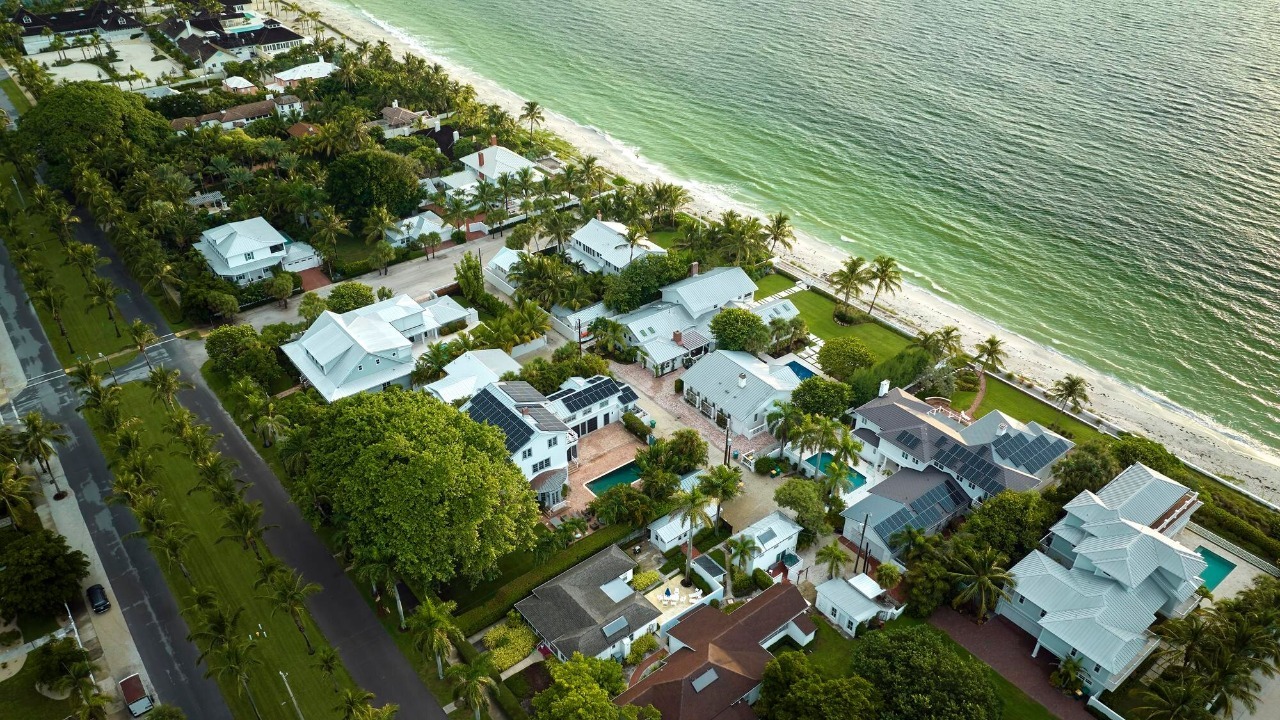
In a corner of coastal Florida, home values have not just climbed, they have effectively doubled in a handful of years as ultra-wealthy buyers compete for a finite supply of waterfront mansions and gated estates. The surge has turned a once seasonal enclave into a year-round base for billionaires, private equity partners and tech founders consolidating their fortunes in a low-tax, lifestyle-driven market. Their appetite for “trophy” properties is now reshaping prices, politics and the social fabric far beyond the oceanfront streets where the bidding wars begin.
At the center of this shift is Palm Beach, where the average home now trades in the realm of private jets and superyachts rather than jumbo mortgages. The same forces are rippling through neighboring luxury hubs from Miami to Naples, creating a new map of American wealth that looks less like Manhattan and Silicon Valley and more like a string of resort towns along Florida’s Atlantic and Gulf coasts.
Palm Beach’s meteoric rise from resort town to wealth fortress
The most dramatic transformation is unfolding in Palm Beach, where home values have surged at a pace that would have seemed implausible a decade ago. Recent data show the town leading Florida’s fastest-growing markets with average home values around $9.8 million, a figure that reflects not just inflation but a wholesale repricing of what it costs to buy into one of America’s most exclusive ZIP codes. Over the past five years, prices in Palm Beach, Florida have climbed 117%, placing the island among the strongest prime residential markets in the world. In global rankings, only a handful of cities such as Dubai, where prices are up 147% since 2019, have outpaced the Florida enclave’s ascent.
Behind those numbers is a specific kind of buyer and a specific kind of property. Agents describe a wave of ultra-high-net-worth individuals targeting “trophy” estates, including a Palm Beach area property that recently came to market next door to Oracle cofounder Larry Ellison. According to reporting by By Kristen Altus, these buyers are not just parking capital, they are embedding themselves in the community, shifting from seasonal visitors to full-time residents who expect private clubs, high-end retail and world-class medical care within a short drive. That shift has helped push Palm Beach into the top tier of global luxury markets, where Globally tracked “sunbelt locales” are now outpacing traditional financial centers, with prime prices in those warmer regions rising 3.7% compared with 3.5% for cities overall.
South Florida’s luxury belt: Miami, Coral Gables and beyond
The Palm Beach boom is part of a broader reordering across South Florida, where high-end housing markets from Miami to Coral Gables are posting historic gains. Analysts tracking global luxury prices note that Miami has seen prices jump 84% over the same five-year period, putting it in the same conversation as Palm Beach for global investors. Almost nowhere in the world have listing prices grown more rapidly than in Palm Beach and, a pairing that now anchors a luxury corridor stretching from the barrier islands down through Brickell and Coconut Grove. In that corridor, waterfront condos and single-family estates routinely list in the eight figures, and new construction is tailored almost exclusively to global elites.
Within Miami-Dade County, the leafy streets of Coral Gables have become a favored landing spot for executives and family offices seeking privacy a short drive from downtown. The broader metropolitan area has emerged as the world’s top destination for ultra-wealthy buyers, with South Florida’s luxury housing market recently hitting a four-year high as sales of homes priced at $10 million and above accelerated. That surge has helped cement Miami’s reputation as one of the most resilient luxury real estate markets in the world, even as higher interest rates and economic uncertainty cool demand in other U.S. cities.
Naples and the Gulf Coast join the top tier
While the Atlantic coast grabs most of the headlines, Florida’s Gulf Coast is quietly matching its performance at the very top of the market. In Naples, aerial views now show a near-continuous line of luxury waterfront homes, each with its own dock, pool and manicured lawn. Recent analysis by By Adam Regan describes Naples as one of the nation’s costliest luxury housing markets, even after some softening through much of 2025. That status reflects both the scarcity of buildable waterfront land and the influx of buyers who might once have focused on California or the Hamptons but now see Southwest Florida as a safer, more tax-efficient bet.
The Gulf Coast’s rise is part of a broader pattern in which Florida cities have seen home values double in a relatively short span. Across the state, prices have been Molded by a combination of inflation, tight supply and surging demand, with some markets effectively doubling in just six years. That trajectory has pushed Florida’s median home price far above its pre-pandemic level and helped make several of its metros, including Naples, among the country’s most expensive places to buy a house. For luxury buyers, the calculus is straightforward: they can secure a waterfront compound in Naples or Palm Beach that rivals anything in Malibu or Miami Beach, often with lower carrying costs and a friendlier tax regime.
Global money, from Manila to Dubai, converges on Florida
Florida’s luxury surge does not exist in a vacuum, it is part of a global reallocation of wealth into prime residential property. International indices show that the strongest price growth over the past five years has been concentrated in a handful of cities, led by Dubai, where values are up 147% since 2019. The second strongest market is Manila, which has recorded an 87% rise powered by domestic wealth creation and expat Filipinos reinvesting in the city. Those same global forces, from currency diversification to geopolitical risk, are now channeling capital into Florida, where buyers see a combination of political stability, dollar-denominated assets and lifestyle appeal.
It is the United States, however, that hosts the largest cluster of these high-growth markets, with Palm Beach and Miami standing out as prime examples of how global demand can feed through to substantial price rises. In Palm Beach, that demand is visible in the steady stream of international buyers touring oceanfront estates and in the way local agents now market properties in multiple languages and currencies. In Miami, it shows up in the skyline, where branded residences tied to luxury names from Baccarat to Aston Martin cater to overseas investors who may split their time between South Florida, Manila and the Middle East. The result is a feedback loop in which global rankings and record-breaking sales attract more capital, which in turn pushes prices higher.
Winners, losers and the future of Florida’s luxury havens
For existing homeowners in places like Palm Beach, the doubling of home values has been a windfall that few other asset classes could match. Longtime residents who bought modestly sized houses decades ago now find themselves sitting on properties worth many millions, particularly in neighborhoods near the ocean or the Intracoastal Waterway. In some cases, those owners are selling to institutional buyers or newly arrived billionaires who assemble multiple parcels into sprawling compounds, a trend visible in the way Palm Beach’s built environment is shifting from smaller cottages to mega-mansions. That consolidation of land mirrors the consolidation of wealth, as a relatively small number of ultra-rich households control an ever larger share of the housing stock in these enclaves.
More From TheDailyOverview
*This article was researched with the help of AI, with human editors creating the final content.

Elias Broderick specializes in residential and commercial real estate, with a focus on market cycles, property fundamentals, and investment strategy. His writing translates complex housing and development trends into clear insights for both new and experienced investors. At The Daily Overview, Elias explores how real estate fits into long-term wealth planning.