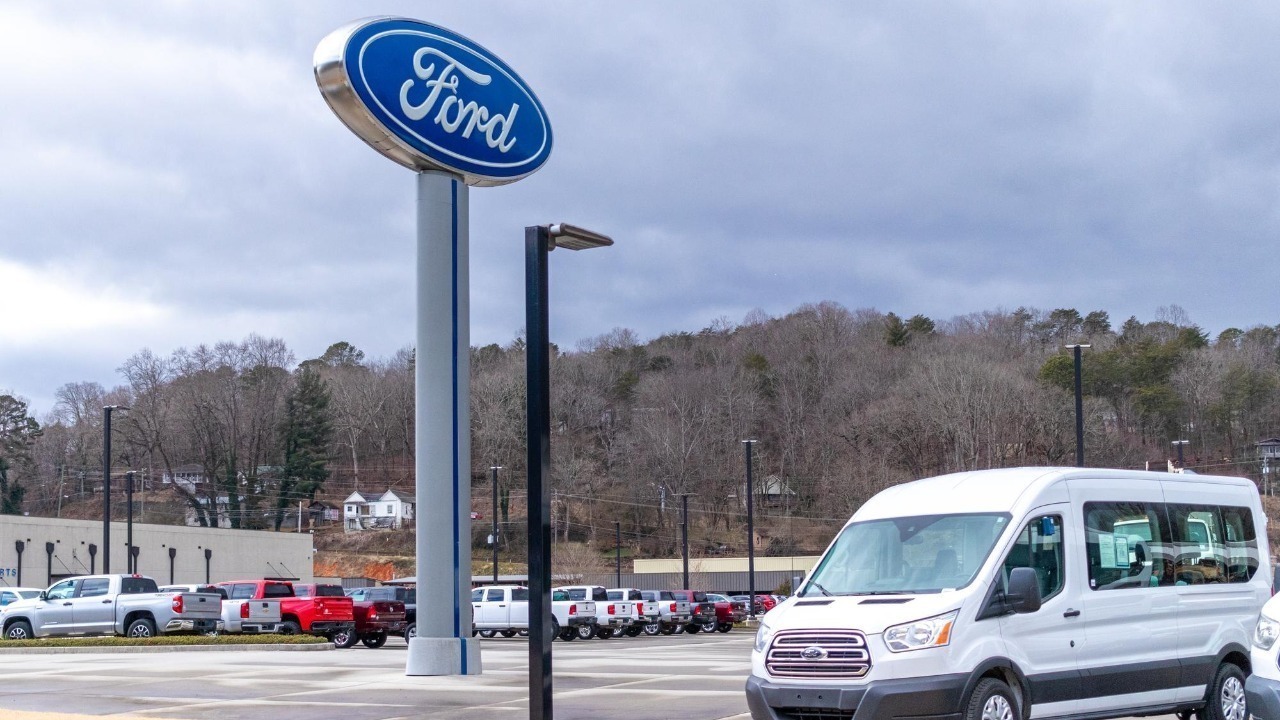
Ford is pouring $2 billion into its Louisville Assembly Plant to pivot from gasoline crossovers to mass-market electric vehicles, a bet that could redefine the company’s U.S. manufacturing footprint. For roughly 2,000 workers in Kentucky, however, that transformation comes with a 10 month shutdown and no guarantee that every job on the line today will be there when the plant restarts.
I see a classic transition dilemma taking shape: the investment is being sold as proof that Kentucky will sit at the center of Ford’s electric future, yet the very workers who built that legacy are being asked to wait, retrain, and trust that the promised EV boom will arrive in time to secure their livelihoods.
The $2 billion bet on Louisville’s electric future
Ford is positioning the Louisville Assembly Plant as a cornerstone of its next generation of affordable EVs, committing $2 billion to retool the factory for a new electric platform aimed at a starting price of around $30,000. Company officials have framed the move as a way to keep the facility relevant as the market shifts away from internal combustion, with the Louisville Assembly Plant for compact SUVs giving way to a flexible line for lower cost battery powered models that can be built at scale once demand materializes, according to detailed plans for Ford is investing $2 billion. The company is effectively betting that price sensitive buyers who have hesitated to go electric will respond once a mainstream automaker can deliver a sub $30,000 EV with familiar branding and nationwide dealer support.
That strategy fits into a broader push by Automaker Ford to accelerate its electric vehicle business in the United States, where the Louisville facility is being singled out for a sweeping overhaul that will touch everything from body assembly to final inspection. The Louisville plant is one of several U.S. sites being upgraded as Automaker Ford hits the pedal on EV production, with the Kentucky investment framed as a key piece of a North American network designed to bring more electric models to market and keep pace with rivals that are also racing to go electric, a shift highlighted in coverage of the Automaker Ford overhaul. In that context, the $2 billion is not just a local story but a signal that Ford sees Kentucky as a proving ground for its mass market EV ambitions.
A “Model T moment” and a radical new assembly line
What makes the Louisville project more disruptive than a typical retooling is Ford’s decision to abandon the traditional moving assembly line that has defined auto manufacturing for more than a century. Executives have described the shift as a “Model T moment,” a reference to the original revolution in mass production, as the company prepares to replace the familiar conveyor driven system with a modular “assembly tree” that breaks vehicles into sub modules built in parallel before final marriage, a change detailed in reporting on how Ford to ditch traditional moving lines. I read that as an admission that the old Model T era system is no longer efficient enough for the complexity and software heavy content of modern EVs, and that the company is willing to rewrite its own playbook to stay competitive.
This new production system is designed around a universal EV platform that can underpin multiple models, which should let Ford swap body styles and features without tearing up the factory each time it wants to refresh the lineup. For workers, that means learning an entirely different way of building vehicles, with more emphasis on modular subassemblies, battery integration, and software diagnostics than on the linear, repetitive tasks that defined earlier generations of auto jobs. The “Model” language used by Ford underscores how sweeping the change will be, and it helps explain why the company is willing to idle the Louisville plant for nearly a year to install the new equipment and train employees rather than trying to bolt EV production onto an aging line that was never designed for high voltage platforms.
2,000 Kentucky jobs “Far From Certain” during 10 month retooling
The human cost of that transformation is already coming into focus, and it is most acute for the roughly 2,000 K workers whose positions are tied directly to the Louisville Assembly Plant’s current product mix. As Ford prepares for a 10 month retooling, company documents and union briefings have made clear that those 2,000 K jobs are “Far From Certain” to return in their current form once the plant restarts, a stark warning captured in reporting that describes Ford’s $2B EV “Gamble” and the risk that some positions could be eliminated as the new production system comes online Ford’s $2B EV Gamble. The retooling window is expected to begin as the plant’s current gasoline models wind down, with a production phase out after 2025 that leaves a gap before the new EVs ramp up.
For workers on the line, that timeline means months of uncertainty about whether they will be called back, transferred to other facilities, or offered buyouts as Ford reshapes its Kentucky footprint. The company has pointed to opportunities at other sites, including roles as at Kentucky Truck Plant, as evidence that it is trying to cushion the blow for Louisville employees who might be displaced by the shift to EVs, a point that has surfaced in coverage of how the Louisville Assembly Plant for workers could be redeployed within the regional network as at Kentucky Truck Plant. Still, the phrase “Far From Certain” is doing a lot of work here, signaling that the EV transition is not a simple one for one swap of old jobs for new ones, especially when automation and new production methods are part of the package.
Cheap EVs, big promises, and Kentucky’s political stakes
Ford has tried to frame the Louisville investment as a win for both workers and consumers by emphasizing that the revamped plant will focus on cheaper EVs that can reach buyers who have been priced out of the current market. Company leaders said on a recent Monday that the $2 billion will support a new generation of compact electric models built in Louisville and targeted at cost conscious drivers, with the goal of delivering a starting price that undercuts many existing EVs while still meeting modern safety and range expectations, a strategy laid out in the announcement that Ford announces $2 billion investment in Louisville. I see that as an attempt to answer critics who argue that EVs remain a luxury product, and to reassure Kentucky residents that the state is not just hosting a high tech experiment but a volume business that can sustain middle class jobs.
State leaders have seized on the announcement as proof that Kentucky is securing its place in the auto industry’s next chapter, describing the $2 billion as one of the largest investments on record and a boost to the state’s position as a hub for electric vehicle manufacturing. In official statements, Kentucky officials have stressed that the project strengthens the state’s long term competitiveness and helps keep its manufacturing base relevant as automakers invest $2B to keep their electric vehicle business moving forward, a framing reflected in coverage that highlights how Kentucky is marketing itself to global automakers. That political narrative, however, sits uneasily beside the reality that thousands of workers are being asked to ride out a long shutdown with no ironclad guarantee that the new EV era will offer them the same security that gasoline powered production once did.
Retooling risk in a volatile EV market
The timing of Ford’s Louisville overhaul adds another layer of risk, because the EV market itself is in flux even as automakers commit billions to new plants and platforms. Over the past two years, demand for electric vehicles has grown but also shown signs of volatility, with some manufacturers trimming production targets or delaying new models when sales fell short of early projections. Ford is moving ahead anyway, betting that a lower price point and a more efficient production system will let it weather short term swings and capture buyers as charging infrastructure improves and battery costs continue to fall, a logic that underpins the decision to invest $2 billion in a single U.S. plant and treat it as a flagship for the next wave of electric models Louisville Assembly Plant for. From a business perspective, that kind of concentration can deliver economies of scale, but it also means that any misstep in product planning or consumer demand will hit Louisville workers directly.
For Kentucky, the stakes are unusually high because the state has tied its economic development narrative to big ticket auto investments, from battery plants to assembly lines, and is now counting on Ford’s EV pivot to validate that strategy. If the bet pays off, Louisville could emerge as a showcase for how a legacy factory can be reinvented for the electric age, with a workforce that has successfully retrained for higher tech roles and a product lineup that keeps the plant humming. If it falters, the 10 month retooling and the uncertainty around 2,000 K jobs will look less like a bridge to the future and more like a warning about how disruptive the EV transition can be when it lands on a single community all at once, a tension that sits at the heart of Ford’s $2B EV Gamble and the question of whether Kentucky Jobs are truly secure During the long Month Retooling period that lies ahead Kentucky Jobs, Far From Certain, During, Month Retooling.
More From TheDailyOverview
- Dave Ramsey warns to stop 401(k) contributions
- 11 night jobs you can do from home (not exciting but steady)
- Small U.S. cities ready to boom next
- 19 things boomers should never sell no matter what

Grant Mercer covers market dynamics, business trends, and the economic forces driving growth across industries. His analysis connects macro movements with real-world implications for investors, entrepreneurs, and professionals. Through his work at The Daily Overview, Grant helps readers understand how markets function and where opportunities may emerge.