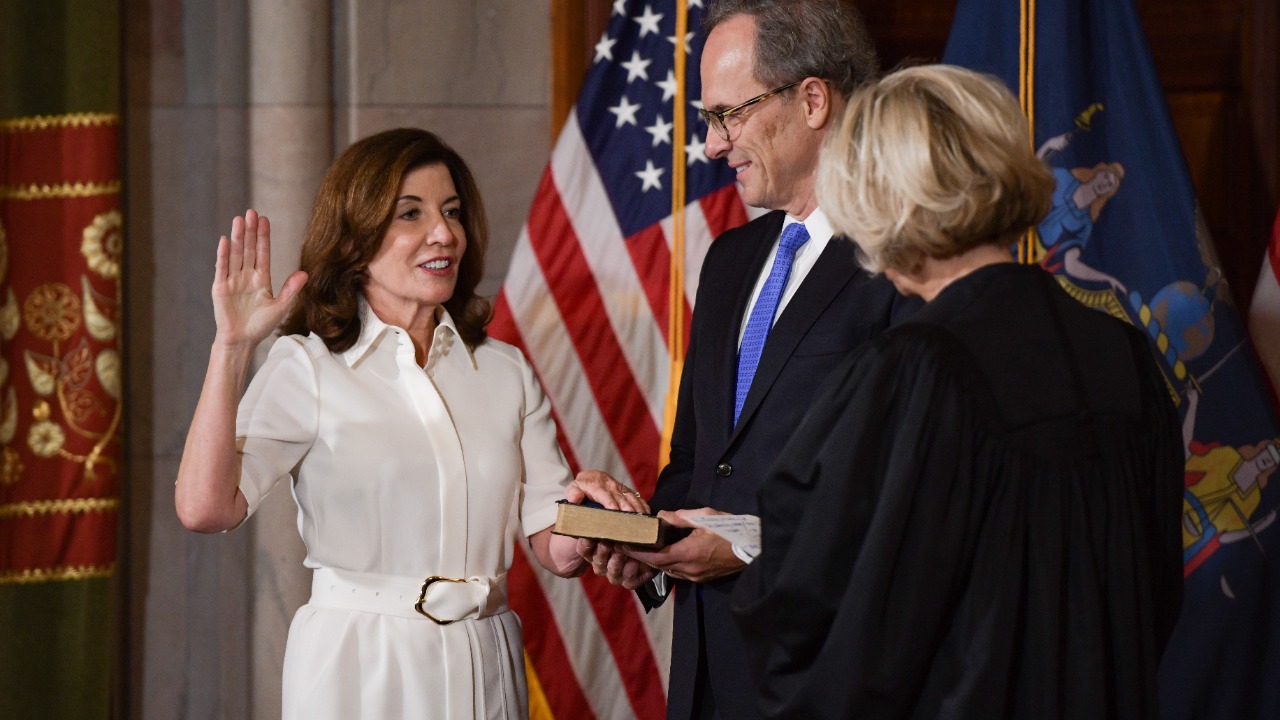
Gov. Kathy Hochul has finally disclosed how much she personally paid in New York City congestion tolls, a small but politically loaded detail in the broader deal that keeps the MTA’s controversial pricing system alive. The revelation lands as the program marks its first full year, with supporters touting cleaner air and stronger transit finances while critics frame it as a cash grab that punishes drivers.
I see her disclosure less as a curiosity about a single motorist’s bill and more as a test of credibility for a governor who once balked at congestion pricing, then embraced it, and now must defend it against legal and political attacks. The numbers on her own account, the MTA’s revenue haul, and the promised investments in transit and neighborhoods all feed into the same question: is this program delivering what New York City was promised, or simply charging drivers more to plug budget holes?
Hochul’s toll bill and the optics of shared sacrifice
The governor’s office in ALBANY has now confirmed how much Gov. Kathy Hochul paid in NYC congestion charges while the tolls were in effect, information that had been withheld even as the program reshaped driving habits across the city. Her staff released the figure under pressure, tying it to the broader MTA deal that keeps the system running and implicitly arguing that the governor is not exempt from the costs she has imposed on other drivers. The disclosure, described as an exclusive look at her own account, underscores that Hochul was charged like any other motorist entering the Congestion Relief Zone, rather than benefiting from quiet carve outs or special treatment, according to the governor’s office in ALBANY.
The political stakes are obvious. Congestion pricing has become a litmus test for whether Gov Hochul is seen as aligned with everyday commuters or insulated from the pain of new fees. By finally revealing the total she paid, her team is trying to blunt accusations that she pushed through a revenue scheme for the MTA while avoiding its consequences. The fact that the disclosure came only after sustained questioning, and was framed through her office rather than a casual admission, shows how sensitive the issue has become for a governor whose name, as Vaughn Golden noted, is now inseparable from the tolling experiment in NYC.
How congestion pricing became central to Hochul’s transit agenda
When Governor Kathy Hochul first took office, she hesitated on congestion pricing, wary of the political blowback from drivers and suburban lawmakers. Over time, she pivoted, making the program a centerpiece of her transportation agenda and arguing that New York City needed a first in the nation model to cut gridlock and fund subways and buses. On the program’s one year anniversary, Governor Kathy Hochul celebrated what she called transformational results, saying that the initiative had delivered less traffic and better transit for New York City and the rest of New York, a claim her office highlighted in a detailed Jan update.
That evolution did not happen in a vacuum. Earlier, Hochul had signaled doubts about moving forward, then reversed course as New York City prepared to Launch First Congestion Pricing Program in the U.S., a shift that critics seized on as evidence she had “flipped” under pressure. Her allies counter that the change reflected new data on traffic, climate goals, and the need to stabilize the MTA’s finances after federal pandemic aid began to dry up. The political narrative, however, is more blunt: she said no to congestion pricing, then she flipped, and now New Yorkers pay more, as one prominent opponent framed it in a pointed Jan post.
The MTA deal: revenue windfall and spending promises
At the heart of the current debate is the MTA deal that locks congestion pricing revenue into the authority’s long term capital plans. The MTA’s own numbers show that the much hated program has raked in more money than expected, with The MTA netting $62M more than projected from congestion tolls, a figure that critics cite as proof the system is nothing but a cash grab. Supporters respond that the extra $62M is precisely the point, arguing that every additional dollar from drivers entering Manhattan’s core helps modernize signals, buy new subway cars, and shore up commuter rail, as reflected in the authority’s recent Feb revenue breakdown.
The spending side of the ledger is equally important. When the MTA Board approved phasing in the Congestion Relief Zone toll, it paired the new charges with specific commitments, including $55 Million in Environmental Mitigation Set for the Region and $100 Million for Place Based Programs for the Bronx, Brooklyn, Newa and other affected communities. Those figures, $55 M and $100 M, are meant to show that the program is not just about Manhattan commuters but also about neighborhoods that have long borne the brunt of traffic and pollution, according to the authority’s Nov resolution.
How the tolls actually work on the street
For drivers, the policy debate boils down to a simple reality: how much it costs to cross into Manhattan and how those charges are applied. Under Hochul’s updated plan, congestion pricing in NEW YORK was set to start in January at a $9 toll for most passenger vehicles entering New York City’s central business district, with higher rates for trucks and some discounts for overnight travel. Gov Hochul framed the $9 figure as a balance between discouraging unnecessary trips and keeping the city accessible, while encouraging drivers to sign up for E ZPass to avoid higher rates, according to the state’s NEW rollout.
Behind that headline number sits a complex set of rules. The MTA’s Congestion Relief Zone tolling system spells out how charges apply based on transaction date, vehicle type, and whether a driver uses an E ZPass or is billed by mail. Congestion Relief Zone tolls with a transaction date of March 6 or later are subject to all applicable fees if they are not paid on time, and the authority’s guidance details how charges interact with existing river crossing and excluded roadway rules. For a delivery driver in a 2022 Ford Transit van or a nurse commuting in a 2019 Honda CR V, the fine print on late fees and exemptions can matter as much as the base toll, which is why the MTA has devoted an entire portal to explaining the tolling mechanics.
Legal fights, political backlash, and what comes next
Even as the money flows in and the governor touts less traffic, the program is under sustained legal and political attack. In the latest courtroom round, opponents argued that the federal administration’s changed priorities give them the authority to cancel the congestion pricing agreement, claiming that Washington should not be able to force New York into a policy that, in their view, harms drivers and small businesses. Their argument then was that the administration’s changed priorities give them the authority to cancel the agreement and that the state must protect hard working citizens, a position laid out in detail during a recent Jan hearing.
The MTA, for its part, has been forced to defend the program not just on policy grounds but also as a matter of financial survival. In a detailed presentation, BY Samantha Liebman New York City reported that agency lawyers warned judges that unwinding congestion pricing now would blow a hole in the capital plan and risk service cuts, even as they insisted that federal approvals were properly granted. The case, UPDATED at 8:54 PM ET and PUBLISHED earlier that evening in EST, underscored how much of the region’s transit future now rests on a tolling system that remains deeply unpopular with some drivers, as reflected in the latest 54 minute hearing coverage.
More From The Daily Overview
*This article was researched with the help of AI, with human editors creating the final content.

Silas Redman writes about the structure of modern banking, financial regulations, and the rules that govern money movement. His work examines how institutions, policies, and compliance frameworks affect individuals and businesses alike. At The Daily Overview, Silas aims to help readers better understand the systems operating behind everyday financial decisions.

