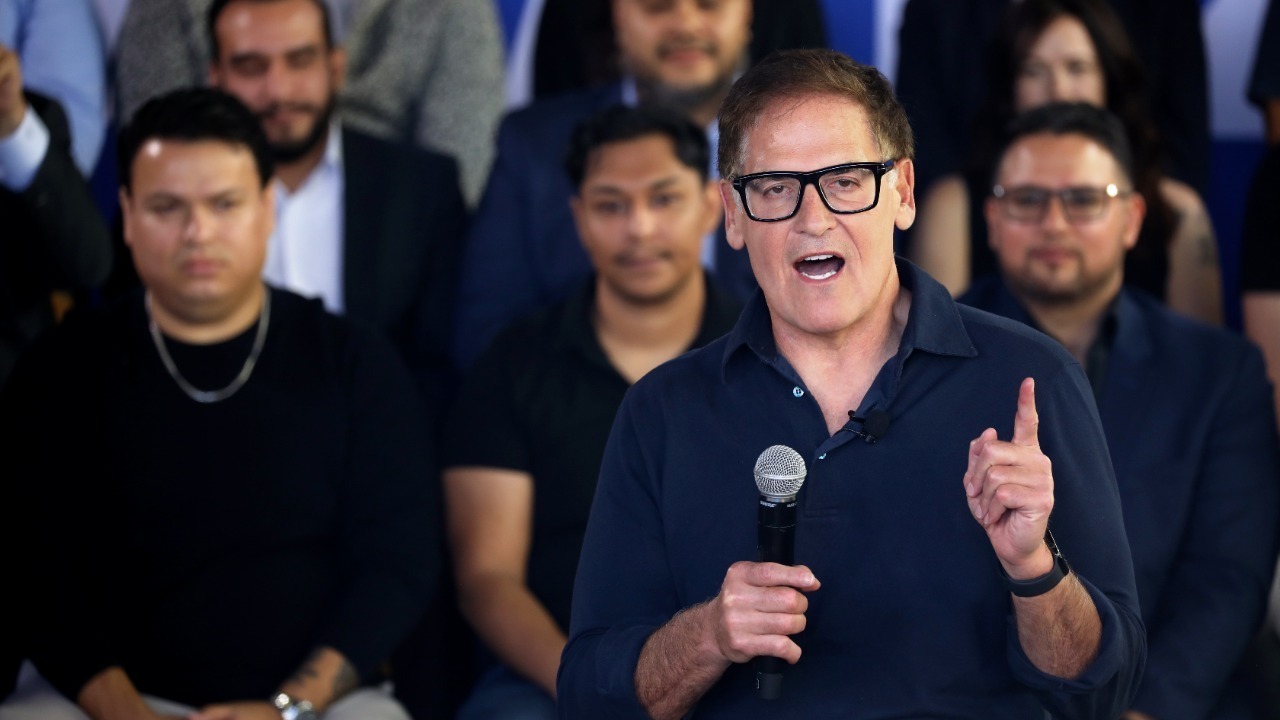
Mark Cuban has spent nearly a decade arguing that artificial intelligence will not just mint new fortunes but fundamentally rewrite who gets to build them. His latest twist on that thesis is vivid: the first trillionaire, he says, could be a lone operator in a basement, armed with consumer-grade AI tools rather than a campus of engineers. The claim is provocative, but it also captures a real shift in power from institutions to individuals that I see playing out across the AI economy.
At its core, Cuban’s argument is not about a specific app or model, it is about leverage. If software once let a small team reach millions, AI lets a single person simulate the output of a large company. The open question is whether that leverage will actually concentrate into a single, basement-born trillionaire, or whether the same forces that democratize AI will spread the upside across regions and communities that have historically been shut out of tech wealth.
From SXSW warning to basement prophecy
Long before generative chatbots became a household term, Mark Cuban was telling audiences that artificial intelligence would define the next wave of extreme wealth. At a talk in Mar, he pointed out that Bill Gates was then the richest person on the planet with more than $85 billion, and argued that the next step change in fortunes would not come from traditional software but from those who truly understand AI. He framed it bluntly, saying the world’s first trillionaires would be people who master artificial intelligence and its derivatives, and he tied that prediction to specific sectors like insurance where he expected algorithms to upend existing business models, a view he laid out in detail at the SXSW Conference and Festivals in comments later captured by financial coverage.
That early warning has since evolved into a more concrete image of how such a fortune might be built. In recent interviews, Cuban has said that as AI tools improve, the person who crosses the trillion-dollar mark might not be a household name today or a veteran of big tech at all. Instead, he has described the possibility that just one individual, working largely alone in a basement and using off-the-shelf AI systems, could assemble products and services at a scale that previously required a multinational corporation, a scenario he has repeated in conversations summarized by conference reports.
Why Cuban thinks one person can now do the work of a corporation
The logic behind Cuban’s basement image rests on how AI compresses the cost of labor, expertise and distribution. A single founder can now use large language models to draft code, design interfaces, generate marketing copy and even simulate user research, all from a laptop. Cuban has argued that as these tools become more capable, the bottleneck shifts from capital and headcount to imagination and execution, which is why he keeps returning to the idea that the decisive skill is not writing every line of code but knowing how to orchestrate AI systems effectively, a point he has made repeatedly in interviews captured in industry analysis.
In that framing, the basement is less about geography and more about independence. Cuban often compares the coming AI wave to the early days of personal computers and the internet, when hobbyists and small teams created companies that later dominated global markets. He has suggested that the same pattern is repeating, only faster, as generative models and automation platforms let a solo founder chain together services that handle customer support, logistics planning and even parts of strategic decision making, an argument echoed in summaries of his comments on how AI could transform industries like insurance and beyond in recent reporting.
From garage myth to AI basement: the new founder archetype
Cuban’s story about a lone basement operator is deliberately reminiscent of the garage myths that surround earlier tech giants. He has explicitly drawn a line from Jeff Bezos founding Amazon in his garage to the next generation of AI-native companies, suggesting that the symbolic garage has moved indoors to a basement where the main infrastructure is cloud compute rather than cardboard boxes. In his view, the key continuity is that transformative companies often start in unglamorous spaces, a point he has underscored while discussing how early-stage founders can now plug into powerful AI services without owning any physical infrastructure, a comparison laid out in detail in recent commentary.
What changes in the AI era is the ratio between space and scale. A garage startup still needed warehouses, staff and logistics networks to reach global dominance, but an AI-first company can outsource much of that complexity to platforms and partners while keeping a tiny core team. Cuban has argued that this makes it plausible for a single founder to control an unprecedented share of the value they create, since they do not have to dilute ownership to hire hundreds of employees or raise massive rounds of capital, a theme that surfaces in his remarks about how “just one dude in a basement” could ride AI to a trillion-dollar valuation, as recounted in syndicated coverage.
The hype, the risks and who gets left behind
There is a risk, though, that the basement trillionaire narrative obscures the uneven terrain beneath it. Cuban himself has acknowledged that AI will not only create fortunes but also displace workers, particularly in sectors like insurance where he expects algorithms to outperform traditional underwriting and claims processing. That kind of disruption can widen inequality long before any individual crosses the trillion-dollar threshold, especially if the gains accrue to a narrow set of founders and investors, a tension that surfaces in his early comments about AI’s impact on industries such as.
There is also a practical constraint that Cuban’s soundbite can gloss over: access to high-quality models and compute is still heavily mediated by large companies and well-funded labs. Even if a founder is physically in a basement, they are functionally dependent on cloud providers, API pricing and regulatory frameworks that can tilt the playing field. Some of Cuban’s recent comments, captured in summaries that note how he compares AI’s rise to the early PC and internet eras, suggest he believes these barriers will fall within the next ten years, but that timeline assumes continued openness and falling costs that are not guaranteed, a nuance reflected in coverage of his prediction that the first AI-driven trillionaire could emerge within the next decade in technology reports.
Will the first AI trillionaire really be alone in a basement?
When I look past the metaphor, I see Cuban’s claim less as a literal forecast and more as a provocation about how concentrated AI-enabled wealth could become. He has repeatedly emphasized that the person who reaches a trillion first is unlikely to be an existing titan like Elon Musk, arguing instead that it will be someone who is simply better at using AI than anyone else. That framing has resonated widely, circulating through investor newsletters and online communities that quote his line about “just one person in a basement using AI,” including posts that highlight how Mark Cuban recently that bold claim.
At the same time, Cuban’s own language hints that he sees this as a spectrum rather than a binary. In one interview he described AI’s upside by saying that is how crazy it could be, stressing that the technology is still in its early innings and that the most transformative uses have not yet been built. He has also talked about his personal use of AI tools in daily life, from drafting messages to analyzing information, suggesting that the same capabilities that might empower a future trillionaire are already reshaping how ordinary professionals work, a point captured in summaries of his remarks on the Potential for First.
More From The Daily Overview
*This article was researched with the help of AI, with human editors creating the final content.

Grant Mercer covers market dynamics, business trends, and the economic forces driving growth across industries. His analysis connects macro movements with real-world implications for investors, entrepreneurs, and professionals. Through his work at The Daily Overview, Grant helps readers understand how markets function and where opportunities may emerge.