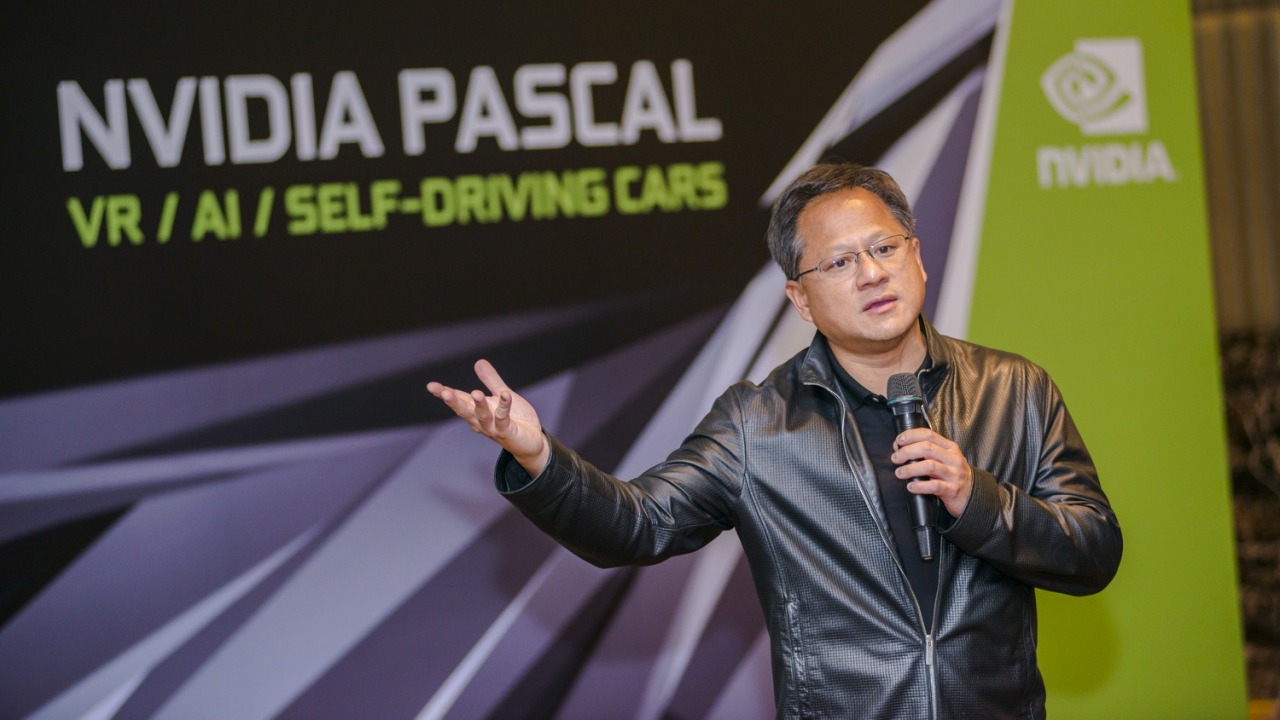
Nvidia chief executive Jensen Huang has vaulted into the ranks of the world’s wealthiest, riding a historic boom in demand for the chips that power artificial intelligence. His fortune has now climbed high enough to place him ninth globally, a shift that underscores how central Nvidia has become to the current technology cycle.
Huang’s rise is not just a story about one executive’s net worth, it is a shorthand for the market’s conviction that Nvidia sits at the heart of the AI build‑out. As investors crowd into the company’s stock and customers race to secure its processors, the scale and speed of his wealth gains have turned into a barometer for the broader AI economy.
The market surge that remade Jensen Huang’s fortune
I see Huang’s new standing among global billionaires as the direct result of a stock market revaluation that has treated Nvidia less like a cyclical chipmaker and more like core infrastructure for AI. Over the past year, Nvidia’s share price has climbed sharply as hyperscale cloud providers, enterprise software vendors, and AI start‑ups have competed for its high‑end accelerators, lifting the company’s market capitalization into the multi‑trillion‑dollar range and transforming the value of Huang’s equity stake in the process. That rally has pushed his personal fortune into the top tier of global wealth rankings, placing him ninth worldwide based on the latest tallies of billionaire net worth.
The mechanics behind that leap are straightforward: Huang owns a significant block of Nvidia shares, and the company’s market value has expanded faster than almost any other large‑cap stock. As AI spending has accelerated, Nvidia’s quarterly revenue and profit have repeatedly beaten expectations, reinforcing investor confidence and driving further gains in the share price. Those compounding moves have added tens of billions of dollars to Huang’s net worth in a relatively short window, according to real‑time wealth trackers, and they explain how a founder who spent decades outside the public spotlight is now grouped with the world’s richest individuals.
How Nvidia became the indispensable AI supplier
Huang’s wealth ranking only makes sense when I look at how Nvidia has come to dominate the market for AI accelerators. The company’s graphics processing units, originally designed for gaming, turned out to be exceptionally well suited for training and running large neural networks, and Nvidia spent years building a software ecosystem around those chips. That combination of hardware and tools has given it a commanding share of the data center AI market, with its H100 and successor platforms widely cited in industry reporting as the default choice for training large language models and other advanced systems, according to detailed breakdowns of AI chip market share.
As cloud providers and enterprises have scaled up AI clusters, they have ordered entire generations of Nvidia products in bulk, from A100 and H100 accelerators to networking gear and software licenses. That demand has produced explosive growth in Nvidia’s data center segment, which now accounts for the vast majority of its revenue and profit, and has turned the company into a critical supplier for firms building generative AI services. Industry analyses of hyperscaler spending show that capital expenditure plans at companies such as Microsoft, Alphabet, Amazon, and Meta are heavily skewed toward AI infrastructure, with a large portion earmarked for Nvidia hardware, a pattern that helps explain the company’s revenue trajectory and Huang’s resulting wealth gains as documented in earnings coverage.
From engineer to billionaire: Huang’s long road to the top
What makes Huang’s new position among the ultra‑rich striking to me is how long his journey has been compared with many of today’s tech billionaires. He co‑founded Nvidia in the early 1990s, spent years battling for relevance in the graphics market, and guided the company through multiple industry cycles before AI finally turned its architecture into the sector’s most coveted asset. Profiles of his career describe a hands‑on engineer who bet early that programmable GPUs could handle general‑purpose computing tasks, a conviction that looked niche at the time but laid the groundwork for Nvidia’s later AI dominance, as detailed in long‑form reporting on his background.
That history matters because it shows Huang’s fortune is tied to a decades‑long strategy rather than a short‑term windfall. He has kept a large equity stake, accepted periods of volatility when gaming or crypto markets softened, and continued to push Nvidia into new workloads such as autonomous driving, scientific computing, and now generative AI. Biographical accounts note that he has consistently framed Nvidia as a “full‑stack” computing company, investing in CUDA software, developer tools, and research partnerships that made its hardware more valuable over time, a pattern that helps explain why the market is now assigning such a premium to the business and, by extension, to his holdings, according to company histories.
What Huang’s wealth says about the AI boom
Huang’s ascent into the global top ten is also a signal about where investors believe the next wave of economic value will come from. When a chip designer’s net worth rivals that of long‑entrenched magnates in retail, energy, or finance, it reflects a conviction that AI infrastructure is the new backbone of growth. Market commentary around Nvidia’s valuation often highlights that its earnings are tied directly to the build‑out of AI data centers, which are expected to require sustained capital spending over multiple years, a thesis that underpins bullish forecasts in AI infrastructure research.
At the same time, I see Huang’s ranking as a reminder of how concentrated the financial upside of the AI boom has been so far. While Nvidia’s chips enable a wide range of applications, from chatbots to drug discovery, the largest gains have accrued to a small set of platform companies and their top executives. Analysts tracking the sector have pointed out that a handful of firms control the majority of AI compute capacity and model development, raising questions about competition, pricing power, and who ultimately benefits from productivity improvements, concerns that are increasingly visible in policy studies on AI concentration.
Risks that could reshape Nvidia’s dominance and Huang’s ranking
For all the momentum behind Nvidia and Huang’s fortune, I view his new status as far from guaranteed. The AI hardware market is drawing intense competition from rivals designing their own accelerators, including custom chips at major cloud providers and alternative architectures from other semiconductor companies. Regulatory scrutiny is also rising, with governments examining export controls on advanced processors and potential antitrust issues around AI infrastructure, dynamics that could affect Nvidia’s growth path and are already influencing forecasts in export control coverage and antitrust analysis.
There is also the basic market risk that AI spending could slow or shift toward more cost‑efficient solutions, compressing margins for high‑end chips. If customers diversify their suppliers or move more workloads to in‑house designs, Nvidia’s pricing power could weaken, which would feed directly into its share price and Huang’s net worth. Financial analysts already model scenarios where growth moderates from its current pace, and they note that any disappointment in AI demand or supply constraints could trigger sharp corrections in highly valued stocks like Nvidia, a possibility that features prominently in AI investing risk reports.
The broader implications of a chip designer in the global top ten
Seeing a semiconductor executive ranked ninth among the world’s richest people crystallizes how much the economic center of gravity has shifted toward compute. For decades, the most visible fortunes were built on consumer brands, real estate, or traditional industrial empires; Huang’s rise reflects a world where the ability to supply AI processing power is just as valuable as controlling oil fields or retail chains. That shift is already influencing how universities train engineers, how governments think about industrial policy, and how investors allocate capital, trends that are documented in global growth studies focused on AI.
I also see Huang’s trajectory as a case study in how technical vision, patient capital, and platform strategy can compound over time. Nvidia’s bet on programmable GPUs and its decision to build a full software stack around them did not pay off overnight, but in the AI era those choices have created a powerful moat that markets are now rewarding at an unprecedented scale. Whether his wealth ranking ultimately rises or falls, the fact that an engineer who spent years refining graphics chips now sits among the world’s richest underscores how central AI infrastructure has become to the global economy, a reality that is likely to shape technology and policy debates for years to come, as reflected in ongoing AI economy discussions.
More From TheDailyOverview
- Dave Ramsey warns to stop 401(k) contributions
- 11 night jobs you can do from home (not exciting but steady)
- Small U.S. cities ready to boom next
- 19 things boomers should never sell no matter what

Grant Mercer covers market dynamics, business trends, and the economic forces driving growth across industries. His analysis connects macro movements with real-world implications for investors, entrepreneurs, and professionals. Through his work at The Daily Overview, Grant helps readers understand how markets function and where opportunities may emerge.

