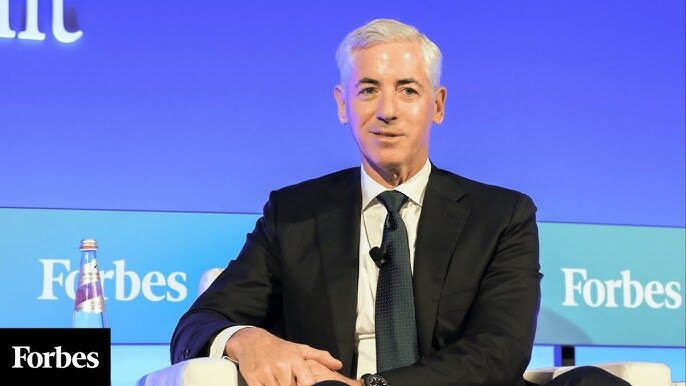
Bill Ackman is preparing to bring a new Pershing Square vehicle to public markets, targeting a $5 billion initial public offering for a U.S. listed closed-end fund that would give everyday investors access to his concentrated style of stock picking. The structure is designed to sit permanently on the market rather than face daily redemptions, and it comes with an unusual twist: a pool of free shares meant to reward early backers and align them with Pershing Square’s long term ambitions.
The move signals a renewed push by Ackman to scale his asset management platform in the United States after earlier attempts stalled, and it lands at a moment when investors are hunting for differentiated equity exposure in a volatile rate environment. By pairing a large IPO target with a sweetener that hands out additional stock, he is effectively testing whether the Pershing Square brand can overcome the skepticism that has dogged closed-end funds in recent years.
How the $5 billion Pershing vehicle is structured
At the core of the plan is a U.S. listed closed-end fund that Ackman intends to float with a $5 billion IPO, a size that would immediately place it among the largest offerings in the asset management space. The fund is expected to follow Pershing Square’s familiar playbook of concentrated bets in a limited number of companies, but unlike a traditional hedge fund, its shares would trade on an exchange under a permanent capital structure. Reporting on Nov 24, 2025 indicated that Bill Ackman plans a $5B IPO for this U.S. listed closed-end fund, positioning it as a flagship for Pershing Square Capital.
The design matters because closed-end funds do not have to meet daily redemptions, which gives managers more freedom to hold illiquid positions or ride out volatility without forced selling. For investors, that stability comes with a trade off, since the shares can swing to premiums or discounts relative to the underlying portfolio. By aiming for a large float from the outset, Ackman is effectively betting that scale and liquidity will help keep the trading price closer to net asset value, while the association with Pershing Square Capital’s existing franchise may help anchor demand for the IPO.
The free share sweetener and partner strategy
What sets this offering apart is the decision to add a sweetener in the form of free stock, a tactic more common in promotional retail deals than in blue chip asset managers. According to reporting on Nov 24, 2025, the firm’s partners are reportedly planning to offer up to a pool of free shares as part of the deal, effectively giving early investors an extra slice of equity in the new fund. The same coverage noted that Bill Ackman Targets $5B IPO For New US Fund, With Some Free Shares As Sweetener, Report described the free share component as a deliberate attempt to make the launch more attractive to both institutional and retail buyers.
In practical terms, that means Pershing Square’s partners are not just raising capital, they are also giving up a portion of their own economics to seed goodwill and create a broader base of aligned shareholders. For a closed-end fund that will live or die on secondary market trading, that alignment is crucial, because a loyal investor base can help support the share price during periods when sentiment turns against the strategy. By explicitly tying the free shares to the IPO process, Ackman is signaling that he wants long term holders who are willing to ride through volatility rather than short term traders chasing a quick pop.
Ackman’s renewed push after Pershing Square USA
This is not Ackman’s first attempt to bring a large U.S. vehicle to market, and the history matters for understanding why he is returning with a different structure. After filing the prospectus in early 2024, Ackman ended funding for Pershing Square USA and withdrew its IPO in July, a retreat that underscored how difficult it can be to sell new listed funds when markets are jittery. Reporting on Nov 21, 2025 noted that After filing the prospectus in early 2024, Ackman ended funding for Pershing Square USA and withdrew its IPO in July, shrinking the scale of his earlier ambitions from a reported $25 billion to $2 billion.
That experience appears to have shaped the current plan in two ways. First, the new vehicle is framed explicitly as a closed-end fund, which gives it a clearer identity and a more predictable capital base than a more open-ended structure. Second, the inclusion of free shares and a more modest $5 billion target suggests Ackman has calibrated his expectations to what the market is willing to absorb, while still aiming for a size that can move the needle for Pershing Square Capital. By acknowledging the setback with Pershing Square USA and pivoting to a structure that better matches investor appetite, he is effectively treating the earlier withdrawal as a dress rehearsal rather than a dead end.
Market timing, rates backdrop, and investor appetite
The timing of the planned IPO is not accidental, coming as investors reassess risk assets in the wake of shifting interest rate expectations. Coverage on Nov 24, 2025 that discussed Ackman’s plans for a Pershing closed-end fund IPO appeared alongside commentary that mortgage rates fall off a cliff to a 3 year low, highlighting how quickly the rate environment has changed. The same reporting noted that Bill Ackman said to eye $5B for Pershing closed-end fund IPO as mortgage rates fall off a cliff, a juxtaposition that underscores the broader shift from defensive positioning back toward growth and equity risk.
Lower borrowing costs tend to support equity valuations, particularly for the kind of high quality, cash generative companies that Pershing Square has historically favored. For a closed-end fund, that backdrop can be especially helpful, since it increases the odds that the underlying portfolio will appreciate in the years after the IPO, which in turn can narrow any discount to net asset value. At the same time, the volatility that accompanies rapid rate moves can make investors more cautious about new issues, which is why the combination of a recognizable manager, a large but not outsized deal size, and a free share incentive could prove decisive in getting the book built.
What the deal means for Pershing Square and public investors
If the IPO succeeds at the targeted $5 billion level, it will mark a significant expansion of Pershing Square Capital’s permanent capital base and deepen its footprint in the U.S. public markets. For Ackman, it would validate the idea that a hedge fund style strategy can be packaged in a closed-end format that is accessible to a wide range of investors, not just institutions and ultra wealthy clients. The reporting that Bill Ackman, IPO, Pershing Square Capital are all tied together in this new listing underscores how central the offering is to his broader business strategy.
For public investors, the fund offers a rare chance to buy into a manager with a long record of high profile activist campaigns through a simple stock purchase, but it also comes with the usual caveats that surround closed-end funds. Discounts to net asset value can persist for years, leverage can amplify losses as well as gains, and the liquidity of the shares does not guarantee an easy exit at a favorable price. The decision to include free shares and to lean on the Pershing brand suggests Ackman is acutely aware of those concerns and is trying to stack the deck in favor of a strong aftermarket. Whether that is enough will depend on how investors weigh the appeal of a $5 billion Pershing vehicle against the structural quirks that have long made closed-end funds a niche corner of the market.
More From TheDailyOverview
- Dave Ramsey warns to stop 401(k) contributions
- 11 night jobs you can do from home (not exciting but steady)
- Small U.S. cities ready to boom next
- 19 things boomers should never sell no matter what

Grant Mercer covers market dynamics, business trends, and the economic forces driving growth across industries. His analysis connects macro movements with real-world implications for investors, entrepreneurs, and professionals. Through his work at The Daily Overview, Grant helps readers understand how markets function and where opportunities may emerge.

