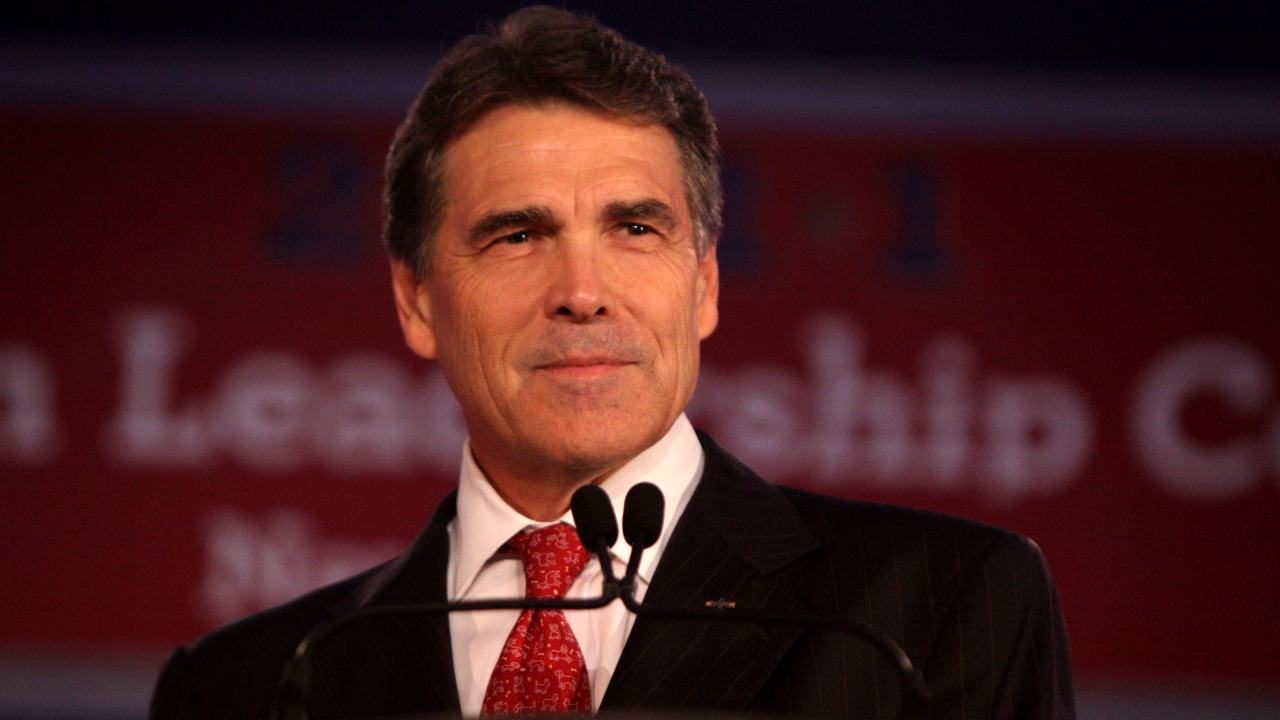
Venezuelan crude is once again steaming toward U.S. refineries, and President Donald Trump is turning that flow into a centerpiece of his energy agenda. As the administration asserts control over Venezuela’s vast reserves and promises billions of dollars in new investment, Former Energy Secretary Rick Perry is publicly cheering the strategy as proof that Trump’s long‑promised energy dominance is finally being realized.
What is unfolding is more than a one‑off shipment deal. It is a sweeping attempt to fuse foreign policy, military power and oil market leverage into a single project, one that hands Washington direct authority over Venezuela’s exports while promising cheap barrels for American drivers and refiners. I see Perry’s praise as a window into how Trump’s allies want to frame this moment: not as a messy intervention, but as a “great victory” for U.S. energy security and geopolitical clout.
Rick Perry’s full‑throated endorsement of Trump’s oil gamble
Former Energy Secretary Rick Perry has moved quickly to cast the new Venezuelan crude flows as validation of Trump’s broader energy vision. In a recent appearance with Varney, Former Energy Secretary Rick Perry joined “Varney & Co.” to talk about Venezuelan oil flowing to the U.S., President Donald Trump’s strategy and what he sees as the growing threat from China, praising the White House for seizing an opportunity that previous administrations let slip. By tying the arrival of Venezuelan barrels directly to Trump’s leadership, Perry is helping the president sell the deal as a deliberate strategic win rather than a desperate response to tight markets.
Perry’s comments also echo his long‑standing preference for an expansive, supply‑side approach to energy. When he ran the Department of Energy, he often argued that more production from more places would strengthen the U.S. hand abroad, and his latest remarks fit that pattern by treating Venezuelan crude as one more lever in a global competition that includes Beijing. In that Varney segment, he framed Trump’s approach as a coherent “strategy” rather than a one‑off bargain, aligning the Venezuelan move with the administration’s wider push to counter China’s influence in commodity markets and along key shipping routes, a narrative that resonates with Republican voters who see energy as a national security tool.
From “all of the above” to Venezuela: Perry’s energy doctrine comes home
Perry’s enthusiasm makes more sense when I place it against his earlier record promoting an “all of the above” energy doctrine. During Energy Week in Washington, he touted an approach that embraced fossil fuels, nuclear and renewables alike, arguing that what the administration did in the early days was about unleashing every domestic resource to achieve what he called energy dominance. That Energy Week push, which came just as the Trump team signaled a notable shift in its energy posture, laid the rhetorical groundwork for treating oil, gas and coal as instruments of power rather than mere commodities, and it is the same logic now being applied to Venezuelan reserves.
Back then, Perry’s message was that the United States should never again be constrained by foreign producers, and that “what we did in the first few months” of the Trump presidency was only the beginning of a longer project to reshape global markets. By applauding the decision to bring Venezuelan barrels under U.S. control, he is effectively extending that Energy Week doctrine beyond America’s borders, suggesting that energy dominance can include supervising another country’s exports when it serves U.S. interests. The continuity between his earlier “all of the above” rhetoric and his current praise underscores how Trump’s allies see the Venezuela move as a natural evolution of a strategy that started with deregulation at home and is now reaching deep into Latin America.
Trump’s $3 billion Venezuelan oil windfall and the 50 m barrel pledge
The centerpiece of Trump’s pitch is a headline‑grabbing promise of cheap foreign crude. President Donald Trump has said that Venezuela will relinquish as much as 50 million barrels of oil to the United States, a shipment he values at up to $2.8 billion and has described as a $3 billion windfall for American taxpayers. In his own messaging, Trump has framed the deal as proof that his hard line on Caracas and his willingness to deploy U.S. power have produced tangible returns, presenting the 50 m barrel figure as both an economic boon and a symbol of restored American leverage in the Western Hemisphere.
That pledge dovetails with independent estimates that The US will import 30 to 50 mbl of Venezuela crude oil worth around $2 billion, a volume that would amount to roughly 1 percent of global production and give refiners on the Gulf Coast a new stream of heavy crude they have struggled to replace. Venezuela and the United States, according to that same assessment, would have reached an arrangement that channels this oil into U.S. markets while keeping formal ownership questions murky, a structure that allows Trump to claim victory at home while maintaining pressure on Caracas. The scale of the shipments may be modest in global terms, but politically, the president is treating every barrel as evidence that his confrontational approach pays off.
Washington’s new grip on Venezuela’s oil exports
Behind the headline numbers lies a more radical shift: Washington is no longer just sanctioning Venezuela’s oil sector, it is taking charge of it. U.S. officials have said they will control Venezuela oil exports indefinitely, a plan that aligns with the Trump administration’s push for American energy companies to rebuild Venezuela’s decaying infrastructure while sanctions are selectively rolled back on the sector. By asserting that this control will last without a clear end date, the White House is signaling that access to export markets will now run through Washington, not Caracas, giving Trump a powerful lever over both Venezuelan politics and global supply.
The operational details of that control have been spelled out by Energy Secretary Chris Wright, who has outlined a U.S. plan to take charge of Venezuelan oil sales and route the proceeds into accounts controlled by Washington. In his description, the Energy secretary presented this as a radical shift aimed at restarting crude flow while ensuring that revenue does not reach the old power structures in Caracas, effectively turning Venezuelan exports into a program supervised by the U.S. government. This architecture allows Trump to claim that he is letting Venezuela’s oil “flow” while still deciding where the money goes, a balance that appeals to hawks in his party who want maximum pressure without sacrificing barrels.
How Energy Secretary Wright says the money will move
Energy Secretary Wright has become the public face of the administration’s argument that this is not a simple resource grab but a managed transition. Wright has said the U.S. will let Venezuela’s oil “flow” and send proceeds back, describing a system in which sales are overseen by Washington and the resulting funds are placed into accounts that can be used for reconstruction and humanitarian needs. In that account, Wright, speaking alongside figures such as Bruce, Nicholas Kerr and Elizabeth Sch, framed the arrangement as a way to stabilize Venezuela while preventing corrupt networks from siphoning off the cash, a narrative designed to blunt criticism that the U.S. is simply looting a weaker country.
At the same time, the structure he describes keeps ultimate authority in American hands. By insisting that revenues be held in accounts controlled by Washington, and by tying any disbursement to benchmarks set by the U.S., Wright is effectively turning Venezuelan oil into a trust managed from afar. That approach mirrors the broader plan he laid out when Energy Secretary Chris Wright detailed U.S. supervision of Venezuelan oil sales, explaining that the government in Washington would oversee contracts, monitor shipments and decide how and when money is released. For Trump, this arrangement offers a way to claim both moral high ground and hard‑nosed advantage, while for Perry it is further proof that the administration is using energy policy as a tool of statecraft.
“We built Venezuela’s oil industry”: Trump’s narrative of ownership
Trump has not been shy about casting the U.S. role in Venezuela’s oil sector in sweeping, almost proprietary terms. In one of his most pointed claims, he declared that “WE BUILT VENEZUELA’S OIL INDUSTRY,” presenting the United States as the architect of a sector that now holds the largest proven reserves in the world and arguing that Washington is simply reclaiming what it helped create. That message, amplified in coverage that notes how the US now controls Venezuela’s oil reserves, the largest in the world, is aimed squarely at voters who see foreign resources as fair game when American know‑how and capital were involved in their development.
Supporters have echoed that framing. A Former Miami mayor has praised what he called a “flawlessly executed” operation around Maduro’s capture, tying it directly to Trump’s vow that U.S. energy would return to Venezuela and insisting that the president is focused on one thing, keeping America safe. In that telling, the intervention is not an invasion but a restoration, a way of bringing back an industry that Trump says he helped build and then watched collapse under hostile leadership. By leaning on this narrative of prior ownership, the White House is trying to recast a controversial military and economic intervention as a kind of homecoming for U.S. energy interests.
Invasion, sanctions and the Department of Energy’s selective rollback
Critics, however, see a very different story, one in which Trump is trying to fix an industry he helped break. Reporting on the ground has described how Trump invaded Venezuela to restore an oil industry he helped destroy, noting that his earlier sanctions and threats of a “military option” contributed to the sector’s collapse before the current push to rebuild it. On Wednesday, Trump’s Department of Energy put out a fact sheet stating that the U.S. is “selectively rolling back” sanctions on the Venezuelan oil sector, a move that underscores how the administration is now loosening restrictions it once championed in order to get the barrels and influence it wants.
That selective rollback is central to the new strategy. By lifting some constraints while keeping others in place, the Department of Energy is trying to thread a needle between punishing past behavior and enabling future production, a balance that allows Trump to claim toughness even as he opens the door to new deals. The fact sheet, issued by Trump’s own Department of Energy, makes clear that sanctions relief is not across the board but targeted at projects and partners that align with U.S. goals, a design that gives Washington maximum flexibility to reward compliance and punish defiance. For opponents of the intervention, this sequence of destroy and rebuild looks less like principled policy and more like a cycle of manufactured crisis and managed recovery.
Chevron, PDVSA and the corporate scramble for Venezuelan barrels
While the White House sets the political terms, companies are racing to secure their own positions in the new landscape. Chevron has sought a broader U.S. license to boost Venezuelan oil exports, pushing for an expanded authorization that would allow it to work more directly with PDVSA, the state‑owned corporation responsible for exploration, production, refining and exporting of oil in the country. In that request, Chevron is effectively betting that Washington’s new control regime will be durable enough to justify fresh investment, and that partnering with PDVSA under U.S. supervision will be more profitable than staying on the sidelines.
The company’s move highlights how corporate interests are aligning with Trump’s geopolitical project. An expanded license would let Chevron help restart fields, upgrade refineries and restructure parts of Venezuela’s oil sector, all while operating under the umbrella of U.S. sanctions policy and security guarantees. For PDVSA, access to a major American partner offers a path out of isolation, even if it means ceding significant control to Washington and its chosen firms. For the administration, having a player like Chevron deeply embedded in Venezuelan operations strengthens the argument that this is a serious, long‑term effort to rebuild capacity rather than a short‑term raid on existing stockpiles.
Reimbursements, “great victories” and the politics of cheap oil
Trump is not only promising barrels, he is also dangling financial backstops to entice U.S. companies into Venezuela’s risky environment. President Donald Trump has said the U.S. government could reimburse oil companies that invest billions of dollars to rebuild Venezuela’s shattered infrastructure, a pledge that effectively socializes some of the risk while privatizing potential profits. By offering to use federal funds to cover losses if projects go sour, he is signaling to firms that Washington will stand behind them as they navigate a country still emerging from conflict and economic collapse.
All of this is being wrapped in triumphal political messaging aimed at voters who feel squeezed by energy costs. In a widely shared clip, supporters described the Venezuela deal as a “great victory” for Trump and the American people, crediting the president with working to revitalize America’s energy landscape, including boosting domestic drilling and lowering oil prices. That framing, captured in a video that lauds Trump for reshaping America’s energy landscape, is central to his reelection pitch: that he alone can deliver both cheap fuel and geopolitical wins. For allies like Perry, the combination of reimbursements for industry and lower pump prices for consumers is the ultimate proof that Trump’s energy plan is working exactly as intended.
More From TheDailyOverview

Grant Mercer covers market dynamics, business trends, and the economic forces driving growth across industries. His analysis connects macro movements with real-world implications for investors, entrepreneurs, and professionals. Through his work at The Daily Overview, Grant helps readers understand how markets function and where opportunities may emerge.

