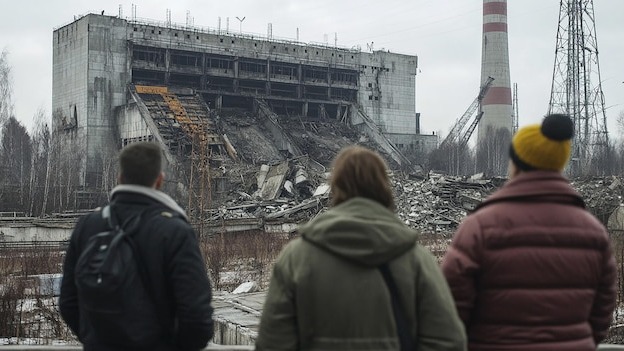
Russia is entering a phase of economic stress that looks less like a normal downturn and more like a structural breakdown, with war spending crowding out civilian life and growth prospects. Output is barely expanding, inflation is accelerating, and the financial system is creaking under the weight of a war economy that increasingly resembles the late Soviet model of guns over butter. The result is a fragile equilibrium that can hold for a while, but at the cost of deepening distortions that will be far harder to unwind later.
The parallels with the USSR’s final years are not just rhetorical. Military and security priorities dominate the budget, oil and gas revenues are shrinking under sanctions, and policymakers are leaning on high interest rates and tax hikes that suppress private investment. The Kremlin’s long‑range planning to 2042 is presented as proof of stability, yet the numbers point to an economy that is cannibalizing its future to sustain a grinding war in the present.
War spending and the return of a command‑style economy
The core driver of Russia’s current predicament is the decision to run the state as a war machine first and an economy second. NATO Secretary General Mark Rutte has warned that NATO Secretary General Mark Rutte said Russia is now spending “nearly 40% of its budget on aggression,” a figure that would have looked familiar to Soviet planners. When such a large share of public money is locked into the military and security apparatus, everything from healthcare to infrastructure becomes a residual category, funded only after the war’s needs are met. That is exactly how late Soviet stagnation hardened into collapse.
The war itself is not delivering quick victories that might justify this sacrifice. Analysts describe how, in the Pokrovsk offensive, Russian forces are advancing remarkably slowly, consuming vast quantities of ammunition, equipment, and manpower for marginal territorial gains. This is the classic trap of a grinding war: costs compound while benefits arrive, if at all, in inches. Economically, it means the state must keep pouring resources into a front that does not generate new revenue, only new obligations, from veterans’ care to equipment replacement.
Stagnant growth, rising inflation, and a squeezed population
On the surface, headline growth figures still show a positive number, but the trend is sharply negative. Official data cited by NHK report that Russia’s gross domestic product in 2025 increased by 1 percent, with Russia’s GDP growing by 1% in 2025, a major slowdown from earlier war‑time spikes driven by emergency defense orders. The International Monetary Fund has already cut its outlook, with The International Monetary Fund on Monday lowering its forecast for Russia’s 2026 growth to 0.8%, well below the Russian Finance Ministry’s own projection. That kind of near‑stall speed is dangerous for a country that is simultaneously fighting a large‑scale war and trying to maintain living standards.
Inflation is eroding those standards even faster. The Russian Central Bank has warned that Russia’s economy is expected to experience accelerated inflation as the government raises the value‑added tax, with the Russian Central Bank highlighting the impact of the higher Value Added Tax (VAT) on prices. Earlier this year, analysts in Feb noted that the surge in consumer prices is primarily attributed to the Value Added Tax hike from 20% to 22%, with the Value Added Tax increase feeding systemic inflation and wage stagnation. For ordinary households, this means pay packets that look the same on paper but buy less food, fuel, and medicine, a pattern that again echoes the late Soviet squeeze.
Oil, sanctions, and the shrinking war chest
For two decades, oil and gas exports acted as Russia’s macroeconomic shock absorber, cushioning downturns and funding both social spending and military modernization. That cushion is now thinning. Detailed analysis shows that Russia’s oil and gas revenues are shrinking as sanctions bite, with the central bank forced to keep interest rates high, cutting the key rate only to 16 percent at its final board meeting of 2025 and projecting inflation of up to 11 percent in 2025–2026, according to Jan reporting. High rates may slow price growth at the margin, but they also choke investment and make it harder for businesses to refinance debt, especially outside Moscow.
External pressure is compounding the problem. New punitive measures from the U.S. and the EU, combined with President Donald Trump’s tariff pressure against Russian energy, have already produced lowered cash flows, with Lowered export revenues estimated in the billions of dollars compared with pre‑war levels. When a war‑dependent budget loses its main hard‑currency lifeline, the state has only a few options left: raid reserves, borrow more domestically, or quietly let the currency slide. Each path carries its own risks for financial stability and public trust.
Banking stress, corporate non‑payment, and the risk of a financial break
Behind the macro numbers, the plumbing of the financial system is starting to rattle. A leading Russian economist interviewed in Feb warned that the country faces a potential banking crisis and budget collapse in 2026, stressing that “this is not a classic bank run” but a more complex squeeze involving liquidity, sanctions, and war‑driven fiscal deficits, according to The CMA. When the state is borrowing heavily at high interest rates to fund the war, banks are tempted to load up on government paper instead of lending to the real economy, which in turn starves businesses of credit.
Corporate Russia is already showing the strain. Analysts note that the main issue for companies in 2026 is likely to be non‑payment by counterparties, with many Russian firms encountering difficulties servicing their debt, a trend highlighted in Its assessment of stormy economic conditions. Business sentiment surveys compiled by Maxim Blant, an Economic commentator at Radio Free Europe/Radio Liberty, show that expectations are now almost as pessimistic as during the pandemic, with Maxim Blant warning that only aggressive policy changes can avoid an acute general crisis. If non‑payments cascade through supply chains while banks tighten lending, the system can seize up in ways that are hard to control, much like the late Soviet arrears crisis that paralyzed factories even before the political collapse.
Human capital drain and the hidden cost of casualties
War is not only expensive in rubles, it is devastating in human capital. Reporting by Tom Chivers notes that Russia’s battlefield casualties are rising, with estimates of killed and wounded reaching into the hundreds of thousands and the death rate per 1,000 troops reportedly about five times US levels, according to Tom Chivers. Every soldier killed or maimed is also a worker, a parent, a taxpayer who will not contribute to the economy in the same way again. The state must then spend more on recruitment, training, and compensation, further swelling the war‑related share of the budget.
At the same time, Russia’s demand for fresh capital is huge and insatiable, with analysts warning that the war has swallowed most of the funds needed to maintain basic infrastructure and that millions of skilled Russians have left the country, including about 1 million Russians in Germany alone, as highlighted in Russia’s demand assessment. This combination of battlefield losses and brain drain is a slow‑burn disaster for productivity and innovation. It is one thing to rebuild a bridge or a factory; it is far harder to replace a generation of engineers, doctors, and entrepreneurs who have either died at the front or built new lives abroad.
More From The Daily Overview
*This article was researched with the help of AI, with human editors creating the final content.

Grant Mercer covers market dynamics, business trends, and the economic forces driving growth across industries. His analysis connects macro movements with real-world implications for investors, entrepreneurs, and professionals. Through his work at The Daily Overview, Grant helps readers understand how markets function and where opportunities may emerge.

