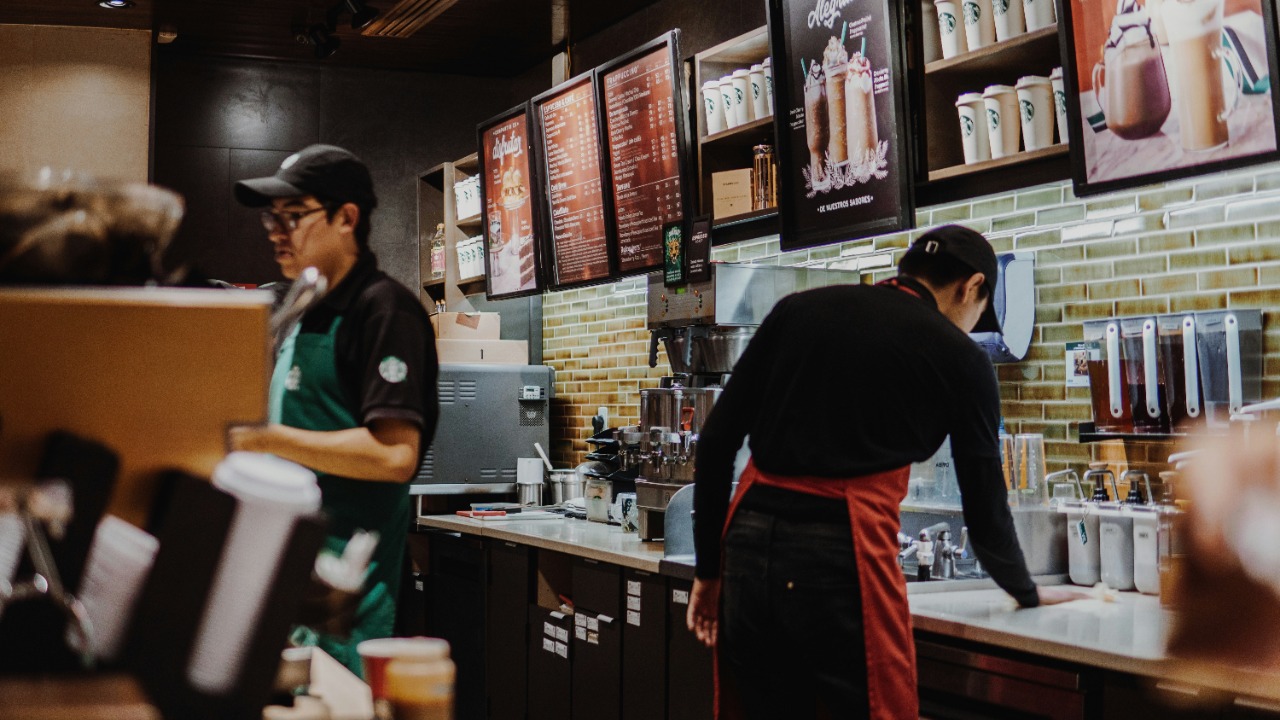
Starbucks is quietly turning one of corporate America’s most ambitious education perks into a central pillar of its talent strategy, expanding a free bachelor’s degree benefit just as enrollment jumps 60%. The company is betting that paying for a first-time Bachelor will not only change workers’ lives but also harden its own pipeline of future managers at a moment when frontline retention is under pressure across the service industry.
As more baristas and shift supervisors discover that a four-year degree is suddenly within reach, the program is evolving from a feel-good benefit into a competitive advantage. I see the latest surge in participation as a signal that workers are recalibrating what they expect from hourly jobs, and that Starbucks is willing to spend real money to keep them.
Starbucks’ free bachelor’s program hits a new scale
The most striking development is the sheer pace of growth. Enrollment in Starbucks’ free college program has surged by 60%, a jump that would be notable for any university, let alone a benefit tied to a coffee chain. That kind of spike suggests the offer is resonating far beyond a niche group of early adopters and is instead becoming a mainstream path for workers who might otherwise see little connection between a café job and a college diploma.
Starbucks is not just keeping the program alive, it is doubling down on it as a core part of its employment brand. The company has framed the benefit as a way to earn a first-time Bachelor without tuition, positioning the program as a bridge between hourly work and long term economic mobility. In a labor market where service jobs are often seen as dead ends, I read this expansion as a deliberate attempt to redefine what a barista role can lead to, both inside and outside the company.
How the Starbucks College Achievement Plan actually works
At the center of this strategy is the Starbucks College Achievement Plan, a partnership that routes employees into online degree programs while they keep working. The company describes the Starbucks College Achievement Plan as a way for eligible workers to pursue a first-time Bachelor through Arizona State University’s online campus, with Starbucks covering tuition so employees can focus on coursework rather than debt. The official program hub lays out how the benefit is structured, from admissions to graduation, and underscores that this is not a one-off scholarship but an ongoing pathway for thousands of workers through the dedicated Starbucks College Achievement Plan site.
The academic side of the partnership is anchored at Arizona State University, which has built a dedicated portal for Starbucks partners that explains degree options, admissions steps, and support resources. On that portal, Starbucks employees can explore majors, connect with enrollment coaches, and see how their work schedules can align with online classes through the tailored Starbucks ASU interface. In practice, this means a barista can clock out of a closing shift and log into a university platform that is explicitly designed around their employer’s benefit, rather than trying to navigate a generic college website on their own.
Degrees on offer and what “College, on Us” really covers
For workers, the promise is not just access to any coursework, but a clear path to a recognized credential. Starbucks markets the education benefit under the banner “Go to College, on Us * Choice Achieve a first-time Bachelor’s degree,” highlighting that employees can choose from more than 150 undergraduate programs online from Arizo State University. That breadth matters, because it means the program is not limited to business or hospitality; a barista with an interest in engineering, psychology, or digital media can find a track that fits their ambitions while still taking advantage of the same corporate funding.
The financial structure is unusually generous by corporate standards. The Starbucks College Achievement Plan is described as covering 100% of tuition and fees for over 140 online undergraduate degrees at Arizona State University, under the formal name The Starbucks College Achievement Plan, or SCAP. In other words, this is not a partial reimbursement that leaves workers scrambling to cover the rest; it is designed so that someone who qualifies can complete a full four-year program without taking on traditional tuition bills, a rare offer in the hourly wage world.
Who qualifies and how the benefit has evolved
Eligibility has always been a critical question, because a generous benefit that few can access is more marketing than substance. Earlier reporting on the collaboration between Starbucks and Arizona State University made clear that if you are a Starbucks member who works a minimum of 20 hours a week, you are eligible to apply for the Starbucks Col, a shorthand reference to the Starbucks College Achievement Plan that has circulated in coverage of the partnership. That threshold, captured in a profile of how Starbucks and ASU “brew new opportunities” for student workers, shows that the company is tying the benefit to sustained part-time or full-time engagement rather than limiting it to a narrow slice of corporate staff, as reflected in the description of the Starbucks member criteria.
Over time, the company has layered in more structure and support around that basic eligibility rule. The formal SCAP framework, which spells out that The Starbucks College Achievement Plan, or SCAP, covers 100% of tuition and fees for over 140 online undergraduate degrees at Arizona State University, signals that this is now a mature, codified benefit rather than a pilot. I see that evolution as a response to both employee demand and competitive pressure: as more retailers and restaurant chains dabble in tuition assistance, Starbucks is moving to lock in a reputation for offering a full degree pathway, not just a modest stipend.
Support systems that help workers actually graduate
Paying tuition is only half the battle; the other half is helping working adults survive the grind of juggling shifts, homework, and family obligations. Starbucks has leaned into that reality by highlighting the support network that surrounds participants in the Starbucks College Achievement Plan. In one program overview, the company emphasizes that as a scholar in the Starbucks College Achievement Plan, you have a robust support system that includes Fellow employees in your store and across the company, academic coaches, and other resources designed to keep students on track, a message that is showcased in a Starbucks College Achievement Plan social clip.
That emphasis on Fellow partners and peer encouragement is not just feel-good branding. For a barista who may be the first in their family to attend college, seeing coworkers navigate the same online platforms and deadlines can make the difference between persisting and dropping out. By framing the program as a community effort, with managers and teammates aware of exam weeks and project crunch times, Starbucks is trying to turn what could be an isolating online experience into something closer to a campus culture, just distributed across thousands of stores.
From barista to manager: why Starbucks is expanding the program
Behind the marketing language, there is a hard business logic to why Starbucks is expanding its free bachelor’s program just as enrollment spikes. Internal data shared through company channels indicates that Starbucks employees who are part of the Starbucks College Achievement Plan are promoted at a higher rate than their peers, a pattern highlighted in a short video that celebrates how the program feeds the company’s leadership ranks through the Starbucks College Achievement Plan lens. If SCAP participants are more likely to move into shift supervisor, store manager, or corporate roles, then the tuition checks start to look less like charity and more like a targeted investment in future leaders.
That same logic helps explain why Starbucks is comfortable scaling the benefit even as the cost per participant rises. When enrollment in the free college program jumps by 60%, the company is not just paying for more credits; it is also deepening a culture where ambitious workers see a long term path with the brand. I read the expansion as a signal that Starbucks believes the retention, promotion, and engagement gains from SCAP outweigh the expense, especially in a tight labor market where replacing a trained barista or store manager can be costly and disruptive.
More From TheDailyOverview

Grant Mercer covers market dynamics, business trends, and the economic forces driving growth across industries. His analysis connects macro movements with real-world implications for investors, entrepreneurs, and professionals. Through his work at The Daily Overview, Grant helps readers understand how markets function and where opportunities may emerge.