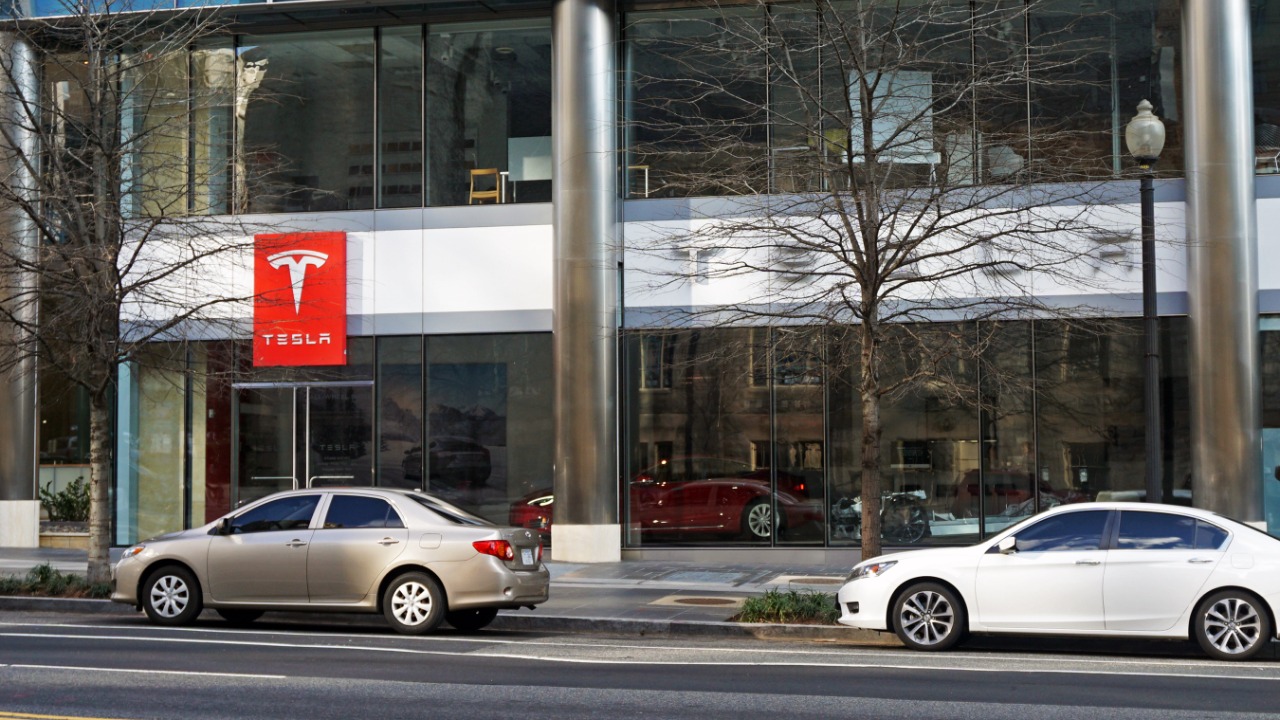
Tesla has stopped pretending that selling ever more cars is its main mission, and the market is scrambling to reprice what that means. After years of chasing volume at almost any cost, the company is now openly prioritizing margins, artificial intelligence and robotics over raw delivery growth, just as its electric vehicle sales stumble and rivals surge. That strategic surrender on car sales has left Wall Street split between those who see a high‑margin tech future and those who fear a shrinking core business with unproven new bets.
The shift comes as Tesla’s deliveries fall for a second straight year, its profits slide and its long‑held crown as the world’s top EV maker passes to a Chinese competitor. At the same time, Chief Executive Elon Musk is pouring tens of billions of dollars into robotaxis, autonomous software and humanoid robots that generate little revenue today, asking investors to look past deteriorating fundamentals and trust a vision that may take years to materialize.
From hypergrowth to retreat on volume
The clearest sign that Tesla Inc has stepped back from its old growth-at-all-costs playbook is in the delivery numbers. In its latest quarterly update, the company reported that vehicle deliveries declined 16% year over year, even as it highlighted improving profitability and a growing focus on artificial intelligence in its Q4 2025 slides. That is a sharp reversal for a company that once promised annual growth of 50% and built factories on multiple continents to chase it.
The production report for the same period underlines how far Tesla has pulled back. Deliveries stood at 406,585 Model 3/Y and 11,642 other models, for a total of 418,227 vehicles in the quarter, according to Tesla’s own Deliveries report. That capped a second consecutive year of falling volumes, a trend that one analysis captured bluntly in the line that Tesla’s Deliveries Have Fallen 2 Years.
Wall Street’s whiplash: margins up, growth down
Investors are now being asked to applaud efficiency gains while looking past shrinking unit sales, and the reaction has been volatile. One detailed breakdown of the quarter noted that margin gains helped offset the delivery decline as Tesla Inc leaned harder into software and automation in its factories, a shift that was highlighted in the company’s TSLA presentation. Another analysis framed the moment as “Efficiency Over Volume,” describing how Efficiency Over Volume and Margin Recovery had suddenly become the story that Tesla Shocks Wall Street with.
Yet the stock has been under pressure as investors digest what that tradeoff really means. One review of the quarter pointed out that as Near term hurdles pile up, Tesla’s automotive revenue and profits are moving in the wrong direction, with free cash flow down 30% year over year, a dynamic captured in the line that Near term hurdles are weighing on sentiment. Another investor note argued that, given the uncertainty, sitting out the stock for now “makes sense” after Management forecast 2026 capital expenditures to exceed $20 billion, more than double the roughly $9 billion spent the prior year, a warning flagged in a separate Management discussion.
Falling behind in the EV race
The strategic pivot is happening against a backdrop of eroding dominance in the core electric vehicle market. In 2025, the Chinese automaker BYD sold more than 2.25 m battery powered vehicles, while Tesla sold 1.65 million, according to figures cited in an analysis of how the Chinese group overtook its American rival. That same review noted that Tesla’s profits slumped 46% and that 2025 marked its second straight year of sales declines, underscoring how quickly the balance of power has shifted toward BYD.
Another report put a sharper political edge on the story, describing how Tesla No Longer World’s Biggest EV Maker a Customer Revolt Over Musk Politics. That account argued that backlash in the United States and Europe to Musk’s outspoken right wing views has hurt the brand, contributing to a loss of market share just as cheaper Chinese competitors flood global markets. A separate analysis of Tesla’s outlook echoed that theme, noting that Yet investors have already lived through a period when sour views on the company knocked a quarter off the stock in early 2025, even as Yet Tesla remained profitable.
Shutting car lines to chase robots and autonomy
Instead of doubling down on new mass market models to regain share, Tesla is winding down parts of its car business to free up capacity for robots. One manufacturing report detailed how the company plans to close down production of two car models and convert a California factory to produce Optimus robots, a move that will reshape its workforce and product mix in the state, according to California focused coverage. That same account noted that the company also plans to convert the site to produce Optimus robots, and quoted Bernard Condon describing how the shift fits into Musk’s broader ambition for humanoid robotics, with Elon Musk personally attending internal events to promote the project.
Strategically, this is part of a broader pivot that some analysts describe as Tesla’s attempt to become a “physical AI” platform rather than a traditional automaker. One investor commentary argued that autonomy and robotics had once again taken over the narrative after Q4, with Tesla, Inc’s physical AI platform overshadowing its weakening fundamentals. Another analysis of the company’s capital plans noted that Management is willing to spend more than $20 billion in 2026 alone to build out this future, even if that means years of heavy investment before robotaxis or Optimus generate meaningful cash, a risk flagged in a separate capital spending discussion.
Wall Street’s split personality on Tesla’s future
All of this leaves Wall Street in a state of cognitive dissonance about Tesla Inc. On one hand, analysts are increasingly skeptical of the company’s earnings power from cars as sales flatten and competition intensifies, a mood captured in a report that said Wall Street is giving off mixed signals about Tesla Inc and that Analysts are questioning whether the company can sustain its valuation on auto profits alone. On the other hand, the same report noted that the stock has at times risen even as the outlook for its sales deflates, a sign that investors are still willing to pay for the possibility that Tesla becomes a dominant player in software, autonomous transport and humanoid robotics.
Some bullish voices argue that the market is entering a “defining year” in which robotaxis and full self driving could finally justify Tesla’s tech premium. One forward looking assessment said that Analysts forecast Tesla deliveries will grow only modestly, but that the real upside lies in self driving robotaxis and autonomy, a view laid out in a detailed Tesla stock outlook. Another commentary framed the debate explicitly as whether TSLA Investors Even Care Amid the AI Pivot that Tesla’s Deliveries Have Fallen for 2 Years, arguing that the stock now trades more like a bet on artificial intelligence than on electric vehicles, a point made in a separate TSLA focused analysis.
More From TheDailyOverview
*This article was researched with the help of AI, with human editors creating the final content.

Elias Broderick specializes in residential and commercial real estate, with a focus on market cycles, property fundamentals, and investment strategy. His writing translates complex housing and development trends into clear insights for both new and experienced investors. At The Daily Overview, Elias explores how real estate fits into long-term wealth planning.

