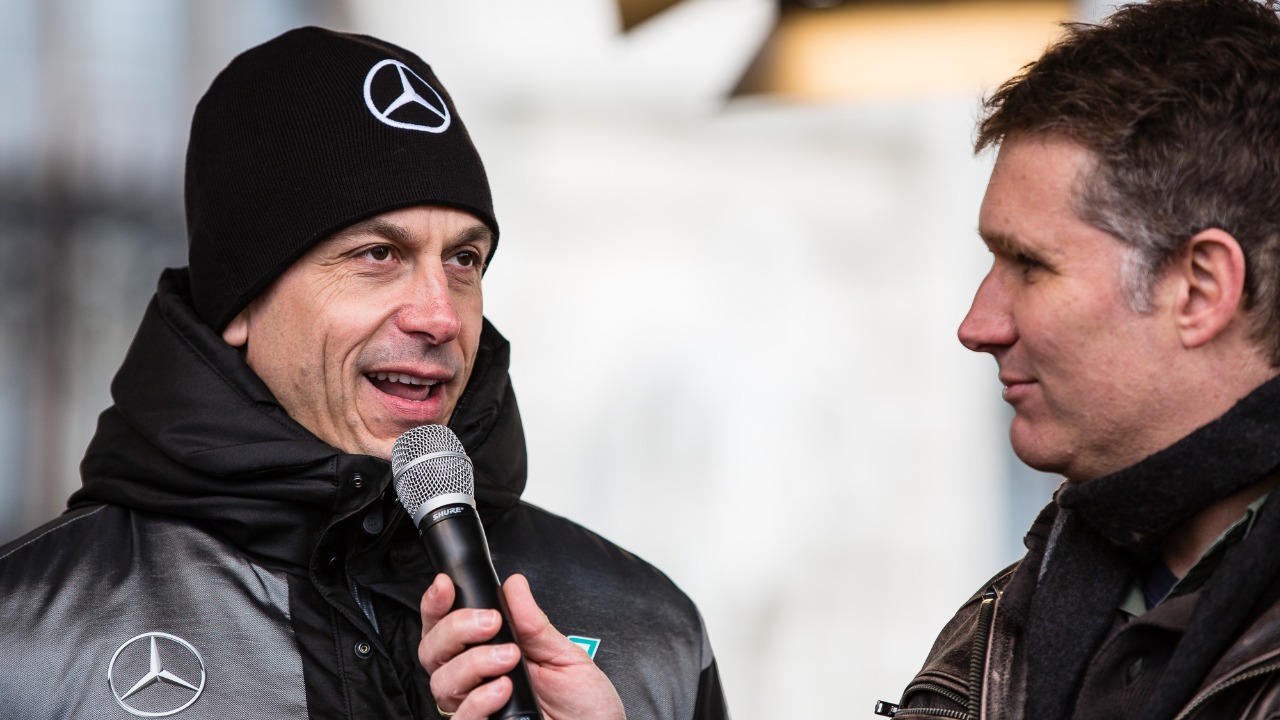
Toto Wolff has cashed in part of his long-held equity in Mercedes, selling a significant slice of his ownership to American billionaire George Kurtz while staying in charge of the Formula One operation. The move reshapes the shareholder map around one of the sport’s most successful modern teams without immediately disturbing Wolff’s role as team principal and CEO.
The deal gives a prominent United States investor a direct stake in a team that has defined the hybrid era, and it lands at a moment when Formula One is pushing harder than ever into the American market. It is less a farewell than a recalibration of power and capital around Mercedes, and it hints at how Wolff sees the next phase of his career and of the series itself.
The structure of Wolff’s sale and what 15% really means
At the heart of the development is a clear, simple number: Toto Wolff has agreed to sell 15 per cent of his stake in Mercedes to American billionaire George Kurtz, a transaction reported on Nov 19, 2025 that still leaves Wolff as a major shareholder and the public face of the team. The sale involves a portion of the equity he built up since joining Mercedes, rather than a complete exit, which is why he remains team principal and CEO even as the ownership ledger changes. That 15 per cent figure matters because it is large enough to give Kurtz meaningful influence, yet small enough that Wolff, Mercedes-Benz and Ineos continue to anchor the team’s control structure, a balance that has been central to the outfit’s stability over the last decade, as highlighted when Wolff’s role as Mercedes team principal and CEO was underlined alongside the new shareholding.
The transaction has been framed consistently across the paddock as a partial monetisation of Wolff’s investment rather than a signal that he is preparing to walk away. Reports on Nov 20, 2025 describe how Mercedes boss Toto Wolff sold part of his one-third stake in the team to CrowdStrike founder George Kurtz, reinforcing that this is a slice of an existing holding, not the whole thing. That context matters because Wolff’s one-third position has long been seen as a guarantee that sporting decisions would be made by someone with skin in the game, and the new arrangement still preserves that alignment, with Mercedes boss Toto Wolff retaining a substantial shareholding even after the 15 per cent sale.
Who is George Kurtz and why Mercedes wants his money
George Kurtz arrives in the Formula One paddock not as a passive investor but as a high-profile technology executive whose business already has deep ties to the series. He is best known as the CEO of cybersecurity company CrowdStrike, and coverage from Nov 20, 2025 makes clear that Mercedes F1 team principal Toto Wolff has sold a 15% stake to CrowdStrike CEO George Kurtz, bringing a long-standing commercial partner directly into the ownership circle. That step formalises a relationship that has grown over several seasons of sponsorship and hospitality, and it reflects how modern Formula One teams increasingly lean on technology and data-driven partners to stay competitive, particularly in an era when cyber resilience is as critical as mechanical reliability, as underlined when Mercedes F1 team principal Toto Wolff sells 15% stake to CrowdStrike CEO George Kurtz was reported from Associated Press Las Vegas.
For Mercedes, bringing Kurtz into the shareholder group is about more than a cash injection, it is a bet that a seasoned American entrepreneur can help unlock new commercial opportunities in a market that Formula One has aggressively targeted with races in Austin, Miami and Las Vegas. Reports from Nov 19, 2025 describe Kurtz as an American billionaire, and that label is not incidental, it signals the scale of his resources and his potential to open doors with other U.S. corporations that might not have considered a European-based team before. By aligning with an exceptional entrepreneur who already understands the paddock’s commercial rhythms, Mercedes is effectively turning a sponsor into a strategic partner with a direct interest in the team’s long term value.
Why Wolff insists this is not a succession plan
Any time a powerful team boss sells a chunk of equity, speculation about succession follows quickly, but Wolff and those around him have been keen to stress that George Kurtz is not being positioned as his heir. Reporting from Nov 20, 2025 makes that point explicitly, noting that Mercedes boss Toto Wolff has sold part of his one-third stake in the team to CrowdStrike founder George Kurtz in a transaction that is not about grooming a replacement but about strengthening the shareholder base and attracting more sponsors. The message is that Kurtz is an investor and partner, not a team principal in waiting, and that Wolff’s day-to-day authority over racing operations remains intact, a distinction that matters in a sport where leadership continuity is often as valuable as raw pace, as reflected in coverage that emphasises Kurtz is not positioning to be Wolff successor.
From a governance perspective, the structure of the deal supports that narrative, since Wolff retains a significant shareholding and his formal titles as Mercedes team principal and CEO. The sale of 15 per cent of his stake does not alter the existing tripartite balance between Wolff, Mercedes-Benz and Ineos, which has underpinned the team’s decision making since the partnership was formalised. Instead, Kurtz joins as a minority investor aligned with Wolff’s vision, rather than as a rival power centre, and the public messaging around the transaction has been carefully calibrated to reassure staff, drivers and partners that there is no imminent change at the top, a point reinforced when reports on Nov 19, 2025 described how Toto Wolff sells 15 per cent of his stake to American billionaire George Kurtz while continuing to lead the team.
Strategic timing amid Formula One’s American expansion
The timing of the sale, reported across Nov 19, 2025 and Nov 20, 2025, is not accidental, it coincides with Formula One’s intensified push into the United States and with Mercedes’ own efforts to reassert itself after a period of Red Bull dominance. Reports note that Mercedes boss Toto Wolff has sold his 15% stake in the Formula One team to U.S. billionaire George Kurtz, with coverage timestamped at Nov 20, 2025, 04:39 PM ET, and that detail situates the deal squarely in the build up to the Las Vegas Grand Prix, a showcase event for the sport’s American ambitions. By closing the transaction around a high profile U.S. race, Wolff and Kurtz maximise the visibility of their new partnership and signal to the paddock that Mercedes intends to be at the forefront of Formula One’s commercial growth in the region, as highlighted when Mercedes boss Toto Wolff has sold his 15% stake in the Formula One team to U.S. billionaire George Kurtz was reported with the precise time of 39 minutes past the hour.
From a sporting standpoint, the deal also arrives as Mercedes recalibrates its technical direction for the next regulation cycle, a process that demands both capital and patience. By bringing in a new investor at this juncture, Wolff secures additional financial firepower without surrendering control, which could prove crucial as the team invests in facilities, personnel and power unit development ahead of future rule changes. The presence of an American billionaire shareholder may also help Mercedes pitch itself more convincingly to U.S. sponsors who want to see local representation at the ownership level, reinforcing the idea that this is a long term strategic alignment rather than a short term cash grab, a narrative supported by the consistent framing of Kurtz as a committed partner in reports from Nov 19, 2025 and Nov 20, 2025 that describe him as an important figure in the future of Formula One.
What the reshaped ownership means for Mercedes’ future
Looking ahead, the sale of 15 per cent of Toto Wolff’s stake to George Kurtz subtly shifts the centre of gravity around Mercedes without overturning it, creating a more diversified but still tightly controlled ownership group. Wolff remains a central figure, both as team principal and CEO and as a major shareholder, while Mercedes-Benz and Ineos continue to provide industrial and financial heft, and Kurtz adds a fresh American dimension that aligns with the sport’s broader trajectory. The key question is how this new mix will translate into competitive advantage, whether through enhanced sponsorship, improved technology partnerships or a stronger foothold in the U.S. market, and early signals suggest that all three are part of the plan, given that reports from Nov 20, 2025 stress Kurtz’s role in bringing more sponsors in and in supporting the long term future of Formula One, as captured when coverage described how Mercedes F1 team principal Toto Wolff sells 15% stake to CrowdStrike CEO George Kurtz and praised him as an exceptional entrepreneur.
For now, the most important takeaway is what has not changed: Toto Wolff is still running Mercedes, still invested financially and emotionally, and still betting that the team can return to the front under the current ownership framework, albeit with a new American partner at the table. The sale crystallises some of the value he has created over the past decade while tying that value to a figure who embodies Formula One’s pivot toward the United States, and it does so without triggering the kind of leadership vacuum that has destabilised other teams in the past. In that sense, the 15 per cent transaction is less a dramatic plot twist than a carefully staged evolution, one that keeps Wolff at the centre of Mercedes’ story while inviting George Kurtz to help write the next chapter.
More From TheDailyOverview
- Dave Ramsey says these two simple questions show whether you’re rich or poor
- Retired But Want To Work? Try These 18 Jobs for Seniors That Pay Weekly
- IRS raises capital gains thresholds for 2026 and what’s new
- 12 ways to make $5,000 fast that actually work

Elias Broderick specializes in residential and commercial real estate, with a focus on market cycles, property fundamentals, and investment strategy. His writing translates complex housing and development trends into clear insights for both new and experienced investors. At The Daily Overview, Elias explores how real estate fits into long-term wealth planning.

