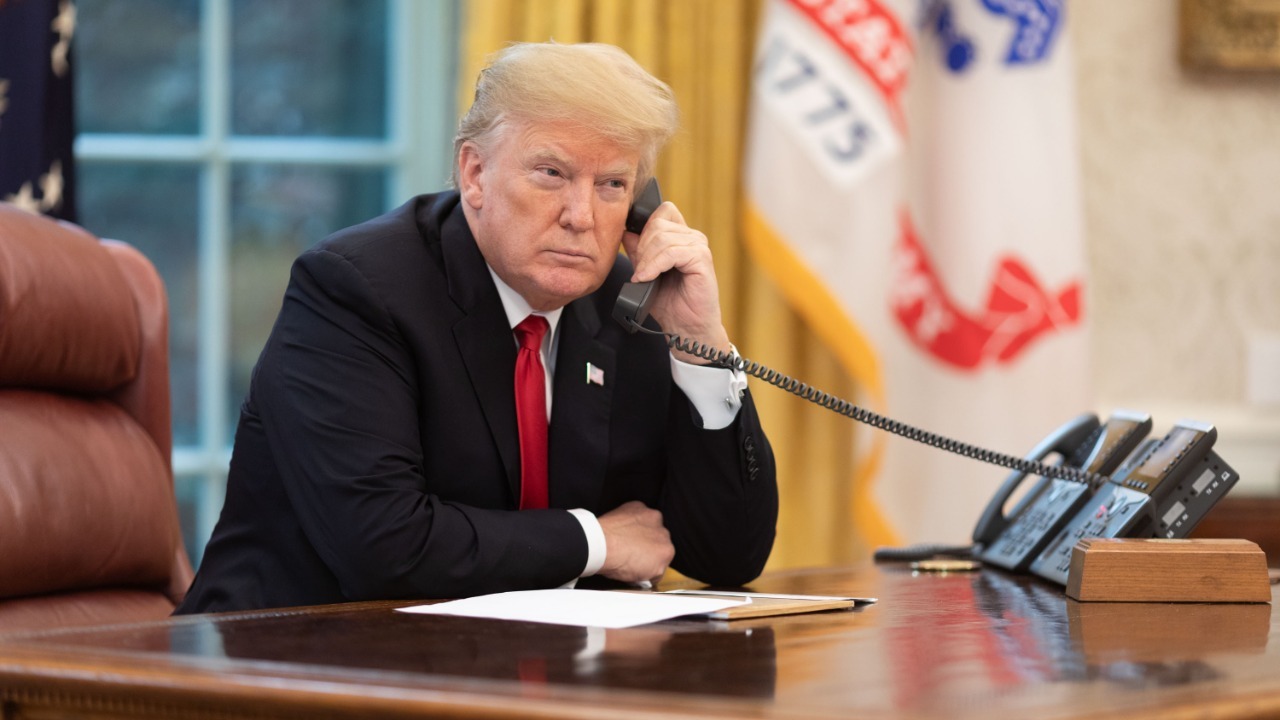
President Donald Trump is turning a massive legal clash with the tax authorities into a political and public relations spectacle, floating the idea of settling his $10 billion claim and handing the money to charity. The president has framed the lawsuit as a test of government accountability after the leak of his tax returns, while also hinting that any windfall could be redirected to causes such as cancer research rather than his own pocket.
That mix of grievance, legal risk and philanthropic posturing has raised the stakes far beyond a typical privacy case, putting the Internal Revenue Service and the Treasury Department under scrutiny and forcing Trump’s critics and allies to game out what a multibillion dollar payout, or even a negotiated settlement, would mean. I see a fight that is as much about narrative and power as it is about damages and doctrine.
How a tax leak turned into a $10 billion confrontation
The core of the dispute is straightforward: President Donald Trump says the federal government failed to protect his confidential tax information, and he wants to be paid for it. Earlier this year, he sued the IRS and the Treasury Department for $10 billion, arguing that the leak of his returns during his first term was an egregious breach of duty by the very agencies tasked with safeguarding taxpayer data, a claim he has now elevated into a marquee legal and political battle that could reshape expectations around financial privacy for public officials.
In the complaint, Trump targets both the IRS and Treasury allegedly allowing his returns to be exposed, and he has cast the case as a response to what he calls a politically motivated leak. The lawsuit builds on the government’s own acknowledgment that the breach was one of the most serious in the IRS’s history, and it positions the president not as a reluctant litigant but as a plaintiff determined to extract a price for what he portrays as institutional failure.
The path from Charles Edward Littlejohn to a presidential lawsuit
Trump’s legal offensive did not emerge in a vacuum, it followed the criminal case against the contractor who admitted to leaking his tax information. Investigators traced the disclosure to former IRS contractor Charles Edward Littlejohn, who had worked for Booz Allen Hamilton on federal contracts and ultimately pleaded guilty to charges tied to accessing and sharing confidential tax data, including Trump’s returns, in a breach that exposed glaring weaknesses in the agency’s internal controls.
The government has acknowledged that Charles Edward Littlejohn was working through Booz Allen Hamilton when he accessed the records, and separate analysis has highlighted how that Contractor Employment and exposed shortcomings in the government’s oversight framework. Trump’s lawsuit leans heavily on that history, arguing that if a contractor could penetrate the system so easily, then the agencies that hired and supervised him should bear financial responsibility for the fallout.
From $230 million to $10 billion, a pattern of retributive claims
The $10 billion figure did not appear out of nowhere, it is the latest escalation in a series of demands Trump has made on federal institutions he believes have wronged him. Before turning his sights on the tax authorities, he pressed the Justice Department for $230 million, arguing that earlier investigations and disclosures had damaged his reputation and business interests, and signaling that he was prepared to use civil litigation as a tool to push back against what he casts as systemic bias.
That earlier claim, described as First the president demanded $230 m from the Justice Department and then Now he is seeking far more from the Internal Revenue Service, has been framed by critics as part of a retributive path in which the president uses the courts to punish agencies that have scrutinized him. I see the $230 million demand and the $10 billion lawsuit as two points on the same trajectory, each raising the stakes and the symbolism of his pushback.
Inside the legal theory and the question of merit
At the heart of Trump’s case is a claim that the government’s failure to prevent the leak of his tax returns entitles him to extraordinary damages, not just for the privacy violation but for the political and commercial harm he says followed. Legal analysts have noted that the suit tests the boundaries of sovereign immunity and statutory protections, since the IRS typically enjoys broad shields against liability, yet the scale and admitted seriousness of this breach give Trump’s lawyers a platform to argue that this is not a routine mishap but a systemic breakdown.
One prominent legal commentator has said that lawsuit by Trump, pointing to the government’s own description of the leak as one of the most serious in the IRS’s history and to the fact that a contractor has already been criminally punished. At the same time, the government is expected to argue that statutory caps, procedural defenses and the difficulty of quantifying reputational harm should limit any payout, setting up a clash between the president’s sweeping narrative of injury and the narrower remedies the law usually provides.
Trump’s settlement talk and the charity twist
Even as he presses the $10 billion claim, Trump has started to talk publicly about the possibility of settling the case rather than taking it through a full trial. In conversations with reporters, he has suggested that a negotiated resolution could be in everyone’s interest, hinting that a settlement would spare the IRS further embarrassment while still allowing him to declare victory and move on, a posture that keeps pressure on the agencies while giving him flexibility to recalibrate the fight.
What makes this settlement talk more unusual is Trump’s suggestion that he might donate any proceeds to charity instead of keeping them. Speaking aboard Air Force One, the President floated the American Cancer Society as a potential recipient, framing the idea as a way to turn a government failure into funding for research and patient support. By raising the prospect of a charitable windfall, he has tried to recast the lawsuit from a personal cash grab into a kind of forced philanthropy, even as critics question whether such a donation would actually materialize or simply serve as a talking point in negotiations.
What a $10 billion payout would mean for the IRS and taxpayers
For the IRS, the financial and institutional implications of Trump’s lawsuit are enormous, even if the final number ends up far below the headline figure. A multibillion dollar judgment or settlement would not come out of a discretionary slush fund, it would effectively be a taxpayer financed payout that could force budget tradeoffs, invite congressional scrutiny and potentially reshape how the agency manages sensitive data and oversees contractors who handle it.
The case has already drawn attention to the Internal Revenue Service building in Washington, where a Photo by Patrick Semansky has become a visual shorthand for the controversy, and to the broader question of how the agency protects not just high profile figures but every filer. If Trump were to secure even a fraction of the $10 billion he seeks, it would likely trigger a wave of internal reforms and external oversight, as lawmakers and watchdogs seek to ensure that such a costly breach of trust does not recur.
Politics at 30,000 feet: Trump’s messaging from Air Force One
Trump has not confined his arguments to court filings, he has used the trappings of the presidency to amplify his narrative about the case. Speaking to reporters aboard Air Force One, he has blended legal talking points with political messaging, portraying himself as a victim of bureaucratic failure and partisan hostility while also casting the lawsuit as a stand for ordinary taxpayers whose data could be at risk if the IRS does not fix its systems.
Accounts of those in flight exchanges describe the President Donald Trump addressing the issue while traveling on Air Force One, and they note that he has tied the case to broader complaints about media coverage of his finances. In that setting, he has also alluded to the possibility of donating any settlement, using the high profile venue to reinforce the idea that he is fighting not just for himself but for a principle, even as the lawsuit itself remains a deeply personal response to the exposure of his own returns.
More From TheDailyOverview
*This article was researched with the help of AI, with human editors creating the final content.

Julian Harrow specializes in taxation, IRS rules, and compliance strategy. His work helps readers navigate complex tax codes, deadlines, and reporting requirements while identifying opportunities for efficiency and risk reduction. At The Daily Overview, Julian breaks down tax-related topics with precision and clarity, making a traditionally dense subject easier to understand.

