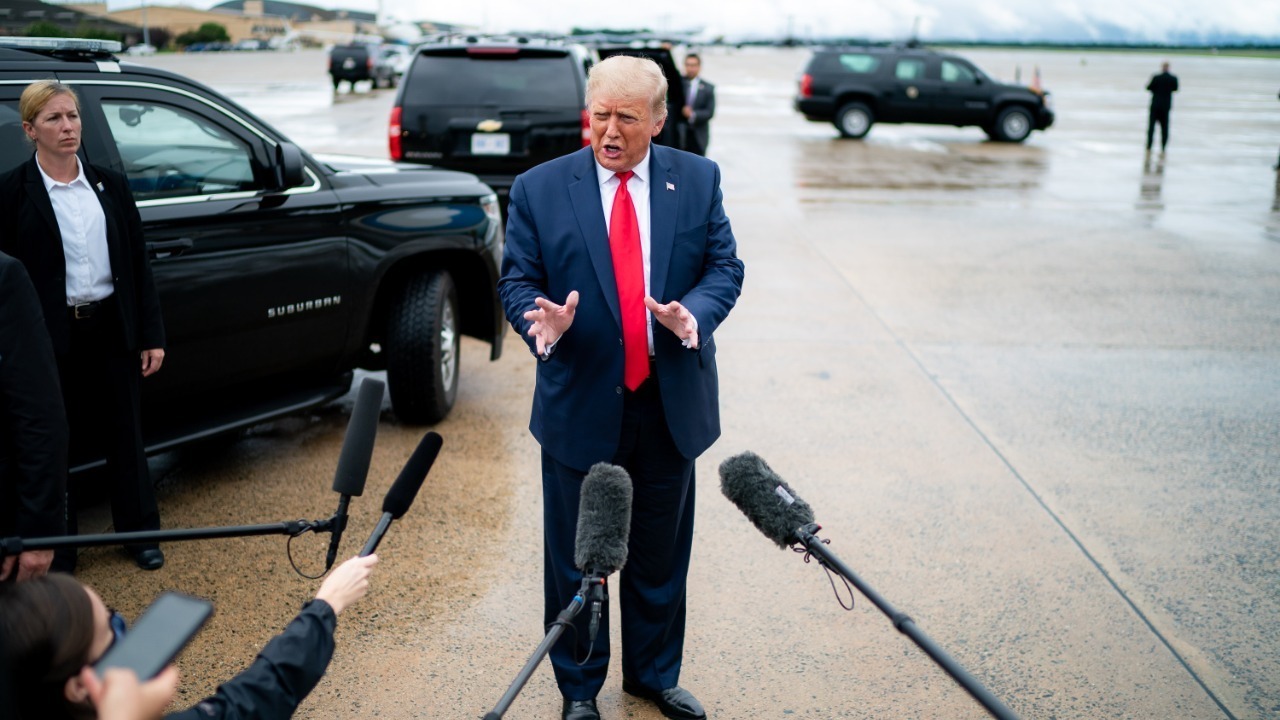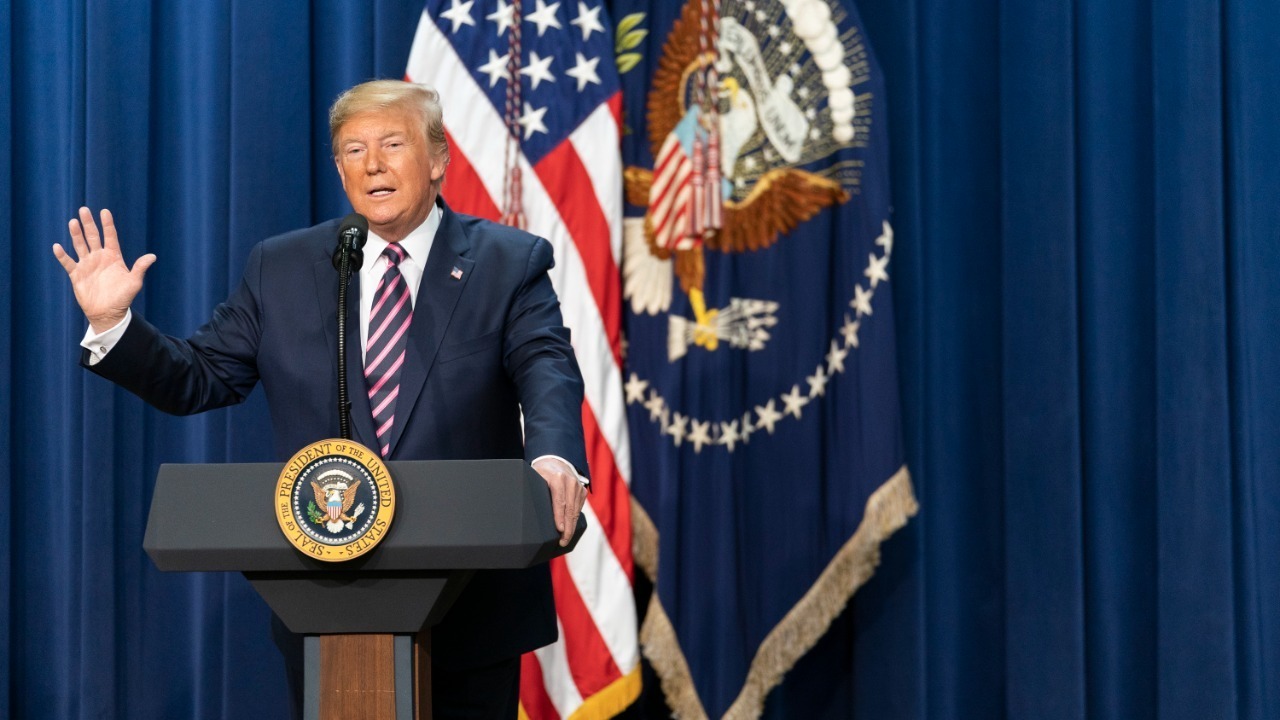
President Donald Trump is brushing off the latest bout of market turbulence, casting the sell-off as trivial and insisting that U.S. stocks are on the verge of doubling in value. His optimism lands at a moment when major indexes are already near records and investors are trying to parse whether politics or fundamentals will set the tone for 2026.
I see a widening gap between the White House’s sky-high rhetoric and the more measured expectations coming from Wall Street strategists, who are projecting solid but far more modest gains for the benchmark indexes over the next year.
Trump’s ‘peanuts’ remark and a promise to double
President Trump used the global stage in Davos to wave away the recent slide in equities, telling his audience that the pullback was “peanuts” and that he expects the stock market to double from here. In remarks highlighted by President Trump he framed the drop as a minor blip in a longer boom and tied his confidence to his administration’s economic agenda. A separate account from Investing notes that he made the comments as U.S. President during a panel at the World Economic Forum, underscoring how central market performance has become to his political narrative.
Trump’s language has been consistent across venues. One detailed recap of his remarks describes how President Trump downplayed the decline and again predicted a doubling in stock prices, presenting it as a natural extension of what he calls a strong economic rebound. Another summary of the same message, labeled Trump Dismisses Stock, reinforces how central the “Peanuts, Predicts Doubling” message has become to his public case that investors should stay all-in on risk assets.
Tariffs, Greenland and a whipsawing market
The bravado comes after a sharp bout of trade-induced volatility that Trump himself helped trigger. Markets sold off after President Donald Trump threatened new tariffs on countries that oppose U.S. efforts to acquire Greenland, ending a stretch of relative calm and reminding investors how quickly policy shocks can hit prices. One analysis framed the episode as part of a broader pattern in which politics and trade policy repeatedly intrude on market fundamentals, asking bluntly How much longer investors can ignore the political “elephant in the room.”
Once Trump backed away from the Greenland tariffs, stocks snapped back. A live market blog reported that Stocks jumped as Trump called off the threats, with Ines Ferré noting that U.S. indexes rallied on hopes of a future deal related to Greenland. Another account said Major U.S. stock averages climbed for a second day after President Donald Trump signaled he would not move ahead with new Europe tariffs, and that one key index notched a record close. A separate commodity and grain market note added that Stock indexes were moving higher as President Trum eased his rhetoric on Greenland and reiterated that the stock market will soon double, showing how his words alone can swing sentiment.
What the numbers say about a doubling claim
Trump’s forecast of a market that “will soon double” sits awkwardly next to the actual levels of the major benchmarks. At the start of the year, the DOW was shown at 48,488.59, up 1.76 percent on the day, while the S&P 500 stood at 6,796.86, a gain of 2.06 percent, and the NASDAQ at 22,954.32, up 2.39 percent. Those are already lofty levels by historical standards, and they imply that a true doubling would require the S&P 500 to approach roughly 13,600 and the DOW to move toward 96,000, a leap that would dwarf even the strongest multi-year bull runs of recent decades.
Professional forecasters are not penciling in anything close to that. Analysts at Bank of America, using the S&P 500 as their benchmark, expect the index to reach 7,100 by year-end 2026, which would represent a gain of about 3.72 percent from current levels. Another section of the same research notes that Analysts are increasingly focused on whether high valuations and potential rate moves could pose trouble for stocks, rather than on any imminent doubling. In other words, the consensus view is for incremental gains, not a moonshot.
A narrower bull market and rising concentration risk
Even without a doubling, the market’s recent performance has been impressive, but it is also more fragile than headline indexes suggest. A Jakarta based note from Gotrade News points out in its Table of Contents that After pulling off double-digit gains for three straight years, the S&P 500 wrapped up another strong run, raising questions about how long the rally can continue. The same discussion highlights how the 500 has become heavily dependent on a handful of mega-cap names, which makes the index more vulnerable if sentiment turns against those leaders.
That concentration risk is echoed in a separate 2026 outlook that lists several Key takeaways, including the warning that the bull market is narrower than it looks. The same analysis stresses that Inflation and the dominance of a few mega-cap tech stocks are shaping index performance, a dynamic that could limit upside if those companies face regulatory pressure, slower growth or simply investor fatigue. When a rally rests on such a small group, the path to a clean doubling of the entire market becomes even steeper, because the rest of the index would have to play a dramatic game of catch-up.
Politics, China and what history suggests happens next
Trump’s confidence also leans heavily on the idea that his trade strategy will ultimately unlock more growth, yet the record so far is mixed. A review of recent market swings notes that UPDATES from traders repeatedly cited his tariff threats and reversals on Greenland as catalysts for intraday surges and slumps, underscoring how policy uncertainty itself has become a driver of volatility. Another live blog described how Wednesday brought a relief rally once President Donald Trump stepped back from new Europe tariffs, suggesting that markets are rewarding de-escalation rather than brinkmanship.
There is also a longer backdrop of trade maneuvering with China. A 2025 review of global commodity markets recalls that when Trump eases trade tensions with China became the dominant narrative in October of that year, markets experienced immediate relief after initial volatility across both commodities and equities. At the same time, a separate warning piece asks How much longer stock investors can shrug off the political risks, noting that the current mix of high valuations and policy uncertainty resembles late-cycle periods such as the run-up to the dot-com bubble. Taken together, the history suggests that while presidential optimism can buoy sentiment in the short term, the path to anything like a doubling will be decided by earnings, interest rates and the durability of global trade peace, not by a single line about “peanuts.”
More From TheDailyOverview
*This article was researched with the help of AI, with human editors creating the final content.

Grant Mercer covers market dynamics, business trends, and the economic forces driving growth across industries. His analysis connects macro movements with real-world implications for investors, entrepreneurs, and professionals. Through his work at The Daily Overview, Grant helps readers understand how markets function and where opportunities may emerge.