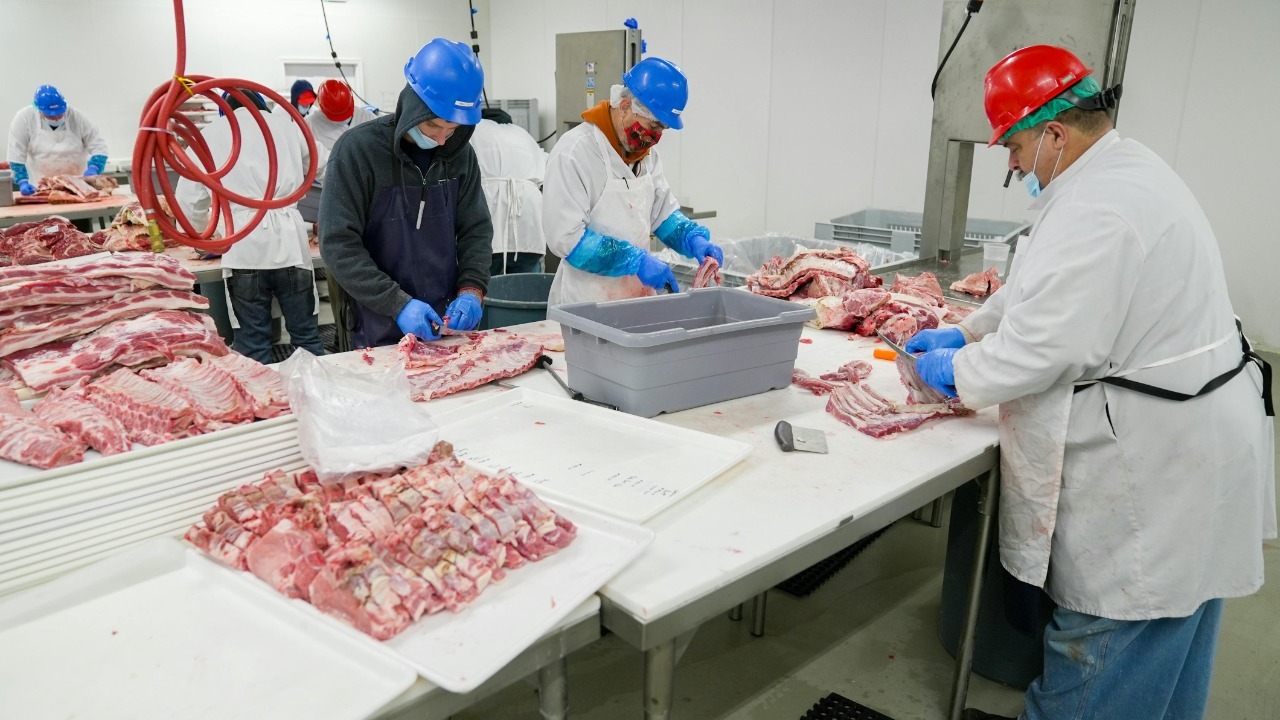
A set of antitrust settlements with five pork processors is open for claims until Thursday, October 29, and the money behind it is not small: Clemens, Hormel, Seaboard, Triumph and Tyson have agreed to pay a combined $117.065 million to resolve claims brought on behalf of people who bought raw pork at the grocery store between 2014 and 2018.
Tyson accounts for most of it. The deadline is the same for everything a class member might want to do — file a claim, opt out, or object — and it falls about six weeks before the court decides whether to approve the deal at all.
Who the settlements cover
The court-approved notice defines the class narrowly, and the details decide eligibility. It covers people and entities who bought raw pork bacon, or raw pork made from bellies, loins, shoulder, ribs or pork chops, fresh or frozen, from the defendants or their alleged co-conspirators, between June 28, 2014 and June 30, 2018.
The purchase has to have been for personal consumption, which the notice defines as buying at a grocery store or supermarket for a household rather than buying directly from one of the defendants. It also has to have happened in one of 24 jurisdictions the case calls “Repealer Jurisdictions”: Arizona, California, the District of Columbia, Florida, Hawaii, Illinois, Iowa, Kansas, Maine, Michigan, Minnesota, Missouri, Nebraska, Nevada, New Hampshire, New Mexico, New York, North Carolina, North Dakota, Rhode Island, South Carolina, Tennessee, Utah and West Virginia.
Some pork is excluded outright. Anything marketed as organic or no-antibiotics-ever is out, and so is any product other than bacon that was marinated, seasoned, flavored or breaded.
Inside the guide: The four-date rule for reading a settlement notice, and the scam-proof rules for telling a real administrator from a copy of one — the two things a notice like this one demands before anything is filled in, given that it carries a claim date, an opt-out date, an objection date and a hearing date that do not mean the same thing. Both are set out in The Settlement & Refund Recovery System.
What each company agreed to pay
The notice breaks the total down by defendant. Tyson agreed to pay $85,000,000. Clemens agreed to $13,500,000, Seaboard to $10,000,000, Hormel to $4,465,000 and Triumph to $4,100,000. Each also agreed to certain non-monetary relief.
A sixth defendant, Agri Stats, settled on different terms. It agreed to reform certain business practices and to other non-monetary relief, and the notice states plainly that no cash payments are available from the Agri Stats settlement. Class members cannot opt out of that one.
Two earlier settlements in the same case, with JBS and Smithfield, have already run their course. The notice says the time period to submit a claim for those has closed, which means anyone who sees older coverage of the pork litigation and assumes the window is the same is working from a deadline that has passed.
What the lawsuit alleges, and what the court has not decided
The underlying case is an antitrust class action alleging that pork processors — including JBS, Clemens, Hormel, Seaboard, Smithfield, Triumph and Tyson — inflated and stabilized the price and supply of pork through the use of Agri Stats, restraints on production and the use of exports.
The notice is explicit that these are allegations. The court has not ruled that the defendants did anything wrong, and the companies deny all allegations of wrongdoing. A settlement here resolves the claims without any finding of liability, which is why the $117 million is described as resolving legal claims rather than as a penalty.
How a payment would be calculated
Nobody receives a fixed sum. The notice says a class member who submits a timely and valid claim form receives a pro rata cash payment proportional to the amount of pork products they purchased — pro rata meaning an equal share relative to everyone else who files. The size of any individual payment therefore depends on how many valid claims come in and how large each one is, neither of which is known until after the window closes.
The fund also gets reduced before distribution. The notice says the court will consider attorneys’ fees of up to 33 1/3% of each gross settlement amount plus interest, up to $5,000,000 in litigation expenses, and $3,000 service awards for each class representative. Those requests are decided at the same hearing that decides approval.
Doing nothing has a consequence of its own. A class member who takes no action stays in the settlements and is legally bound by them, giving up the right to sue those companies later over these claims, without receiving any cash payment.
The dates that are not the deadline
October 29 is the date that governs claims, and it is also the date for opting out and for objecting. All three must be submitted or postmarked by then.
December 11 is a different kind of date. The court will hold a fairness hearing that day at 11:00 a.m. CST to decide whether to approve the settlements and rule on the fee requests. Class members may attend or send a lawyer, but attendance is not required, and the hearing is not an alternative route to a payment for someone who missed the claim deadline. A settlement that is approved in December pays out on the claims filed by October.
The gap between those two dates is where mistakes happen, because a notice that lists several dates invites the assumption that the latest one is the one that matters. It is the earliest that does.
Verifying the claim before filing it
Large consumer settlements attract imitation sites, and this one is specific enough to copy convincingly. The official case website is overchargedforpork.com, which hosts the settlement agreements for all defendants, the detailed product definitions and the claim form, and the case’s toll-free line is 1-888-287-5434.
A legitimate claims administrator does not charge a fee to file. Anyone uncertain whether a notice arriving by email is genuine can ignore its links entirely and go to the case website directly, which is where the notice itself points for the full definition of the settlement class and the instructions for opting out or objecting.
Four dates on one notice
This notice carries a claim deadline, an opt-out deadline, an objection deadline and a fairness hearing, and only the October 29 date actually governs whether a claim counts. The December 11 hearing reads like the real event and is not one, which is the specific way a settlement with a live window gets missed — and a household that bought bacon somewhere in a 2014-to-2018 window has nothing written down that would settle which purchases fall inside the class definition.
The Settlement & Refund Recovery System sets out the four-date rule for reading a settlement notice alongside a step-by-step filing walkthrough and a claim log and payment tracker, so a filing can be recorded and its status followed after the window shuts.
See the four-date rule in The Settlement & Refund Recovery System.
This article was created with AI assistance and reviewed for accuracy against the court-approved settlement notice and the official case website.

Cole Whitaker focuses on the fundamentals of money management, helping readers make smarter decisions around income, spending, saving, and long-term financial stability. His writing emphasizes clarity, discipline, and practical systems that work in real life. At The Daily Overview, Cole breaks down personal finance topics into straightforward guidance readers can apply immediately.
