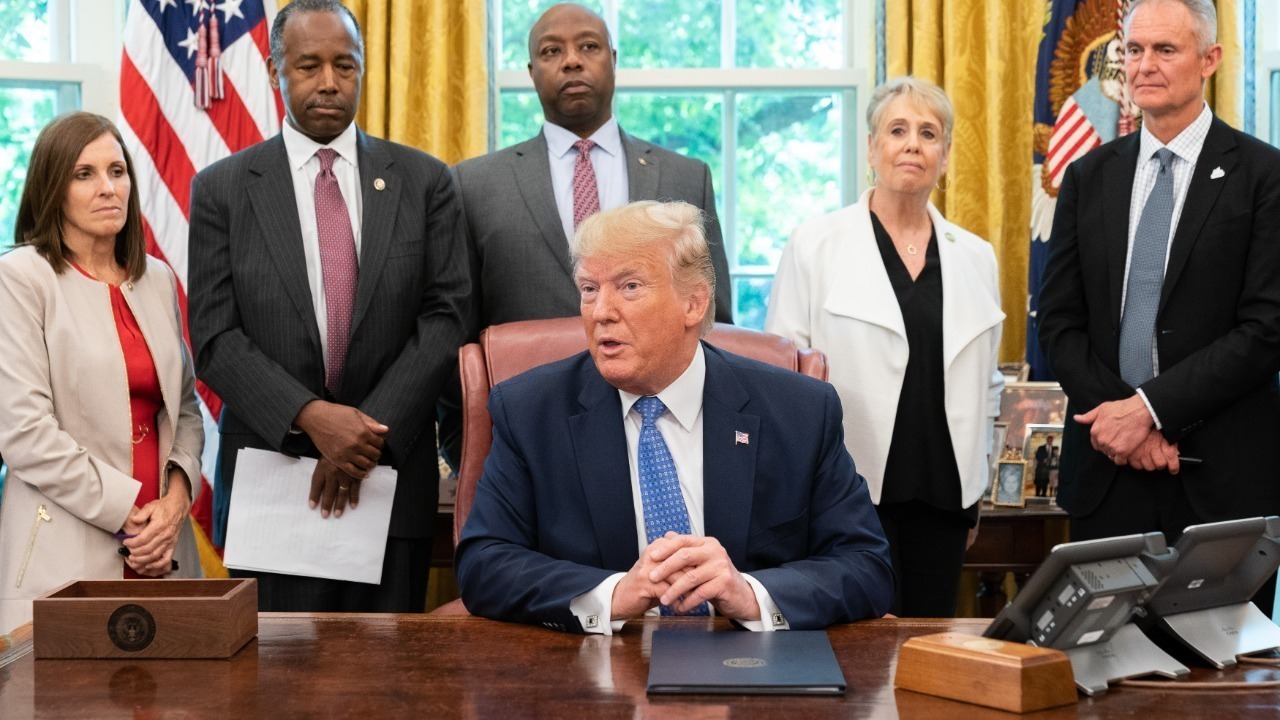
Major American banks are moving in lockstep with Washington on one of President Donald Trump’s signature economic projects, pledging to match federal seed money in new child-focused savings vehicles branded as Trump Accounts. The shift effectively turns household bank products into extensions of a White House initiative, with megabanks promising to mirror government cash in Trump-linked accounts for employees’ children. It is a striking convergence of public policy, corporate benefits and partisan branding that could reshape how families think about long term saving.
At its core, the move means that for eligible workers at the biggest institutions, the first dollars in a child’s Trump Account will now come from both the US Treasury and their employer, on top of whatever parents contribute themselves. As the program rolls out across Wall Street and corporate America, I see a test case emerging for how far financial firms are willing to go in aligning their products and perks with a sitting president’s agenda.
How Trump Accounts work as a government-backed seed
The Trump administration has framed Trump Accounts as a way to give every eligible child a small but meaningful financial foothold, funded initially by the federal government. In prepared remarks, the Secretary of the Treasury, Scott Bessent, described the structure in simple terms, saying that “Funding through Treasury” would provide a government seed and that “Thanks to Trump Accounts, eligible children born between January 1 of the launch year and a specified cutoff date receive an automatic deposit” that can grow over time. That framing positions the accounts as a hybrid between a child trust fund and a retirement starter, with the Treasury deposit locked away until adulthood.
According to those same remarks, there are “four ways” Trump Accounts can be funded, starting with the federal seed and extending to family contributions, employer matches and even support “through donations from state governments.” That design opens the door for a layered funding stack in which Washington, state capitals and private companies all pour money into the same account. By branding the vehicles explicitly as Trump Accounts and tying them to a defined birth window, the administration has created a policy instrument that is both technocratic and unmistakably political, a point that becomes more pronounced as large banks step in to match the federal contribution.
Megabanks pledge to mirror the federal $1,000
The most eye catching corporate move so far has come from the country’s largest consumer banks, which are now promising to match the government’s initial deposit for their own workers’ children. JPMorgan and Bank of America have told staff that they will mirror the Treasury’s $1,000 contribution for each eligible child, effectively doubling the starting balance for families on their payrolls. One corporate memo, reported by David Ho, framed the move as part of a broader effort by corporate America to support a retirement and savings scheme that begins at birth, explicitly linking the bank match to the same $1,000 that flows from the US Treasury into each Trump Account.
A separate communication confirmed that JPMorgan and Bank of America “will match the government’s $1,000” for employees’ Trump accounts, underscoring that the bank contribution is explicitly pegged to the federal amount rather than to a percentage of salary or some other formula. Reporting on US banking giants described how these institutions intend to match the government contribution to Trump Accounts for children of eligible US employees, with one account noting that the story was filed at 10:20:48 AM IST, a reminder of how closely markets track even the timestamp of such announcements.
Political stakes for Trump and the Republican Party
For President Trump and the Republican Party, the alignment of Wall Street with Trump Accounts is as much about politics as it is about savings behavior. Reporting on the internal bank memos notes that the president and his Republican Party have been working to address voters’ affordability concerns ahead of the November midterm elections, and that the Trump Accounts initiative is one of the flagship responses. One account of the policy push explains that the administration has discussed raising the ceiling on annual public contributions to as much as $2,500 per year, a figure that appears in a memo cited by Jan and framed as part of a pilot that could expand if it proves popular.
By encouraging banks to match the federal seed, the White House can argue that Trump Accounts are not just a government program but a public private partnership that multiplies the impact of taxpayer dollars. The fact that Major Ame institutions are now on board gives the initiative a corporate validation that campaign strategists will likely highlight in advertising and stump speeches. At the same time, the overt Trump branding of the accounts risks hardening partisan lines around what might otherwise be a broadly popular idea, a tension that is evident in coverage of how Wall Street is quietly rolling out Trump-branded products even as some customers bristle at seeing their kid’s savings account turn into a campaign slogan.
Inside the banks: benefits strategy and reputational risk
From the banks’ perspective, matching Trump Accounts is both a benefits upgrade and a reputational gamble. Internal communications show that BofA and JPMorgan executives have approved policies under which the banks will supplement the US government’s $1,000 Trump Account contribution for each eligible child until the child turns 18, effectively committing to a long term stream of small deposits. That promise sits alongside rising executive pay and bonuses at the same institutions, a juxtaposition that could invite scrutiny from employees and the public who may question whether the new benefit is generous enough relative to the banks’ overall profitability.
At the same time, the decision to tie a core benefit to a program named after Trump exposes the banks to political blowback if the initiative becomes polarizing. Coverage of the rollout notes that some parents are uneasy about seeing their children’s accounts explicitly labeled as Trump Accounts, while others welcome the extra money regardless of the branding. For human resources departments, the challenge will be to present the match as a neutral financial perk rather than an endorsement of any politician, even as the accounts themselves are rooted in a policy architecture laid out by Funding speeches and White House messaging.
What it means for families and the future of socially minded finance
For families, the practical effect of these moves is straightforward: a child whose parents work at a participating bank could start life with at least $2,000 in a dedicated savings vehicle, split between the federal $1,000 and the employer’s $1,000 match, with the potential for more if states or relatives contribute. Over 18 years, even modest investment returns on that base could translate into a meaningful sum for education, housing or retirement, especially if the administration follows through on proposals to raise annual public contributions up to $2,500 per year. Reporting on US banking giants confirms that the match applies to children of eligible US employees, a detail that underscores how the benefit is being used as a targeted talent tool rather than a universal entitlement, as noted in coverage by Trump Accounts watchers.
More broadly, the Trump Accounts experiment is colliding with a parallel movement in socially responsible investing, where groups like Reach and networks such as GBN and firms including Athens Impact have been urging savers to align their money with their values. Those organizations typically focus on environmental, social and governance screens, but the arrival of explicitly branded presidential accounts raises a new question about whether political identity will become another axis of financial product design. As corporate America, including Bank of America and other household names, deepens its support for the Trump scheme, I see a financial landscape emerging in which a child’s first savings account is not just a place to park cash but a symbol of how tightly government, employers and personal finance have become intertwined.
More From TheDailyOverview
*This article was researched with the help of AI, with human editors creating the final content.

Silas Redman writes about the structure of modern banking, financial regulations, and the rules that govern money movement. His work examines how institutions, policies, and compliance frameworks affect individuals and businesses alike. At The Daily Overview, Silas aims to help readers better understand the systems operating behind everyday financial decisions.

