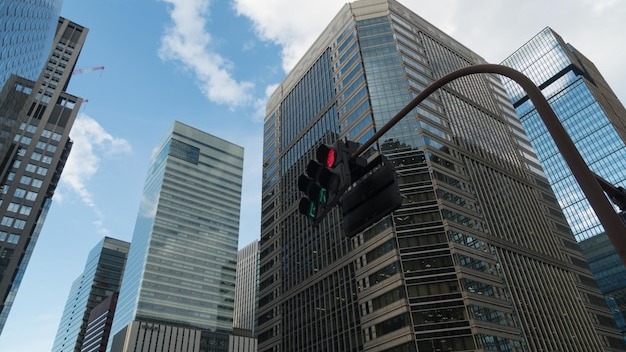
Chicago’s downtown office market closed 2025 with a vacancy rate of 26.6%, a figure that reflects not just empty floors but a widening fiscal crisis for the city’s homeowners. As commercial property values crater across the Loop, Cook County has begun resetting assessments on hundreds of buildings, and the resulting tax burden is shifting squarely onto residential taxpayers, who saw a record median increase in their bills last year.
Vacancy Rates Climbed All Year
The deterioration in Chicago’s central business district did not arrive in a single quarter. By midyear 2025, direct vacancy had already reached 24.7% with negative net absorption of 1.5 million square feet, signaling that tenants were shedding space faster than any new leases could replace them. That trend only accelerated in the second half of the year, pushing the downtown CBD vacancy rate to 26.6% by the fourth quarter, according to CBRE’s market figures. The jump of nearly two full percentage points in roughly six months confirms that the problem is structural, not seasonal, and reflects a deeper shift in how companies use office space in the wake of hybrid work.
What makes the vacancy numbers especially damaging is the speed at which they are translating into price destruction. Two sales captured in the fourth-quarter data illustrate the collapse: 190 N LaSalle traded for $55 million, down from $230 million in 2019, while 125 S Wacker sold for $51.5 million after previously changing hands for $145 million. Those discounts, roughly 64% and 76% respectively, are not outliers. They represent the new reality of price discovery in a market where tenants have shrunk their footprints and few buyers are willing to absorb the risk of a half-empty tower with uncertain leasing prospects. With each sale that clears at a steep discount, appraisers and lenders must recalibrate expectations, making it harder for other owners to refinance or sell without taking similar losses.
Tax Burden Shifts to Homeowners
When office buildings lose value on paper, they also lose value on the tax rolls, and someone has to make up the difference. The Cook County Assessor’s Office reset values on 559 commercial properties in Chicago, a move that formally acknowledged the decline in what those buildings are worth. Because property taxes in Cook County are distributed across all classes of real estate based on relative assessed value, a large drop in the commercial share mechanically increases the share borne by residential owners. Unless local governments cut spending, the total levy remains the same, so the shrinking office base effectively shifts the bill onto homeowners and small landlords.
The fiscal math is already visible in household budgets. An analysis by Cook County Treasurer Maria Pappas found that Loop commercial property values dropped by $379.2 million while median tax bills for Chicago homeowners rose 16.7% to $4,457. For a city where roughly half of households are renters, the increase will eventually flow through to higher rents as landlords pass along rising costs. The dynamic creates a perverse feedback loop: empty offices depress the commercial tax base, which inflates residential bills, which in turn squeezes consumer spending in the very neighborhoods that need foot traffic to survive. Over time, rising housing costs can also push middle-income residents to the suburbs, further eroding the city’s tax base and complicating efforts to stabilize downtown.
Distressed Towers Drag Down Surrounding Blocks
The financial pain is not confined to balance sheets and tax bills. A Wall Street Journal investigation profiled a Chicago office tower mired in bondholder conflict and foreclosure proceedings, documenting how a single distressed building can hollow out its immediate surroundings. Reduced foot traffic from vacant upper floors leads to shuttered ground-floor retail, which removes the lunch spots, dry cleaners, and coffee shops that once gave the block economic life. The reporting described these properties as “zombie buildings,” structures that are technically standing but functionally dead from a commercial standpoint and increasingly perceived as unsafe or uninviting by pedestrians.
That pattern is repeating across the Loop and adjacent submarkets. When a building’s largest tenants leave and no replacement demand exists, the owner often cannot service the mortgage, triggering a chain of special servicing, missed payments, and eventually a forced sale or foreclosure. Each distressed property that sits dark for months or years sends a signal to neighboring landlords and prospective tenants that the area is in decline, making it harder to attract the very leasing activity that could reverse the trend. The spillover effects extend well beyond real estate investors to the small-business owners who rely on office workers, the service employees whose hours are cut as occupancy falls, and transit systems that see ridership and fare revenue decline as downtown loses its pull.
Debt Markets Flash Warning Signs
Behind every vacant tower is a loan, and the national debt markets tied to office buildings are now under severe stress. The office CMBS delinquency rate hit a record 12.34% in January 2026, according to Trepp, far exceeding the overall CMBS delinquency rate of 7.47% across all property types. Office loans are the single largest drag on the commercial mortgage-backed securities market, and the delinquency rate has been climbing steadily as pandemic-era forbearance agreements expire and borrowers confront refinancing at sharply higher interest rates. Investors who once treated office-backed bonds as relatively safe income streams are now facing mounting losses, which could make future capital for downtown buildings more expensive or scarce.
Chicago is particularly exposed to this refinancing crunch because so many of its downtown towers were financed or last traded during the low-rate era before 2022. When a loan matures and the building is worth 60% or 70% less than the original purchase price, the borrower faces a gap that no lender will fill on the same terms. The result is either a deeply discounted sale, as seen at 190 N LaSalle and 125 S Wacker, or a default that pushes the property into special servicing and eventually back onto the market at fire-sale pricing. Each transaction at a steep discount resets the comparable values for neighboring buildings, creating a downward spiral in appraised worth that feeds directly back into lower assessments and, by extension, higher residential tax bills. Local governments that depend heavily on property tax revenue may find themselves squeezed between rising service demands and a politically volatile mix of falling commercial values and rising homeowner anger.
A Structural Problem for City Finances
The convergence of high vacancy, falling valuations, and stressed debt markets points to a structural, not cyclical, problem for Chicago’s downtown. Hybrid work has permanently reduced demand for traditional office layouts, and companies that do expand are often seeking newer, amenity-rich buildings, leaving older stock at risk of long-term obsolescence. In that environment, simply waiting for a rebound is unlikely to restore the tax base that supported city services in the 2010s. Policymakers face difficult choices: encourage conversions of obsolete offices to housing or mixed use, accept higher residential tax burdens, or cut spending in ways that could further undermine downtown’s competitiveness.
Any path forward will require coordination between city hall, county officials, lenders, and building owners, because the feedback loops now in motion run through all of their balance sheets. Conversions can be costly and technically challenging, especially for deep-floorplate towers, but they offer one of the few ways to replace lost office demand with new residents and retail activity. At the same time, tax policy will need to balance relief for homeowners with the reality that large commercial owners are already seeing their assessments slashed. Without a deliberate strategy to manage the transition, Chicago risks entrenching a two-tier downtown of thriving Class A towers and decaying “zombie” buildings, along with a residential tax base that bears an ever-larger share of the bill for a shrinking commercial core.
More From The Daily Overview
*This article was researched with the help of AI, with human editors creating the final content.

Elias Broderick specializes in residential and commercial real estate, with a focus on market cycles, property fundamentals, and investment strategy. His writing translates complex housing and development trends into clear insights for both new and experienced investors. At The Daily Overview, Elias explores how real estate fits into long-term wealth planning.

