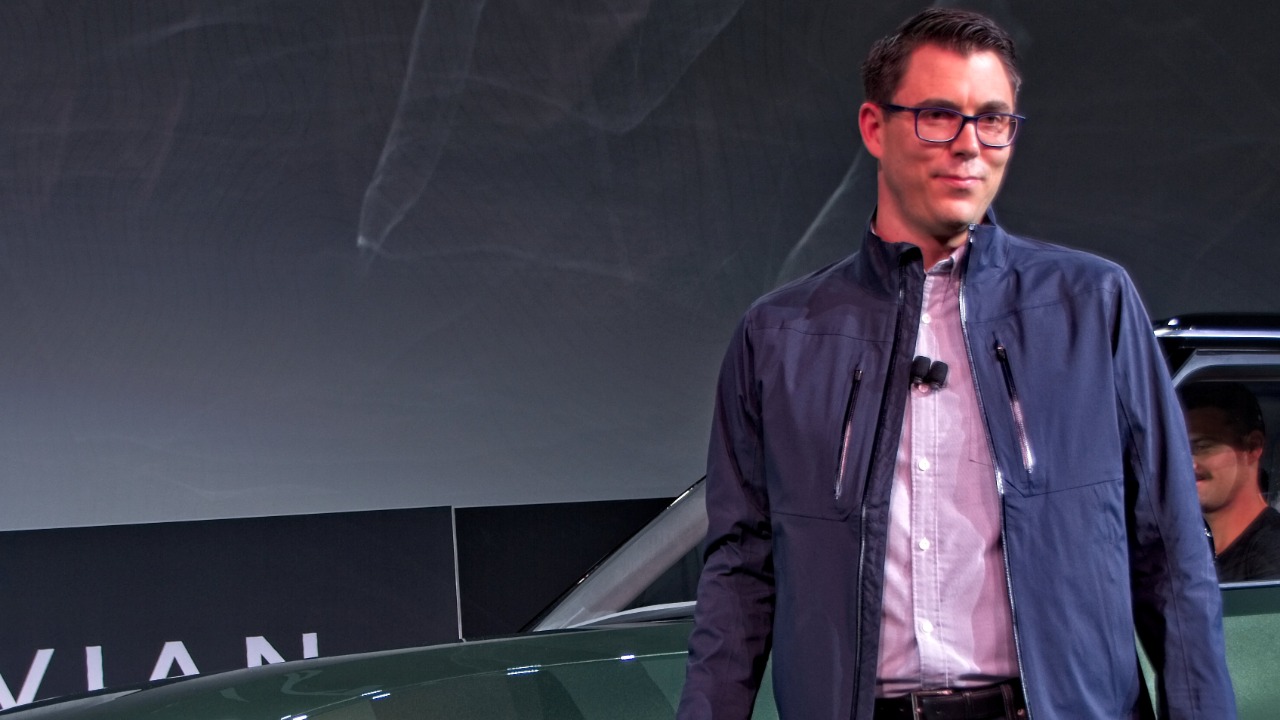
Electric vehicles have become a cultural lightning rod in the United States, but Rivian’s top executive is trying to pull them back into the realm of simple product choice. Rivian CEO RJ Scaringe argues that buying one of his company’s trucks or SUVs is not a partisan statement, pointing to an evenly split customer base as proof that the R1 lineup appeals to both sides of the aisle.
His case lands at a pivotal moment for the EV market, as political rhetoric collides with questions about charging access, model variety, and the long-term prospects of young automakers. I see his comments as an attempt not only to defend Rivian’s brand, but also to reframe how Americans think about electrification itself.
EVs have “become political,” but Rivian wants out of the culture war
RJ Scaringe has been unusually blunt about the way electric vehicles are talked about in the United States, acknowledging that EVs have “become political” even as he insists they should not be. He has described how the technology is often dragged into broader fights over climate policy and regulation, even though the core product is simply a different kind of truck or SUV. In his view, the polarization around EVs is a distortion of what is happening on the ground, where buyers are weighing torque, range, and utility rather than trying to send a message to Washington.
That argument rests on his experience selling the R1T pickup and R1S SUV into regions that are hardly stereotypical EV territory. Rivian CEO RJ Scaringe has emphasized that both Republicans and Democrats are showing up in his order books, and that interest in his vehicles stretches across red and blue states in the United States. By stressing that reality, he is trying to separate the lived experience of Rivian owners from the partisan narratives that swirl around EV mandates and federal incentives.
Inside the 50/50 party split among R1 buyers
Scaringe’s most striking data point is his claim that Rivian’s flagship customers are almost perfectly divided politically. He has said that among buyers of the R1T and R1S, the split between right-leaning and left-leaning owners is “50” to “50,” a balance that undercuts the idea that EVs are toys for coastal liberals. I read that as a deliberate counter to the caricature of the electric truck driver as a niche early adopter, and as a signal that Rivian sees its addressable market as the same broad swath of Americans who have long bought full-size pickups and family SUVs.
That even split also helps explain why Scaringe is so vocal about rejecting a partisan label for his products. If half of his customers lean conservative and half lean progressive, he has every incentive to keep the brand focused on performance, design, and practicality rather than ideology. In describing that “50” to “50” breakdown among R1 buyers, he has framed it as evidence that the company is reaching Republicans and Democrats in roughly equal measure, a point he has reinforced in recent comments about party-leaning buyers. For a young automaker trying to scale, that kind of ideological balance is not just a talking point, it is a strategic asset.
“Shocking lack of choice” and why EV buyers still feel boxed in
Even as he pushes back on the politics, Scaringe is candid about the structural challenges facing EV shoppers. He has described a “shocking lack of choice” for electric vehicle buyers in the United States, arguing that the market still offers far fewer compelling options than the gasoline side. From his vantage point, someone who wants an electric truck or SUV with real off-road capability, towing capacity, and premium features still has only a handful of viable models to consider, which limits how quickly mainstream drivers can make the switch.
That critique is not just self-serving, it reflects the broader shape of the market. While legacy automakers have announced dozens of EV nameplates, many are compliance cars, limited-run models, or vehicles that do not match the size and capability Americans expect from their trucks and SUVs. Scaringe has contrasted the U.S. landscape with markets where buyers already enjoy far more variety, noting that Rivian’s CEO said there’s a “shocking lack of choice” for EV buyers in the United States and that customers currently see the most choice in China. When I look at that comparison, it underscores how much room there is for new entrants and fresh segments, and why Rivian is racing to fill those gaps before incumbents catch up.
R2, Autonomy Day and the push to broaden Rivian’s appeal
To move beyond its early adopter base, Rivian is preparing a second act built around more affordable models and advanced software. Scaringe has framed the upcoming R2 platform as a critical lever for growth, one that will let the company reach buyers who cannot stretch to an R1T or R1S but still want a capable electric SUV or crossover. In his telling, the R2 family is designed to bring Rivian’s design language and off-road DNA into a lower price band, which could make the brand relevant to suburban families and fleet operators who have never considered an EV before.
Alongside that hardware push, Rivian is leaning into software and driver-assistance features as a way to differentiate itself and deepen customer loyalty. Scaringe has highlighted an upcoming Autonomy Day and related initiatives as central to Rivian’s growth story, arguing that better automated driving and connected services will make its vehicles more useful over time. In a recent interview, Rivian CEO RJ Scaringe described how R2 and autonomy are expected to drive growth, tying the company’s future to both a broader product lineup and more sophisticated software. I see that strategy as an attempt to make Rivian less vulnerable to short-term swings in EV sentiment and more anchored in long-term technology trends.
Politics, perception and the stakes for Rivian’s business
Scaringe’s insistence that EVs should not be political is not just philosophical, it is directly tied to Rivian’s survival in a crowded and volatile market. The company is competing in a segment where the market for electric trucks and SUVs is growing as consumer preferences shift toward more versatile, eco-friendly vehicles, but where competition from established automakers is intensifying. Investors are watching closely to see whether Rivian can carve out a durable niche as larger brands pour resources into their own electric pickups and crossovers, and whether the company can manage costs while scaling production.
In that context, any perception that Rivian is aligned with one political tribe could narrow its potential customer base at the very moment it needs to expand. Scaringe has been clear that both Republicans and Democrats are buying his vehicles, and that he wants the brand to feel as natural in a rural driveway as it does in a coastal city garage. Market analysts note that the company must navigate a landscape where the market for electric trucks and SUVs is growing but also becoming more crowded, with established automakers entering the EV space and bringing their own loyal followings. For Rivian, convincing Americans that buying an EV is no more political than choosing a different engine option is not just a branding exercise, it is a bet that the broad middle of the market is ready to see electric trucks as normal.
More From TheDailyOverview

Grant Mercer covers market dynamics, business trends, and the economic forces driving growth across industries. His analysis connects macro movements with real-world implications for investors, entrepreneurs, and professionals. Through his work at The Daily Overview, Grant helps readers understand how markets function and where opportunities may emerge.

